Excerpts from today’s El Deber follows:
The Cabinet (executive government ministers) vetoed the signing of the agreement with the TIPNIS indigenous people; they want to make a viable regulation of the law 180 that protects the Isiboro-Sécure Park and requested that the text establishes clearly that all commercial activity of their resources is prohibited.
This was confirmed by leader Fernando Vargas, who said that “comments were raised this morning (yesterday) and the Cabinet has raised that the inviolability applies to the entire Park;” “what we see is that they interpret differently the intangibility as we understand it”.
The Deputy Minister of environment, Cinthia Silva, explained that the Government presented a new wording to four articles of the 12, which were agreed by both sides and declared time out so that indigenous leaders submit specific counter-proposals observations.
“What we agreed is the character of intangibility, they then asked that intangible emphasis should be made for the core (of the TIPNIS), but it was a vacuum and seems that it excludes the inviolability of other areas and this was not the agreement, then we have asked to specify that the character of intangibility applies to all the Park”, said Silva.
In this context, she said that this precision may not violate the rights of the inhabitants and that the indigenous people shall have the right to use and have the exclusive use of those resources, and that this must be respected for the livelihood of the people. “The inviolability applies to all the Park, but it respects their traditional activities.”
The other point of conflict is related, because the intangibility prohibits any commercial activity, then indigenous people may take advantage of all the resources, but with “non-commercial” activities. [??!! who understands this?]
Criticism at Durban Summit

With the presentation of an unpublished video of police repression to the TIPNIS Marchers in Yucumo, the leaders of the CIDOB Foundation, Adolfo Chávez, and the Conamaq, Rafael Quispe, along with Edwin Vásquez, the Coordinator of indigenous organizations of the Amazon basin (Coica), gave yesterday a joint press conference, within the framework of the Conference of the parties (COP17), been held in Durban (South Africa).
The official Bolivian delegation, headed by René Orellana, scheduled to give, at the same time another Conference, suspended it until further notice.
During the Conference, attended by several international media, Quispe and Chavez explained the position of their organizations and made a criticism to the Government of Evo Morales, who was portrayed as a “capitalist, extractivist and abusive”. [I found an exaggeration to label as “capitalist or neoliberal” this type of attitude; it may be the type of discourse style that is in fashion by some people; to me capitalism of this century is different from the days of Marx; social corporate responsibility and consumer preferences have changed private entrepreneurial activities; innovation and to be free to choose concepts allow the world to cope and face current societal challenges] Both leaders hope to meet at some point with the Bolivian delegation to coordinate joint positions, but always prioritising the defence of the TIPNIS and other indigenous territories. [let’s wait how the government will react… long gone are the days where this very same groups and other supporters were proposing current Bolivian president to the nobel prize]
“An indigenous President who said he was the defender of mother earth, wanted to murder her by crossing her with a path.” We are very concerned about the time we spent with this Government, who gave us much hope with respect to our rights and because they are inserted in the new constitution. “However, our rights have been violated, and there are no words to tell what happened in the protest-walk of the TIPNIS while defending our indigenous territory,” said Chavez.
Published by Bolivian Thoughts
Senior managerial experience on sustainable development projects.
View all posts by Bolivian Thoughts

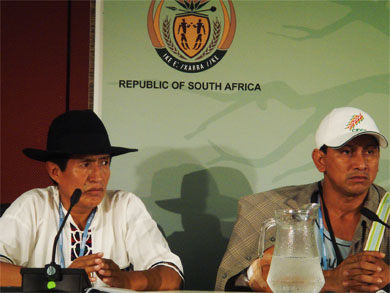 With the presentation of an unpublished video of police repression to the TIPNIS Marchers in Yucumo, the leaders of the CIDOB Foundation, Adolfo Chávez, and the Conamaq, Rafael Quispe, along with Edwin Vásquez, the Coordinator of indigenous organizations of the Amazon basin (Coica), gave yesterday a joint press conference, within the framework of the Conference of the parties (COP17), been held in Durban (South Africa).
 Bolivian Thoughts | Pensamientos Bolivianos (Bilingual/Bilingüe)