
It is 9:16 and El Deber’s website reports that the protest-walk has decided to enter San Ignacio de Moxos, the people blockading the access remain blockading, please be alert as I will tweet developments as they evolve…
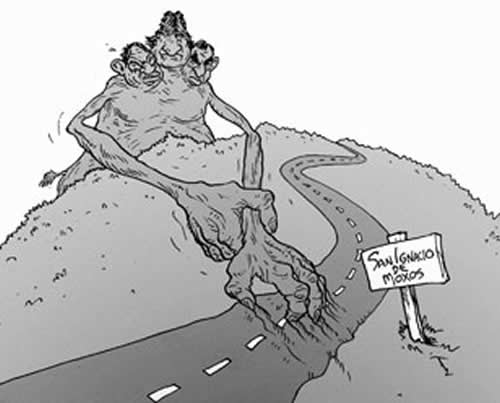
Pablo Ortiz reports for El Deber. Along the article, I am inserting a number of cartoons that portray the ordeal of this brave group who are defending their territory and are protecting our National Park System [pertinent description will be provided inside these type of brackets, to differentiate from the article content]:
Moxos in the middle of a ‘trench warfare’
Thousand meters separates the two sides that do not want to give up. The ninth indigenous March reached Algodonal, where they placed their trench to try to enter into the center of San Ignacio. They can try today or maybe tomorrow [May 8], but they did not relinquish the idea of reaching the missionary temple to receive the blessing of a priest.
 On the other side, where the road to Trinidad splits between the Centre of the ‘moxeña’ population and the exit to San Borja, there is a group of 200 people waiting behind a barbed wire fence. They say that they are there to ensure that the mobilized group take the route to San Borja, but that if they pass the wire, they not are responsible for what might happen. Some [the former] want that the road which aims to be built by the Government between San Ignacio de Moxos and Villa Tunari does not split in two the heart of the Isiboro Sécure National Park (TIPNIS) and the indigenous territory. The others [latter] see in this requirement a condemnation of development. [La Razon, April 27, 2012; current president in the middle and his two ministers on the sides; of the presidency ‘trying’ to restrain the minister of government ‘repressive’ actions]
Now each side takes their previsions. The media no longer have unrestricted access to the camp of the March, there is the indigenous guard that ensures the privacy of the mobilization when leaders gather to define their actions.
 Also the ‘ignacianos’ take cover. Almost all accesses of the city are wired and neighborhood joints have been organized to establish a secure perimeter for the population. Only two points are open to connect with the rest of Beni.
Inside, downtown, the majority of businesses are closed and ‘herds’ of mototaxistas [taxi service in motorcycles] go through the streets as one kind of ‘de-facto’ police forcing abide the indefinite work stoppage [instructed] by San Ignacio institutions. [Los Tiempos, May 2, 2012; the dog says t the boy “no kid, don’t annoy the hornet nest, you will end up running away!”]
There is no room for flexibility or sensible actions in this scenario. When the March reached Algodonal, some drunk ‘mototaxistas’ came to the mobilization, insulting the marchers. The column responded with his battle cry: “long-live the ninth indigenous March!”. In Algodonal [the marchers] have accommodated under leafy mango trees and received the solidarity of the indigenous community called Argentina, which donated them a heifer to recover energy.
 On the ‘moxeña’ Vigil, shouting “the TIPNIS Yes is part [split]!” and “we want road!” already had become general when Layda Núñez Moy, Vice President of the TIPNIS, attempted to pass through the sector of the vigil to deliver two letters. They were addressed to the Mayor, Basil Nolvani, and the Lieutenant Governor, Sixto Bejarano. Demanded them guarantees for passing through the Centre of the town, but they never reached destination. Layda was intercepted by the Vigil [town people opposed to the marchers], which forced her to get off of the motorcycle and flee under threat of burning the bike which was carrying her. They demanded that letters be carried by leaders Bertha Bejarano, Pedro Nuni or Fernando Vargas.
Layda believed that they had broken the documentation, but it is with María Victoria Abularach, Member of the Moxos Defence Committee, which denies that they had assaulted [Layda]. Abularach says that what the people are doing is not a blockade, that the protest-walk may go by the [outer] ring road, preventing them [the marchers] from entering the town.
And Bertha Bejarano, President of the March, says the opposite. “I won’t go to expose me or be easy prey.” I have nothing to talk to those people, I do not represent them. I am President of the indigenous of Moxos, not of them. I do not have to ask for permission to enter my big house [the town]”, she said. For walking group the reflection is simple: if they go by the ring road, they will be attacked anyway.
The wisdom nor comes from the side of the Government either. From the Interior Regime, Jorge Perez, Deputy arrived yesterday in San Ignacio and said that the March was the CIDOB, not of indigenous people. He assured that the mobilization is less legitimate than the eight, which is composed of more indigenous people from the Highlands than the lowlands, which are ‘importing’ indigenous people from other countries and radical sectors of the cities. Nevertheless, he requested that they allow the March to go wherever they wanted.
With the tragedy served the final assault depends on the Church [Catholic]. The marchers hope that bishops reaching today [May 8] Algodonal to be witnesses of their passage through the town. San Ignacio de Moxos already drove out in 2004, priest Enrique Jordá and they will not have a problem in expelling others.
“There is energy and courage”
FERNANDO VARGAS / PRESIDENT OF THE TIPNIS
-Why is it important to pass by San Ignacio de Moxos?
The people of San Ignacio is not owned by the Mayor nor is the hacienda [property] of Juan Ramón Quintana [minister of government] for him to barbed wire. San Ignacio is from the ‘moxeños’. We can not go by another way because we aren’t thieves, we are people with dignity and with respect, we want to demonstrate to the people that we are not going to come to harm anyone, but we want to enter the Church to hear mass in defense of life and the integrity of all those who are marching.
-Do you see strength in the March towards passing?
Beyond political conflicts, we see in progress there is enough energy and courage and that is a strength for me and the Bolivian people. We have neglected [set aside] political issues, beyond the blockade of San Ignacio problems, because it is not all the Ignatian people, are among those who are blocking with the Mayor. Unfortunately, if something happens, will remain in the memory which was what a native from Trinidad said, in 2010, in San Miguelito, said that he would not allow that they divided the TIPNIS nor the settlers get [inside], [he] told us: “We will be with you to defend the territory”.
-Has breached his word?
 Now they are like the central Government: in an indigenous Government violating indigenous rights, indigenous municipal government is undermining the integrity of a March which is claiming a constitutional right. We are not asking for anything outside the law. These problems we leave them in second plane, in the foreground is the courage and the bravery to keep fighting for [our] territories, for life, for biodiversity. What we will achieve now is what we will leave to our children and our children’s children. [El Diario, May 6, 2012; an avalanche approaching fast the running away public officials…]

 Bolivian Thoughts | Pensamientos Bolivianos (Bilingual/Bilingüe)