
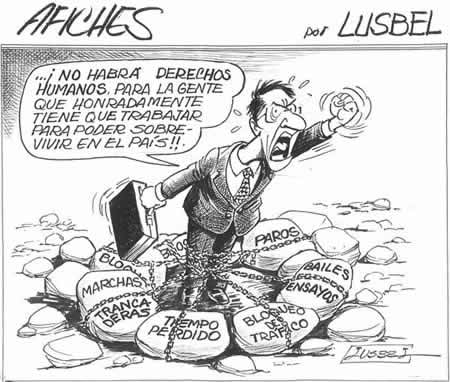
 This cartoon is from El Diario, December 6, 2011. It shows a citizen chained around blockades, marches, bottlenecks, lost time, traffic cuts, dance rehearsals, strikes. An Angry frustrated Bolivian saying: “..Aren’t there human rights for people who honestly have to work to be able to survive in the country!!”
In addition, El Deber captured the opinion of some analysts regarding current society’s perception of current government “weakness” towards conflicts:
Seven blockades in two weeks
– November 20. Yapacaní settlers closed for eight days the road demanding the resignation of the Mayor.
– November 21. The Coroma community blocked [the road for] nine days because of the boundary issue between Oruro and Potosi.
– November 23. Coroma blocked [again] because of the boundary issue between Oruro and Potosi.
– November 29. The owners of trailers and semi-trailers blocked the international borders and roads, because they were against the fixed rates [the government established] to legalize their flat/trailers. [heavy load transport association]
– November 30. Blockade in the Chaco region [Tarija] because they were demanding for the payment of the solidarity programme (Prosol). [a bonus]
– December 2. The public University of El Alto blocked the streets [La Paz] demanding greater budgetary allocation.
– December 5. Santa Cruz [public] transport closed the highway to Cochabamba due to the increase in the municipal toll of Bs4 to Bs12. On the other hand, Montero’s taxi bikers blocked because of the sale of fuel to vehicles [motorcycles] without plate was not authorized. [central government ruling]
http://www.eldeber.com.bo/2011/2011-12-07/vernotaeconomia.php?id=111206223537
[If we agree with the “perpetual conflicts” Mendez definition, and after reviewing the above list in the reasons for those conflicts, we have to acknowledge that something really fundamental is going wrong in Bolivian politics. Those are issues that could have been resolved in a negotiation table. If we go back to the days when there were non-democratic governments, society appointed unions to fight those regimes with whatever means possible. That is to blockade, to resent any ruling, well that is no longer the case, and society has allowed some individuals/organizations to take the ‘decision/negotiation’ into their own hands.
To make things worse, now this government is empowering some “social movements” and will meet with them to decide on policy issues, thus taking away the nature and role of the National Assembly. What is more striking is that those movements are politically aligned and are part (informally) of this government. So, in a way we are beginning to live under an authoritarian regime.
So, the government ‘may’ look weak but it could also mean that they ‘promote, incentivate’ all the turmoil just to have control and enforce their questionable policies.]

 Bolivian Thoughts | Pensamientos Bolivianos (Bilingual/Bilingüe)