
El Deber reports on how the tax structure in Bolivia for Art is still confusing, un-motivating and restraining our culture. This cartoon shows how puzzled look all our forms of Art.
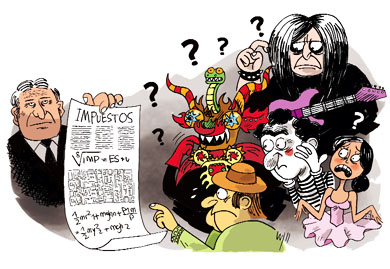
When Gonzalo Hermosa, leader of Los Kjarkas [on of the major and most famous folk groups in country; one of their songs became the Lambada and was recently sung by JLo], appeared upset in the media last week, complaining that several concerts in Bolivia were cancelled because of the tax rule No. 10-0012-11, his words hurt more than one in current Bolivian government.
“Even former dictatorships were more benevolent to the artists, (Hugo) Banzer left a law that would exempt artists from taxation. We’re supposed to in times of change and now this happens,” said the folklorist.
Since May 20, when the National Tax Service (SIN in Spanish) hardened the control and tax payments for public performances; the artistic activities of national as well as foreign entering the country was diminished considerably. A wave of cancellations of concerts prompted the union to mobilize. Because of that, the National Association for Cultural Promotion was created to initiate debate over new tax procedure that would favor culture promotion.
For the whole article, use the link below. Follows six Q&A that will help clear doubts:
1. Who pays taxes and who are exempt when organizing a public spectacle? The natural and legal persons organizing public events like New Year’s Eve dances, music concerts, plays, sporting events, among others.
Or when the viewer pays a ticket to enjoy it. This entry has the character of a ‘bill’ [invoice], which generates the same tax credit. This means that the tax is contained in the bill paid by the buyer of the ticket.
Those artists born in Bolivia are exempt from paying taxes, which meet the condition of holding their events directly (the artist), in municipal and state scenarios that take cultural purposes in the framework of the provisions of Law N º 2206.
2. How does the performance guarantee bond operates? A first requirement is a financial instrument that guarantees the payment of taxes through the invoices. It is obtained by the natural person or legal entity that holds the event in accordance with procedures established by the ASFI.
This bond must be filed with the SIN, prior to the performance of the show, to assess number of places/seats and obtaining the invoices.
This bond may be charged by the SIN, when whoever is conducting the event fails to pay taxes. When taxes are paid on time, the SIN gives the bond back to the taxpayer.
3 What is the procedure to be performed by an artist who wants to be exempt from taxes? Within the framework of Law No. 2206, Board Policy Resolution No. 10-0022-11 provides that the Bolivian artist, who has the accreditation of their organization or entity where is registered, and has no obligation to present Bank Guarantee bond, so it is exempt, subject to the issues contained in that provision.
Artists must demonstrate this condition by appearing in person to the SIN, at the jurisdiction where the event will be held; with the required documents in addition to the rent contract of the stage where the show will be performed.
If they do this process through a third party, they must accompany the power of attorney granted by the artist before a public notary.
4. What is the tax procedure to be performed by an entrepreneur who organizes a public spectacle? The employer who hires a Bolivian or foreign artist, with the purpose to obtain a profit, must submit a bank guarantee for 35% of the value of the seats, as collateral for the upcoming payment of taxes.
Must appear in person to the SIN carrying all required documents per Board’s Policy Resolution No. 10-0012-11, to be issued by the respective Administrative Resolution authorizing the printing of the invoices. This procedure must be performed within a minimum of 48 hours before the event. [and keep your fingers crossed that the approval and printing will be in time to have the chance to sell the tickets for that performance]
5. How does the number of tickets/places is determined? The taxpayer should go to the SIN, and present all the documents specified in the Normative Resolution 10-0012-11 to the Collector Platform District offices in the jurisdiction where the event will take place, and must indicate the number of invoices/seats. The value of them (from all sectors enabled), the contract with the artists or the value thereof, among other documents.
Then, the documents are revised and if there are no observations, the SIN issues an administrative order authorizing pre issuance of the tickets/invoices with the covenant “Eventual public spectacle.”
If the taxpayer issues invoices lower than the actual value, the buyer has the right to report this fact to the SIN, pay the taxes for the higher values and then claim buyer tax credit for the future.
6. What instances must use an artist who finds it difficult to make a show? You should contact the Head of the Department of Revenue, Control or the district manager of the jurisdiction of the taxpayer. (Source of the six points: National Tax Service – SIN in Spanish)
http://www.eldeber.com.bo/2011/2011-11-13/vernotaahora.php?id=111112200345
I recall attending a concert in Rotterdam, purchased the ticket, went there and in less than 10 minutes got in and had my numbered seat and enjoyed Tina Turner. While if you go to a concert in Santa Cruz stadium, and even if you paid VIP expensive seats, the crowds enters your space, the so wrongly called “local ingenuity” has people cutting lines [if you read point four above, then you now understand why do you have to purchase tickets the same day of the event], that ‘local ingenuity’ goes then to moving the crowds to places where they don’t belong (did not pay for that space); and on top of all the above you have to wait for prolonged hours… and that is the sad reality nationwide.
Another year, in Peru I bought the tickets to a performance, well in advance through the internet. Why can’t we have the same type of efficiency?

 Bolivian Thoughts | Pensamientos Bolivianos (Bilingual/Bilingüe)