
Brujula Digital:
March against incendiary laws faces harsh police repression, they use tear gas and arrest an activist
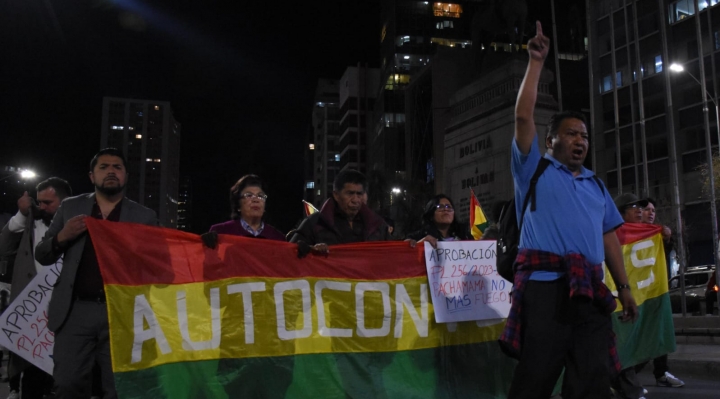
Demonstration marched through the city’s main streets. Photo: APG
Hundreds of activists mobilized on Wednesday night in the city of La Paz, demanding action against the fires that have devastated nearly four million hectares of forests and grasslands. The protesters called for the repeal of the “incendiary laws” and, in their attempt to enter Plaza Murillo, were repelled by police officers, who also detained one of the leaders.
Summoned through social media, the young people marched through the main streets of the city, chanting for the Government to repeal the laws they consider responsible for the environmental disaster. Upon reaching Plaza Murillo, a restricted access area, they attempted to force their way in but were met with resistance from the police guarding the area.
The situation escalated when the protesters complained of unequal treatment, arguing that a day earlier, a march organized by the Central Obrera Boliviana (COB), aligned with President Luis Arce, was allowed to enter, while they were denied access. “We feel discriminated against,” expressed some activists amidst the clashes.
The protest led to acts of violence, and the police dispersed the protesters with tear gas. During the intervention, a young man was detained. Preliminary reports suggest the individual is Juan Giacoman, from the movement Legion Against Animal Cruelty, who was taken to the Tactical Police Operations Unit (UTOP).
Among the visible slogans on banners and signs were messages like: “Declaration of disaster,” “Repeal the incendiary laws,” “No more fire,” and “We can’t get used to this.”
The fires are largely attributed to the practice of “chaqueo” or “controlled burns,” which have affected vast areas of land, turning into uncontrollable blazes in Bolivia’s eastern region. The laws referred to by the protesters were passed in 2013, during the government of Evo Morales, and allow the expansion of the agricultural frontier and land clearing in the eastern and northern Amazon regions, currently the most affected by the fires.
BD/RED
Brújula Digital:
Marcha contra leyes incendiarias recibe dura represión de la Policía, los gasifica y aprehende a un activista
Manifestación recorrió las principales vías de la ciudad. Foto:APG
Centenares de activistas se movilizaron este miércoles por la noche en la ciudad de La Paz, para pedir acciones contra los incendios que devastaron cerca de cuatro millones de hectáreas de bosques y pastizales. Los manifestantes exigieron la abrogación de las “leyes incendiarias” y, en su intento por ingresar a la Plaza Murillo, fueron repelidos por efectivos policiales, quienes además detuvieron a uno de los líderes.
Convocados a través de redes sociales, los jóvenes recorrieron las principales calles de la ciudad, alzando consignas para que el Gobierno derogue las normas que consideran responsables del desastre ambiental. Al llegar a la Plaza Murillo, un lugar de acceso restringido, intentaron entrar por la fuerza, pero se encontraron con la resistencia de la Policía, que resguardaba el área.
La situación escaló cuando los manifestantes denunciaron un trato desigual, argumentando que un día antes se permitió el ingreso de una marcha organizada por la Central Obrera Boliviana (COB), afín al presidente Luis Arce, mientras que a ellos se les negó el paso. “Nos sentimos discriminados,” expresaron algunos activistas en medio de los enfrentamientos.
La protesta derivó en actos de violencia, y la policía dispersó a los manifestantes con gas lacrimógeno. Durante la intervención, un joven fue detenido. Según reportes preliminares, esta persona sería Juan Giacoman, del movimiento Legión Anticrueldad de Animales, quien fue trasladado a las instalaciones de la Unidad Táctica de Operaciones Policiales (UTOP).
Entre las consignas visibles en pancartas y cartulinas se leían mensajes como: “Declaración de desastre,” “Abrogación de las leyes incendiarias,” “No más fuego,” y “No podemos acostumbrarnos.”
Los incendios, en gran medida, son atribuidos a las prácticas de “chaqueo” o “quemas controladas,” que han afectado grandes extensiones de terreno hasta convertirse en fuegos incontrolables en la región oriental de Bolivia. Las leyes a las que hacen referencia los manifestantes fueron aprobadas desde 2013, durante el gobierno de Evo Morales, y permiten la expansión de la frontera agropecuaria y los desmontes en zonas del oriente y el norte amazónico, actualmente las más afectadas por los incendios.
BD/RED

 Bolivian Thoughts | Pensamientos Bolivianos (Bilingual/Bilingüe)