
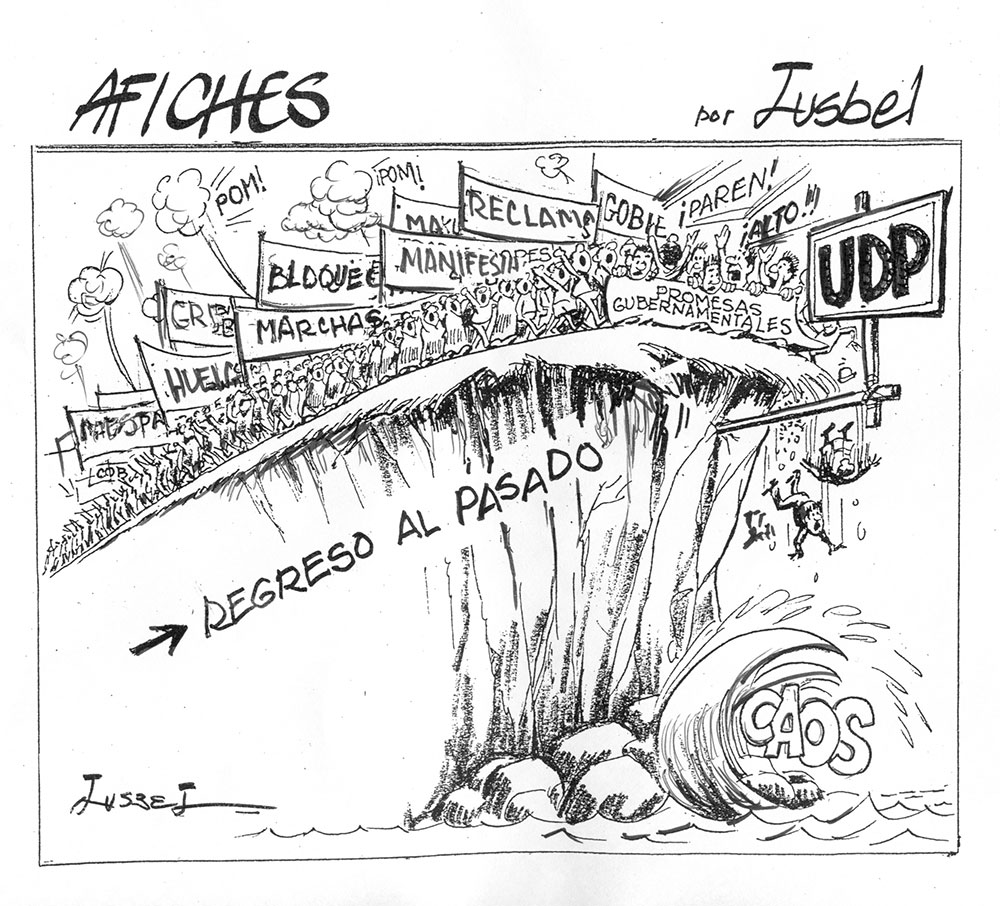
Gonzalo Chávez, El Deber:
The ideological delirium in which the Government finds itself drives it to control the entire spectrum of economic and political analysis. It defines what a crisis is, in its image and likeness, it determines which indicators do or do not measure a crisis and from this, it builds a propaganda narrative about the success of the economic model, which borders on fanaticism.
The fundamentalists of populism repeat the mantra ad nauseam: the lowest inflation on the planet, the most incredible growth in the world and the lowest unemployment in the universe. And when they recognize some gap in instability, they explain it by the international crisis or an internal conspiracy.
And now, faced with the avalanche of questions from journalists and analysts about the deterioration of various macroeconomic indicators, they vehemently deny the problems. The ostrich of the revolution puts its head in the ground.
Of course, those in power understand crisis as synonymous with economic catastrophe and terminal social disaster, as in today’s Venezuela and/or the hyperinflation of the mid-1980s in Bolivia. Faced with these definitions and historical disasters, we now enjoy infinite health, according to the official discourse.
On this occasion, allow me to demystify some of the absolute truths constructed from power. So, following the butcher’s recommendation, we go in parts.
Bolivia registers an accumulated price level for 2023 of 1.48%. For the nomenclature this is paradise on earth. But a closer reading of this indicator shows that, strictly speaking, we are facing repressed inflation, bribed by subsidies for hydrocarbons and food. At this point in the championship, subsidies – which can no longer be financed with gas revenues – must exceed $2 billion. Prices are also tied up by a fixed exchange rate, which is sustained with a brutal loss of international reserves. Therefore, judging a pimple by its surface and treating it with belladonna is not understanding that, beneath it, there is a gigantic pile of unsustainable subsidies. Tick, toc, tick toc the price bomb ticks. This is a symptom of crisis in China, Burundi or here.
Economic growth has been slowing since 2014. In 2023 it will be around 2%. The systematic fall in the gross domestic product (GDP) is associated with the lack of surplus from the gas sector, which previously supported it. This is another delayed effect time bomb. This is also a clear symptom of crisis.
The swelling of very poor quality jobs and survival strategies, which the government insists on calling employment, is based on an informal economy and is now unsustainable. The government no longer has the resources to continue inflating the consumption bubble. What is observed here, beyond the propaganda, is that occupations and jobs are increasingly precarious and hide the agony of a model that relied on the underground economy. Whatever perspective is adopted, this, too, is a deep structural crisis.
The long lines of trucks, cars and transport in search of diesel is a manifestation of problems. Likewise, the shortage of dollars, in all areas, – which has already created a parallel currency market and which strangles imports – is also a symptom of a hairy crisis. And what about the public deficit, which on average was 7.5% of GDP 11 years ago? The fiscal crisis, which increased internal and external debt and destroyed international reserves, is another sign of crisis.
That Bolivia has lost, between 2014 and today, more than US$13 billion in international reserves and sold grandmother’s jewels to partially close the public deficit, finance unproductive projects or simply to survive, shows that we are spending our savings without shame. When one takes a step larger than the opening of the legs and is scraping the pot, it is another manifestation of crisis.
The strangulation that has occurred of the state company, YPFB – with the consequent shrinking of the gas sector, which from being the engine of growth and generator of surplus has become an activity in agony – is the mother of all crises.
That the total public debt in Bolivia exceeds 80% of GDP, (30% external debt, 30% internal debt and 20% debt of public companies), by any parameter, is a very strong financial pressure for the economy and of course, it is another manifestation of crisis.
The brutal depredation of the environment that occurs in many sectors and for different reasons is, probably, the most serious consequence of the extractivist model that has burned millions of hectares of our forests, and poisoned hundreds of rivers. This attack against the future is probably the most serious manifestation of crisis due to its structural consequences.
That 80% of people have an informal occupation and that this is the basis for growth of various sectors such as commerce and services, where productivity is very low and human capital is devalued is another time bomb and of course, more crisis symptoms.
That the judicial system in Bolivia is in pieces and that it has become the refuge of the most cynical mafias, which threaten to eat away at democracy and institutions, is another symptom of a tremendous structural crisis.
Likewise, the pus of corruption circulates in several of our institutions and contaminates the pillars of society based on smuggling and drug trafficking. Of course this is another symptom of a crisis.
Finally, and no less important, is the educational blackout, that is, the poor quality of our education systems that have worsened with the pandemic crisis and that are drowning the country’s children and young people in mediocrity. Likewise, the precarious health system, which makes the majority of the population pilgrims in hospitals and health posts without adequate care, is also killing the future. Educational blackout and disastrous health are other undoubted symptoms of crisis.
Therefore, the fact that the Government wants to hide this multidimensionality of the problems is also a crisis of values and ethics. Faced with this situation, of course, there are several solutions, but the first is, without a doubt, to recognize that you are facing several types of crisis. This is the first step to starting real change.
El delirio ideológico en el que se encuentra el Gobierno, lo impulsa a controlar todo el espectro del análisis económico y político. Define qué es crisis, a su imagen y semejanza, determina qué indicadores miden o no una crisis y a partir de ello, construye una narrativa propagandística, sobre el éxito del modelo económico, que raya en el fanatismo.
Los fundamentalistas del populismo repiten hasta el cansancio el mantra: la inflación más baja del planeta, el crecimiento más increíble del mundo y el desempleo más bajo del universo. Y cuando reconocen algún resquicio de inestabilidad, explican éste, por la crisis internacional o una conspiración interna.
Y ahora, frente a la avalancha de preguntas de periodistas y analistas sobre el deterioro de varios indicadores macroeconómicos, niegan los problemas vehementemente. El avestruz de la revolución meta su cabeza en la tierra.
Por supuesto, los dueños del poder entienden crisis como sinónimo de hecatombe económica y desastre social terminal como en la Venezuela actual y/o la hiperinflación de mediados de los años ochenta en Bolivia. Frente a estas definiciones y desastres históricos, ahora gozamos de salud infinita, según el discurso oficial.
En esta oportunidad permítanme desmitificar algunas de las verdades absolutas construidas desde el poder. Así que, siguiendo la recomendación del descuartizador, vamos por partes.
Bolivia registra un nivel de precios acumulado para el 2023 de 1,48%. Para la nomenclatura esto es el paraíso en la tierra. Pero una lectura más cercana de este indicador muestra que, a rigor, estamos frente a una inflación reprimida, sobornada por los subsidios a los hidrocarburos y a los alimentos. A estas alturas del campeonato, las subvenciones – que ya no se pueden financiar con la renta gasífera – deben sobrepasar los $us 2.000 millones. Los precios también están maniatados por un tipo de cambio fijo, que es sostenido con una brutal pérdida de reservas internacionales. Por lo tanto, juzgar a un grano por su superficie y tratarlo con belladona es no entender que, debajo de este, hay un puchichi gigantesco de subvenciones insostenible. Tic, toc, tic toc corre la bomba reloj de los precios. Este es un síntoma de crisis en la China, Burundi o aquí.
El crecimiento económico viene desacelerándose desde el año 2014. En el 2023 estará rondando el 2%. La caída sistemática del producto interno bruto (PIB) está asociado a la falta del excedente del sector gasífero, que antes lo sostenía. Esta es otra bomba de tiempo de efecto retardado. Esto también es un síntoma claro de crisis.
La hinchazón de trabajos de muy mala calidad y estrategias de sobrevivencia, que el gobierno se empeña en denominar empleo, se basa en una economía informal y que ahora, es insostenible. El gobierno ya no tiene los recursos para seguir inflando la burbuja de consumo. Aquí lo que se observa, más allá de la propaganda, es que las ocupaciones y los trabajos son cada vez más precarios y ocultan la agonía de un modelo que apostó a la economía subterránea. Cualquiera sea la perspectiva que se adopte, esto también, es crisis estructural profunda.
Las largas filas de camiones, automóviles y transporte en búsqueda de diésel es una manifestación de problemas. Asimismo, la escasez de dólares, en todos los ámbitos, – que ya han creado un mercado paralelo de las divisas y que estrangulan las importaciones – es igualmente un síntoma de crisis peluda. ¿Y qué decir del déficit público, que en promedio es 7,5% del PIB hace 11 años? La crisis fiscal, que aumentó la deuda interna y externa y pulverizó las reservas internacionales, es otra señal de crisis.
Que Bolivia haya perdido, entre 2014 y la actualidad, más de $us 13.000 millones de dólares de las reservas internacionales y vendido las joyas de la abuela para cerrar parcialmente el déficit público, financiar proyectos improductivos o simplemente para sobrevivir, muestra que estamos gastando nuestros ahorros sin pudor. Cuando uno da un paso mayor que la apertura de las piernas y está raspando la olla es otra manifestación de crisis.
El estrangulamiento que se ha producido de la empresa estatal, YPFB – con el consecuente achicamiento del sector gas que de ser motor del crecimiento y generador del excedente se ha convertido en una actividad en agonía – es la madre de todas las crisis.
Que la deuda pública total en Bolivia sobrepase el 80% del PIB, (30% de deuda externa, 30% de deuda interna y 20% de deuda de empresas públicas), para cualquier parámetro, es una presión financiera muy fuerte para la economía y por supuesto, es otra manifestación de crisis.
La brutal depredación del medio ambiente que se da en muchos sectores y por diferentes razones es, probablemente, la consecuencia más grave del modelo extractivista que ha quemado millones de hectáreas de nuestros bosques, y que envenenó centenas de ríos. Este atentado contra el futuro es, probablemente, la manifestación de crisis más grave por sus consecuencias estructurales.
Que el 80% de la gente tenga una ocupación informal y que esta sea la base de crecimiento de varios sectores como el comercio y los servicios, donde la productividad es muy baja y se devalúa el capital humano es otra bomba de tiempo y por supuesto, más síntomas de crisis.
Que el sistema judicial en Bolivia este en pedazos y que se haya convertido en el refugio de las mafias más cínicas, que amenazan comerse la democracia y las instituciones, es otro síntoma de una tremenda crisis estructural.
Asimismo, la pus de la corrupción circula en varias de nuestras instituciones y contamina los pilares de sociedad en base al contrabando y el narcotráfico. Por supuesto es este otro síntoma de una crisis.
Finalmente, y no por eso menos importante está el apagón educativo, es decir, la pésima calidad de nuestros sistemas de enseñanza que han empeorado con la crisis de la pandemia y que están ahogando en la mediocridad, a los niños y jóvenes del país. Así mismo, el precario sistema de salud, que hace que la mayoría de la población peregrine en hospitales y postas sanitarias sin atención adecuada, también está matando el futuro. Apagón educativo y salud desastrosa son otros síntomas indudables de crisis.
Por lo tanto, que el Gobierno quiere ocultar esta multi dimensionalidad de los problemas también es una crisis de valores y de ética. Frente a esta situación por supuesto que hay varias soluciones, pero la primera es, sin duda alguna, reconocer que estás frente a varios tipos de crisis. Este es el primer paso para comenzar un cambio verdadero.
https://eldeber.com.bo/opinion/hay-o-no-crisis-en-bolivia_349836


 Bolivian Thoughts | Pensamientos Bolivianos (Bilingual/Bilingüe)