
Armonia Foundation [a proud Bolivian NGO] has released an important book and Gemma Candela reports for La Razon:
The masked tororí (Hylopezus auricularis) shakes its wings in the Bolivian Amazon. He lives between the Madre de Dios and Beni rivers. There are only between 300 and 500 survivors of this bird of 14 centimeters long, the majority concentrated in the savanna area of Riberalta. But there, the population growth has led to the expansion of the urban territory at the expense of the natural environment. For this reason, the Habitat of the tororí [is diminished] with the passage of time and, if no action is taken as an orderly planning of the new neighborhoods, this species would eventually disappear from the site, which would mean the extinction of this bird that is found in Beni and Pando.
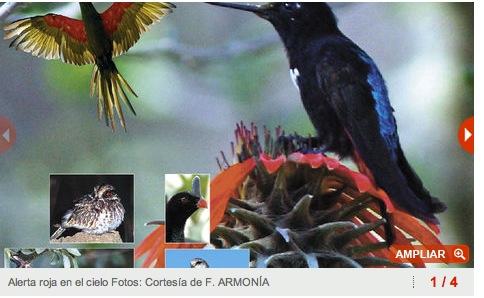 Bolivia is the sixth country in South America in the ranking of endemic birds’ specimens: there are 17 families of birds that are exclusive to this piece of the world population. In addition, other 181 pass by Bolivian skies on their migratory flights between the North and South of the American continent. In total there are 1,422 types of birds in Bolivia, which are supposed to represent 43 per cent of all those who populate South American soil. Of them, 1,325 species are nesting in these lands. However, they face dangerous threats that can significantly reduce the number of individuals and even carry some of these to the final and irreversible disappearance.
…
Armonia launches a bleak prognosis: If immediate action is not taken in a decade thousands of hectares of forest that depend on 400 species of birds have become fields of monoculture. And, although some birds have grown accustomed to this metamorphosis, with what can not cope is pesticides that farmers use.
…
The diagnosis indicates that, currently, 25% of the birds of the Bolivian territory has some kind of actual or potential use. Native people elaborate dresses and traditional headdress with feathers, which leads to the death of large numbers of birds a year. There is also the hunting of certain specimens for their meat and for medicinal uses and magical rituals.
…
Armonia at the same time, postulates the formation of environmental educators and the inclusion of this subject in the curriculum of the school classrooms. And become allies to peoples that coexist with these animals in danger of extinction, putting aside prohibitions and giving them new economic alternatives, since they are necessary players for the maintenance of the species.
The mamaco (Crax globulosa) is 90 centimeters and weighs about 2,500 grams. It stands out for its crest wavy forward and because there is little more than one hundred of them that expose its dark tail in the Beni Department, in the southwest of the Amazon. There fight against the geographical isolation, forest activities and indiscriminate hunting. But a light of hope has leaned for the preservation of this bird feeds on fruits, seeds, and small animals.
In the vicinity of the Beni river, the Tacana people of San Marcos town banned logging and hunting of this precious bird, then its residents were trained and became involved in the monitoring and investigation of the bird fauna of the area. All of this was born under the umbrella of a strategy designed by BirdLife International, local groups of conservation, which was applied in Bolivia by Armonia. A successful example to be emulated in other natural reservoirs in the country, to save other birds that fly the Bolivian sky.
BOOK ‘STATE OF CONSERVATION OF THE BIRDS IN BOLIVIA’ (F. ARMONIA)
[if you want to read more about these bird species, and more pictures, please see the whole Spanish report in the link below]
http://www.la-razon.com/suplementos/escape/Alerta-roja-cielo_0_1569443122.html
For more info about Fundacion Armonia, use this link. The start-up is a little slow and has a message on top, but disregard it and wait, it is only in Spanish but worth seeing this association’s work and of course very nice pictures.

 Bolivian Thoughts | Pensamientos Bolivianos (Bilingual/Bilingüe)