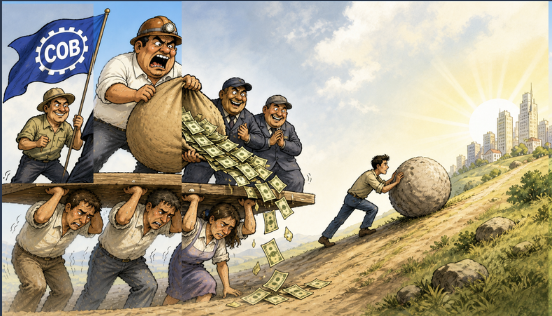
Editorial, Bolivian Thoughts:
BOLIVIA’S LABOR DAY: A CELEBRATION OF PARASITISM
Every May 1, Bolivia is subjected to the same tired spectacle: marches, firecrackers, threats, anti-American slogans, and a fresh round of wage demands from the Bolivian Workers’ Central, the COB.
This year has been no different.
Once again, the COB has taken to the streets demanding higher salaries, rejecting any meaningful labor reform, and warning of more radical action if its list of demands is not fully met.
The truly offensive part is not the percentage they demand.
It is the mindset behind it.
The COB no longer represents Bolivia’s productive worker. It does not speak for the entrepreneur, the laborer who rises before dawn, the small manufacturer, the merchant risking his capital, or the young Bolivian trying to build a future through effort and initiative. Today, the COB represents something else entirely: a union bureaucracy deeply embedded in Bolivia’s political machinery, a class of permanently mobilized leaders whose existence depends on demanding, obstructing, and blackmailing.
These are men removed from real work, sustained by union dues, political favors, and state patronage. They live off agitation. Their careers are built not on creating wealth, but on cultivating grievance.
And that points to the psychological reality many in Bolivia still refuse to confront.
The typical COB leader is not motivated merely by economics. He is driven by three deeper impulses: ideological resentment, addiction to disruptive power, and contempt for the success of others.
First, ideological resentment.
For decades, Bolivia’s union class has been marinated in the stale dogmas of Marxism: the businessman is an exploiter, the free market is predatory, private investment is suspicious, the United States is the eternal villain, and the State must redistribute what others produce. The Soviet Union collapsed a generation ago, yet Lenin still occupies their imagination. Castro remains a hero. Chávez remains a symbol of “resistance.” Their anti-imperialism, meanwhile, is intellectually fraudulent. They denounce Washington while showing no discomfort whatsoever with the geopolitical interests of Cuba, Venezuela, Russia, or China. They do not oppose empires; they simply choose the empires that flatter their socialist instincts.
Second, addiction to power.
A Bolivian union boss learned long ago that he does not need to produce anything in order to wield influence. He need only paralyze. He can block highways, shut down cities, intimidate governments, and appear on television as a “voice of the people.” That small but destructive power becomes intoxicating. Conflict turns into identity. Without permanent confrontation, these men are politically irrelevant.
Third, contempt for those who produce.
The free market offends them because it rewards discipline, competence, risk, efficiency, and merit—qualities that union bureaucracies neither embody nor control. Meritocracy is intolerable to people whose only social leverage comes from coercion. It exposes them for what they are: unproductive middlemen living off political muscle.
Since 2006, the COB ceased to function as an independent labor organization and instead became a parasitic ally of the MAS regime. It negotiated wage hikes by decree, labor privileges, expanded state control, political quotas, and protection from within the ruling socialist order. It became a willing participant in the populist experiment that bloated Bolivia’s public sector, multiplied corrupt and loss-making state enterprises, subsidized inefficiency, and encouraged the fantasy that national prosperity could be legislated from a podium.
Every Labor Day brought the same ritualized absurdity: the president standing beside COB leaders announcing new salary increases, as though wealth were created by speeches and signatures.
But wealth is not created by decree.
It comes from the businessman forced to shut his doors.
It comes from the formal worker who loses his job.
It comes from the taxpayer squeezed ever harder.
It comes from inflation eroding purchasing power.
It comes from debt passed on to future generations.
Bolivia is now living with the consequences of that delusion: a swollen State, bankrupt public companies, chronic fiscal deficits, dwindling reserves, investor distrust, legal insecurity, and a political culture in which demanding has become more profitable than producing.
Yet even now, in the midst of a severe economic and political crisis, the COB continues to demand more.
It does not matter that the economy is stagnant.
It does not matter that small businesses are suffocating.
It does not matter that formal employment is shrinking.
It does not matter that Bolivia’s youth survive increasingly in the informal sector.
They demand because they can.
And they can because Bolivia spent two decades mistaking organized street pressure for moral legitimacy.
The blunt truth is this: the COB feeds on the poverty it pretends to defend.
It needs dependent, poorly informed, emotionally manipulable masses. It hands them rhetorical crumbs, offers them the mythology of class struggle, and harvests political obedience. It does not liberate workers. It uses them as expendable fuel in order to preserve the privileges of union leadership.
Its worldview is not merely outdated. It is poisonous.
Statism, coercive unionism, hostility toward private capital, demonization of merit, and the permanent glorification of conflict have acted as a political cancer in Bolivia for decades.
If the country is serious about survival, it must reject this mentality.
Bolivia needs less State, not more.
More private investment, not more failed public monopolies.
More legal certainty, not more union extortion.
More individual opportunity, not more ideological intimidation.
More merit, more productivity, more responsibility.
The republic will not be rebuilt while the nation remains hostage to organizations that do not work, do not allow others to work, and believe governance consists of extortion by mob pressure.
Bolivia’s Labor Day should no longer be treated as a festival of fossilized union rhetoric.
It should become the moment when the country finally says no to organized parasitism.
Editorial Pensamientos Bolivianos:
EL PRIMERO DE MAYO Y EL PARASITISMO ORGANIZADO
Cada 1 de mayo Bolivia vuelve a presenciar el mismo ritual agotador: marchas, petardos, amenazas, consignas antiimperialistas y una nueva lista de exigencias salariales de la Central Obrera Boliviana. Este año no fue distinto. La COB volvió a salir a las calles para reclamar un incremento del 20%, rechazar cualquier reforma laboral y advertir que radicalizará sus medidas si no se satisface su pliego petitorio.
Lo verdaderamente indignante no es solo la cifra. Es la mentalidad.
La COB ya no representa al trabajador productivo. No representa al emprendedor, al obrero que madruga, al pequeño industrial, al comerciante que arriesga capital ni al joven que busca una oportunidad. La COB representa hoy a una burocracia sindical enquistada en el aparato político boliviano, una casta de dirigentes profesionalmente movilizados cuya existencia depende de exigir, bloquear y chantajear.
Son hombres declarados en comisión, es decir, liberados del trabajo real pero mantenidos por cuotas sindicales, favores estatales o privilegios políticos. Viven de la protesta. Su carrera no se construye produciendo riqueza sino administrando resentimiento.
Y aquí aparece el elemento psicológico que muchos prefieren ignorar.
El dirigente cobista promedio no actúa solo por cálculo económico. Está impulsado por tres motores profundos: resentimiento ideológico, adicción al poder callejero y desprecio por el éxito ajeno.
Primero, el resentimiento ideológico. Durante décadas fueron educados en la vieja liturgia marxista: el empresario es explotador, el mercado es enemigo, la inversión privada es sospechosa, Estados Unidos es el demonio y el Estado debe repartir lo que otros producen. Aunque la Unión Soviética colapsó hace más de treinta años, en sus cabezas Lenin sigue vivo. Cuba sigue siendo ejemplo. Venezuela sigue siendo “resistencia”. China y Rusia no les molestan porque el antiimperialismo de esta gente nunca fue moral; siempre fue selectivo y utilitario.
Segundo, la adicción al poder. Un dirigente sindical boliviano descubre muy pronto que no necesita crear nada para sentirse importante: basta con paralizar. Puede cerrar carreteras, colapsar ciudades, intimidar gobiernos y aparecer en televisión como “representante del pueblo”. Ese pequeño poder embriaga. La movilización se convierte en identidad personal. Sin conflicto, dejan de existir.
Tercero, el desprecio por quien produce. El mercado libre es ofensivo para ellos porque premia mérito, disciplina, riesgo y eficiencia, virtudes que la burocracia sindical no posee ni puede controlar. Por eso odian la meritocracia: porque la meritocracia expone su inutilidad.
Desde 2006 la COB dejó de ser un contrapeso sindical para convertirse en socio parasitario del MAS. Negoció aumentos por decreto, privilegios laborales, expansión estatal, cuotas de poder y protección política. Fue parte del modelo populista que multiplicó empresas públicas deficitarias, subsidios insostenibles y gasto sin productividad. Cada Primero de Mayo se celebraba la misma escena: presidente y COB anunciando nuevos incrementos, como si el dinero naciera en los balcones del Palacio.
Pero el dinero no nace del decreto.
Sale del empresario que cierra.
Sale del formal que despide.
Sale del contribuyente que paga más.
Sale de la inflación que destruye salarios reales.
Sale de la deuda que hipotecó el futuro.
Bolivia está cosechando exactamente lo que sembró durante veinte años: un Estado obeso, empresas estatales corruptas, déficit fiscal crónico, subsidios impagables, ausencia de dólares, desconfianza inversora y una cultura política donde pedir es más rentable que producir.
En medio de esta crisis, la COB insiste en pedir más.
No importa si la economía no crece.
No importa si miles de pequeñas empresas agonizan.
No importa si el empleo formal es una rareza.
No importa si la juventud sobrevive en la informalidad.
Piden porque pueden.
Y pueden porque durante años Bolivia confundió presión callejera con legitimidad moral.
La verdad debe decirse sin eufemismos: la COB se alimenta de la pobreza que dice defender. Necesita masas dependientes, mal informadas y emocionalmente movilizables. Reparte migajas retóricas y cosecha obediencia política. No emancipa al trabajador; lo utiliza como combustible humano para conservar privilegios dirigenciales.
Sus ideas son un cáncer político: estatismo, sindicalismo coercitivo, odio al capital, satanización del mérito y culto enfermizo al conflicto.
Si Bolivia quiere sobrevivir, debe romper con este modelo mental.
Necesitamos menos Estado, no más.
Necesitamos inversión privada, no más monopolios públicos quebrados.
Necesitamos seguridad jurídica, no más chantaje sindical.
Necesitamos trabajadores libres, no comisarios obreros.
Necesitamos meritocracia, responsabilidad y productividad.
La república no será recuperada mientras el país siga arrodillado ante organizaciones que no trabajan, no dejan trabajar y creen que gobernar es extorsionar.
Este Primero de Mayo no debería ser una fiesta del sindicalismo fósil.
Debería ser el comienzo del rechazo nacional al parasitismo organizado.


Leave a Reply