By Oscar Antezana:
The conclusion of the gubernatorial elections, in which ruling-party leaders won in two of the country’s nine governorships, in some way reflects the discontent after six months of Paz Pereira’s administration. The delayed reforms that have been announced for months also create discouragement. Or the fact that commitments are signed with international organizations but no dollars arrive. And when they do arrive, they will be for projects. What the economy requires is dollars, support for the balance of payments, so that the government can import gasoline and loosen up the banking system and investments, among other things. And the cherry on top has been the presentation of the 2026 budget, where it seems that it only underwent a slight touch-up from the MAS-era budgets. A disappointment and frustration to the point that people are already growing tired of the President’s optimistic but hollow words.
Faced with this bleak picture, figures who have influence over public opinion have recently expressed negative and pessimistic views about Bolivia’s immediate future, particularly regarding society, which is what makes a nation. With good reason.
“The underlying problem is a clash of legitimacies. On one hand, a central government sustained by the state structure and control of resources; on the other, local authorities with direct, immediate, and territorially solid backing. This tension is not new, but it has reached a critical point” (El Día).
“Divided between the highlanders and the lowlanders, they never understood one another and it does not seem they ever will after 200 years of living in the same prison. Some want investments, the others nationalizations. Some want socialism, the others liberalism. Some love the State, the others despise it as a thief… Some love the wiphala and the others reject it… Some block roads and the others get screwed… Some are a little whiter and the others a little browner. Some eat yuca and the others chuño…” (Manfredo Kempff).
“Politics ceased to be public service and became a profitable trade for disciplined mediocrities” (Johnny Nogales).
One week before President Paz took office, an article of mine was published: Citizen Governability. “Two things could happen that would prevent Rodrigo Paz from taking advantage of the best opportunity a Bolivian President has had in decades. First, that he, as President, does not make the right decisions; at the end of the day, he is the President… Second, that the caucuses of both the PDC and LIBRE splinter, that is, break into more than one faction…” It continued: “but in Bolivia governability also has an aspect that has to do directly with the citizenry; that is, not merely having a majority in Congress and/or the State’s capacity to enforce the Law. The moral values that are so corroded must be refreshed and strengthened, and that is one of the heaviest legacies left to us by MAS. We cannot normalize lying, cynicism, abuse, impunity, theft, backroom deals, and discrimination. I suggest, Mr. President… carry out a massive and permanent awareness campaign about our forgotten values, such as honesty, punctuality, the value of one’s word, effort, compliance with the Law, etc.… so as to understand and accept the sacrifices that we all must make and endure the difficult days that lie ahead.”
Society is not merely polarized; it is chipped apart. How can we call ourselves a nation if all leaders have a different economic, political, social, and/or institutional point of view? How can we be a nation if citizens do not have a common denominator that makes us work for Bolivia? How can we be a nation if society does not share moral values to guide us in our civic and political behavior? We are a Tower of Babel; we cannot build a country like this.
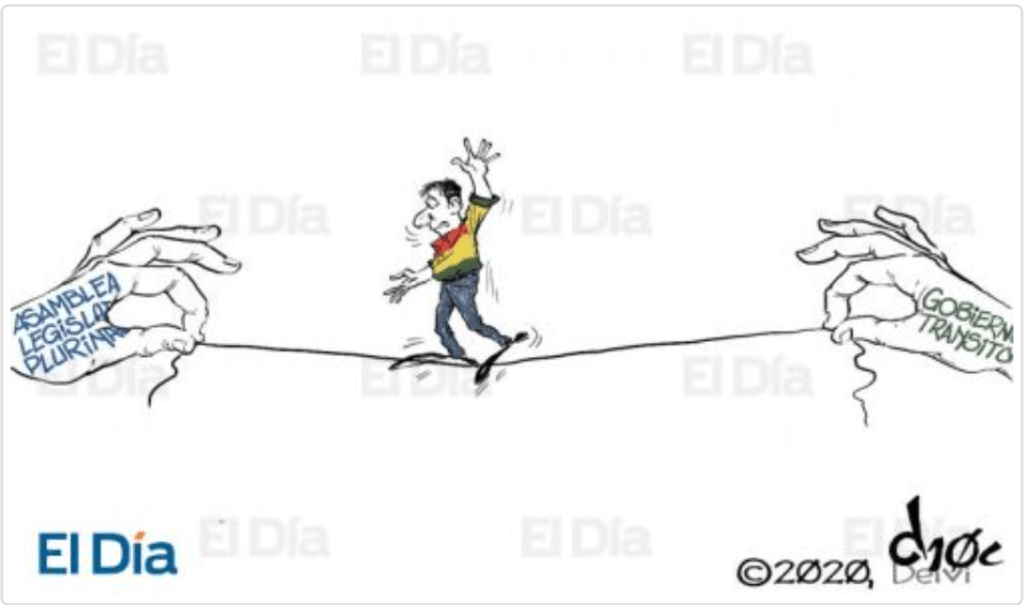
What is failing is the main thing—leadership, vision, and the President’s concrete initiative. Up to this point, he keeps everyone balanced on a thin rope. We did not elect him for that. We elected him to govern, to make difficult decisions (it is not enough to maintain an imaginary stability, and a temporary one at that), not to avoid making waves and merely survive while thinking about 2030. He is not doing it because his PDC/MAS allies who helped elect him do not cooperate, or because he is afraid of social/political conflicts. But in doing so, is he not leading us toward a conflict of even greater scale? Tuto Quiroga and Samuel Doria Medina, silent; they will say they are not the government, and indeed they are not, but they are Bolivians who have the HONOR AND PRIVILEGE of influencing and contributing to the country’s development.
“When did Bolivia get screwed? Bolivia was born screwed. A question and an answer that are not my inspiration…,” says Manfredo Kempff. But no one is free of sin: not the politicians, nor the citizens; not the cambas, nor the collas; not the businessmen, nor the workers; not the peasants, nor the professionals. We all keep screwing Bolivia.
Por Oscar Antezana Malpartida:
La finalización de las elecciones para gobernadores, donde líderes del oficialismo ganaron en dos de las nueve gobernaciones, de alguna manera reflejan el descontento después de seis meses de gobierno de Paz Pereira. Las postergadas reformas que desde hace meses se anuncian, también crean desazón. O que se firman compromisos con organizaciones internacionales pero no llegan dólares. Y cuando llegue, serán para proyectos. Lo que la economía requiere son dólares, apoyo a la balanza de pago, para que el gobierno importe gasolina y se descontracture el sistema bancario y las inversiones, entre otros. Y la cereza en la torta, ha sido la presentación del presupuesto para el año 2026 donde parece que solamente sufrió un retoque a los presupuestos masistas. Una decepción y frustración que hasta la gente se está cansando de la palabras optimistas, pero huecas, del Presidente.
Ante este cuadro desolador, personajes que tienen influencia en la opinión pública, han expresado recientemente opiniones negativas y pesimistas sobre el futuro inmediato de Bolivia, particularmente la sociedad, que es lo que hace a una nación. Con razón.
“El problema de fondo es un choque de legitimidades. Por un lado, un gobierno central que se sostiene en la estructura estatal y el control de los recursos; por otro, autoridades locales con respaldo directo, inmediato y territorialmente sólido. Esta tensión no es nueva, pero ha alcanzado un punto crítico” (El Día).
“Divididos entre los altoperuanos y los llaneros, nunca se entendieron ni parece que se vayan a entender luego de 200 años de convivir en la misma prisión. Los unos quieren inversiones, los otros las nacionalizaciones. Unos quieren socialismo los otros el liberalismo. Unos aman el Estado, los otros lo repudian por ladrón… Unos aman la wipala y los otros la repudian… Unos bloquean y los otros se joden… Unos son más blanquitos y los otros más morenitos. Unos comen yuca y los otros el chuño…” (Manfredo Kempff).
“La política dejó de ser servicio público y se transformó en oficio rentable para mediocres disciplinados” (Johnny Nogales).
Una semana antes de que el Presidente Paz asuma la presidencia, se publicó un artículo mío: Gobernabilidad Ciudadana. “Dos cosas pudiesen suceder para que Rodrigo Paz no aproveche la mejor oportunidad que ha tenido un Presidente boliviano en décadas. Primero, que él, como Presidente, no tome las decisiones correctas; al final del día, él es el Presidente… Segundo, que las bancadas tanto del PDC como de LIBRE se resquebrajen, es decir, se partan en más de una facción…” Continuaba: “pero en Bolivia la gobernabilidad también tiene un aspecto que tiene que ver directamente con la ciudadanía; es decir, no con tener mayoría en el Congreso y/o la capacidad del Estado de hacer cumplir la Ley. Se tiene que refrescar y fortalecer los valores morales que están tan corroídos y es uno de los legados más pesados que nos deja el MAS. No podemos normalizar la mentira, el cinismo, el abuso, la impunidad, el robo, los negociados y la discriminación. Le sugiero, señor Presidente… ejecute una campaña masiva y permanente de concientización sobre nuestros valores olvidados, como la honestidad, la puntualidad, el valor de la palabra, el esfuerzo, el cumplimiento con la Ley, etc.… para entender y aceptar los sacrificios que todos debemos hacer y tolerar los días difíciles que se vienen.”
La sociedad no está solamente polarizada, esta astillada. ¿Cómo nos podemos llamar una nación si todos los líderes tienen un punto de vista económico, político, social, y/o institucional diferente? ¿Cómo podemos ser nación si los ciudadanos no tenemos un común denominador que nos haga trabajar por Bolivia? ¿Cómo podemos ser nación si la sociedad no comparte valores morales que nos guíen en nuestro comportamiento ciudadano y político? Somos una Torre de Babel; no podemos construir un país así.
Está fallando lo principal – el liderazgo, la visión y la iniciativa concreta del Presidente. Hasta el momento, mantiene a todos sobre una cuerda delgada. No lo elegimos para eso. Lo elegimos para que gobierne, para que tome decisiones difíciles (no es suficiente mantener una estabilidad imaginaria, y además momentánea), no para que no haga ondas y sobreviva y piense en el 2030. No lo hace porque sus “aliados” PDC/ Masistas que lo ayudaron a ser elegido no colaboran o porque tiene miedo a conflictos sociales/ políticos. Pero, no está llevando a un conflicto de mayor escala. Tuto y Samuel, callados; dirán que ellos no son gobierno, efectivamente, pero son bolivianos que tienen el HONOR Y PRIVELIEGIO de influir y aportar al desarrollo del país.
“¿Cuándo se jodió Bolivia? Bolivia nació jodida. Una pregunta y una respuesta que no son inspiración mía…”, dice Manfredo Kempff. Pero nadie está libre de pecado: ni los políticos, ni los ciudadanos; ni los cambas, ni los collas; ni los empresarios, ni los obreros; ni los campesinos, ni los profesionales. Todos seguimos jodiendo a Bolivia.


Leave a Reply