
El Diario:
Lack of economic information increases Bolivia’s country risk
- The population distrusts the Government’s data and the national economy, which is why they chose to reduce their expenses and prioritize their purchases, which slows down the dynamism of the domestic market.
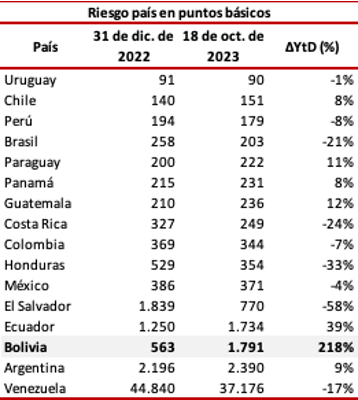
The lack of information on international reserves, of the Gross Domestic Product (GDP), added to the shortage of dollars generates distrust at the international level and causes an increase in the level of country risk. Meanwhile, the Government assures that Bolivia has positive economic indicators compared to other nations.
The data in Bolivia became a scarce commodity, since we do not know the data on the international reserves, we only know that all the resources from the sale of gold were spent, just as it is known that the Special Drawing Rights (SDRs) were already used. of the International Monetary Fund (IMF), laments economist Gonzalo Chávez on his social networks.
Risk
Meanwhile, the economist and former director of the Central Bank of Bolivia (BCB), Gabriel Espinoza Y., wrote on his social network X @g_espinoza, few days back, that “the country risk of #Bolivia that has reached on Wednesday, surpassed the 1,800 basis points (bp.) and yesterday closed at 1,791 bp., which means that the country would have to pay an interest rate of more or less 24% to be able to access credit in the private debt markets. This happens in a week in which the importance of politics has taken over the economy on the President’s agenda, which is why his Minister of Economy came out to deny a crisis that is palpable.”
He adds: “The performance is so bad (and the distrust it arouses in international markets is so great), that if we compare the situation with the beginning of the year, not even Argentina, with everything and the ongoing electoral process, has deteriorated as much as Bolivia. Even worse, Venezuela has improved its position.”
“Personally, I believe that in addition to the focus on politics, what has strongly penalized the perception of risk was the failure to take advantage of opportunities to give a speech about change in economic management. The denial of the crisis by Arce and his team, contrary to what they are trying to achieve, brings uncertainty to the population, and much worse than bad, it is uncertain,” he maintains.
The lack of information slows down the national economy and affects the country’s risk rate, said Chávez in time to ensure that there will be no second bonus, since to achieve this payment Bolivia will have to grow by 10% in the second quarter, which it will not.
He regretted that there is no data on the execution of public investment, which increases the climate of uncertainty, especially with repressed inflation and the mirage of an unemployment rate of 3.75%.
80% work in the informal economy, that is, 3.6 million people survive in the sector, since they do not have employment but rather a precarious occupation, said Chávez, reiterating that the economy is slowing down.
Distrust
A few days ago, they presented the study “1000 Bolivians Say” – 4th. Wave, prepared by OMG (Omnicom Media Group), which points out that Bolivians distrust the economy and see uncertainty for the next half of 2024.
They also decided to reduce their expenses and prioritize their purchases, which are mostly spent on health and food, the majority do not have enough to save in financial institutions.
Growth
Chávez indicates that the national economy began to slow down since 2014, only that the Government never admitted, and now it will not grow at 4.8% as the authorities estimated, since in the first quarter a figure of only 2.2% was recorded. .
There are also no current GDP figures for the second quarter and foreign trade figures come out a month late. Everything causes uncertainty and public opinion regrets the lack of transparency of the authorities and institutions in charge of processing economic data.
Deceleration
International organizations projected a growth of less than 2% for the current administration, and the percentage decreases for the following years, which means that the deceleration of the national economy will continue.
However, the Government assures that with the projects it has underway, such as lithium and biodiesel, as well as the Mutún Steel plant, among others, they will generate important resources for the country, more than gas, even.
Official
Meanwhile, economic analyst Martín Moreira points out that Bolivia has positive economic indicators compared to other countries; However, the risk rating agencies do not take them into account, because “they do not forgive” the fact that the State does not depend on its financial conditions, according to ABI.
“According to the country’s economic indicators, a positive outlook can be observed (…). Despite these achievements, it is regrettable that the risk rating agencies do not take them into account,” said the expert.
It is projected that exports will exceed 10,000 million dollars by the end of the year, less than the more than 13,000 million registered in 2022. A law was approved to strengthen the Net International Reserves (RIN), but the figures are unknown, it is estimated that It does not exceed 2,000 million after the sale of gold and an investment plan of 2,800 million was drawn up in the industrialization of lithium, subject to the approval of agreements with Chinese and a Russian company.
Falta de información económica eleva el riesgo país de Bolivia
- La población siente desconfianza de los datos del Gobierno y de la economía nacional, por ello optó por reducir sus gastos y priorizar sus compras, lo que frena el dinamismo del mercado interno.
La falta de información sobre las reservas internacionales, del Producto Interno Bruto (PIB), sumado a la escasez de dólares genera desconfianza a nivel internacional y provoca elevar el nivel de riesgo país. Mientras, el Gobierno asegura que Bolivia tiene indicadores económicos positivos respecto a otras naciones.
Los datos en Bolivia se convirtieron en un bien escaso, pues los datos de las reservas internacionales no sabemos, sólo sabemos que se gastó todos los recursos de la venta del oro, así como se sabe que ya utilizaron los Derechos Especiales de Giro (DEGs) del Fondo Monetario Internacional (FMI), lamenta el economista Gonzalo Chávez en sus redes sociales.
Riesgo
Mientras tanto, el economista y exdirector del Banco Central de Bolivia (BCB), Gabriel Espinoza Y., escribió en su red social X @g_espinoza, hace unos días atrás, que “el Riesgo País de #Bolivia ha llegado el miércoles a superar los 1.800 puntos básicos (pb.) y ayer cerró en 1.791 pb., lo que significa que el país debería pagar una tasa de interés de más o menos 24% para poder acceder a créditos en los mercados privados de deuda. Esto pasa en una semana en la que la importancia de la política le ha ganado a la economía en la agenda del Presidente, por lo que su Ministro de Economía salía a negar una crisis que es palpable”.
Agrega: “Tan malo es el desempeño (y tanta la desconfianza que despiertan en los mercados internacionales), que si comparamos la situación con inicios de año, ni siquiera Argentina, con todo y proceso electoral en curso, se ha deteriorado tanto como Bolivia. Peor aún, Venezuela ha mejorado su posición”.
“Personalmente creo que además del foco en lo político, lo que ha penalizado fuertemente a la percepción de riesgo, fue la falta de aprovechamiento de las oportunidades para dar un discurso de cambio en la conducción económica. La negación de la crisis por parte de Arce y su equipo, contrariamente a lo que tratan de lograr, traen incertidumbre a la población, y mucho peor que malo, es incierto”, sostiene.
La falta de información frena a la economía nacional y afecta a la tasa de riesgo país, señaló Chávez a tiempo de asegurar que no habrá segundo aguinaldo, ya que para alcanzar este pago Bolivia deberá crecer en 10% en el segundo trimestre, cosa que no lo hará.
Lamentó que no haya datos de la ejecución de la inversión pública, lo que aumenta el clima de incertidumbre, más con una inflación reprimida y el espejismo de una tasa de desempleo de 3,75%.
El 80% trabaja en la economía informal, es decir 3,6 millones de personas sobreviven en el sector, pues no tienen empleo sino una ocupación precaria, aseguró Chávez al reiterar que la economía se desacelera.
Desconfianza
Hace unos días, presentaron el estudio “1000 Bolivianos Dicen” – 4ta. Ola, preparado por OMG (Omnicom Media Group), en la que se señala que los bolivianos desconfían de la economía y ven incertidumbre para el próximo semestre de 2024.
Así también decidieron reducir sus gastos y priorizar sus compras, que más se destinan a salud y alimentos, la mayoría no tiene para ahorrar en las entidades financieras.
Crecimiento
Chávez indica que la economía nacional ingresó en desaceleración desde el 2014, solo que el Gobierno nunca admitió, y ahora tampoco crecerá al 4,8% como estimaban las autoridades, ya que en el primer trimestre se registró una cifra de sólo 2,2%.
Tampoco hay cifras actuales del PIB del segundo trimestre y las de comercio exterior salen con un mes de retraso. Todo provoca incertidumbre y la opinión pública lamenta la falta de transparencia de las autoridades e instituciones encargadas de procesar los datos económicos.
Desaceleración
Los organismos internacionales proyectaron un crecimiento menor de 2% para la presente gestión, y el porcentaje baja para los siguientes años, lo que significa que continuará la desaceleración de la economía nacional.
Sin embargo, el Gobierno asegura que con los proyectos que tiene en marcha, como el litio y el biodiésel, así como la planta Siderúrgica del Mutún, entre otros, generarán recursos importantes para el país, más que el gas, inclusive.
Oficial
Entretanto, el analista económico Martín Moreira señala que Bolivia tiene indicadores económicos positivos respecto a otros países; sin embargo, las calificadoras de riesgo no los toman en cuenta, porque “no perdonan” que el Estado no dependa de sus condiciones financieras, según ABI.
“Según los indicadores económicos del país, se puede observar un panorama positivo (…). A pesar de estos logros, es lamentable que las calificadoras de riesgo no los tomen en cuenta”, aseveró el experto.
Se proyecta que las exportaciones superarán los 10.000 millones de dólares para fin de año, menor a los más de 13.000 millones registrados en 2022. Se aprobó una ley para fortalecer las Reservas Internacionales Netas (RIN), pero se desconoce las cifras, se estima que no pasa de los 2.000 millones tras la venta del oro y se elaboró un plan de inversiones de 2.800 millones en la industrialización del litio, sujeto a la aprobación de los acuerdos con las empresas china y una rusa.


 Bolivian Thoughts | Pensamientos Bolivianos (Bilingual/Bilingüe)