
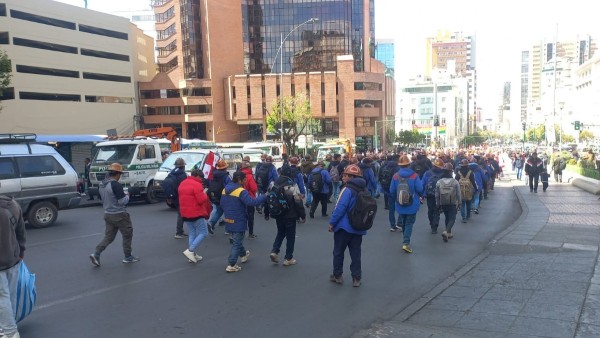
MARCHA DE MINEROS COLAPSÓ EL CENTRO PACEÑO. FOTO: RRSS
Experts warn
The massive march of the miners affiliated with the National Federation of Mining Cooperatives of Bolivia (Fencomin) should not be an excuse to negotiate the natural heritage or to ask for the green light in illegal mining exploitation, maintain the director of the Bolivian Documentation and Information Center (Cedib), Óscar Campanini, and the representative of Productivity Biosphere Environment (Probioma), Sofía Balcázar.
Hundreds of cooperative members arrived yesterday from the nine departments of the country to the Government headquarters to present their 10-point petition to the Government.
In Balcázar’s opinion, the miners’ march seeks to put pressure on the President of the State, Luis Arce Catacora, to respond to their request, which is structured according to the interest of their sector, as production actors; however, the expert reminded the Government that it should not govern only for the sector that supports it politically.
“We believe that regardless of the pressures that may exist or from the productive actors, there are certain things that should not be negotiated, such as the issue of fundamental human rights or natural heritage or the management of Mother Earth,” said the representative of Probioma.
The petition list consists of 10 points: respect for the institutional unity of Fencomin and its federations; guarantee the operational stability of mineral, metal and non-metal exploitation activities; security for the commercialization of minerals, metals and non-metals; legal certainty and red tape of procedures; environmental policy for the country’s cooperatives; development policies and issues of immediate attention.
The vice president of Fencomin, Zenón Guarachi, affirmed that the issue of debureaucratization of procedures is making the request for work areas viable, which is not being attended to by the Mining Administrative Jurisdictional Authority (AJAM).
For his part, the director of Cedib added that the miners’ request to “guarantee operational stability for the exploitation of minerals” is like giving them the green light for illegal exploitation, because many cooperative members do not comply with the regulations. He specified that they cannot use as an “excuse”, that it is the only activity they have, to threaten the lives of Bolivians and the environment.
According to data from the Vice Ministry of Mining Cooperatives, in Bolivia, as of May 2023, there were nearly 30,000 mining cooperatives registered in general in the country, of which nearly 1,800 are dedicated exclusively to gold extraction. Of this last quantity, at least 85% are constituted in the north of La Paz.
Balcázar indicated that the State should place above economic interest, the collective interest of the populations that live in the Amazon, where high levels of water contamination is taking place, an element that is consumed by the indigenous people. She specified that if the law were to be applied, one of the consequences would be to “sweep away” all illegal mining activities. (ANF)
Expertos advierten
La masiva marcha de los mineros afiliados a la Federación Nacional de Cooperativas Mineras de Bolivia (Fencomin) no debe ser una excusa para negociar el patrimonio natural ni para pedir luz verde en la explotación minera ilegal, sostienen el director del Centro de Documentación e Información Bolivia (Cedib), Óscar Campanini, y la representante de Productividad Biosfera Medio Ambiente (Probioma), Sofía Balcázar.
Cientos de cooperativistas arribaron ayer de los nueve departamentos del país a la sede de Gobierno para presentar al Gobierno su pliego petitorio de 10 puntos.
En criterio de Balcázar, la marcha de los mineros busca presionar al presidente del Estado, Luis Arce Catacora, para que responda a su pliego petitorio que está estructurado en función al interés de su sector, como actores de producción; sin embargo, la experta recordó al Gobierno que no debe gobernar solo para el sector que lo apoya políticamente.
“Consideramos que al margen de las presiones que puedan existir o de los actores productivos, hay ciertas cosas que no se deben negociar como el tema de los derechos humanos fundamentales ni el patrimonio natural o el manejo de la madre tierra”, indicó la representante de Probioma.
El pliego petitorio consta de 10 puntos: respeto a la unidad institucional de Fencomin y sus federaciones; garantizar la estabilidad operativa de las actividades de explotación de minerales, metales y no metales; seguridad para la comercialización de minerales, metales y no metales; seguridad jurídica y desburocratización de trámites; política ambiental para las cooperativas del país; políticas de fomento y temas de atención inmediata.
El vicepresidente de la Fencomin, Zenón Guarachi, afirmó que en el tema de desburocratización de trámites se encuentra viabilizar la solicitud de áreas de trabajo, que no está siendo atendida por la Autoridad Jurisdiccional Administrativa Minera (AJAM).
Por su parte, el director del Cedib añadió que el pedido de los mineros de «garantizar la estabilidad operativa para la explotación de minerales», es como darles luz verde para la explotación ilegal, porque muchos cooperativistas no cumplen la normativa. Precisó que no pueden usar como “excusa”, de que es la única actividad que tienen, para atentar contra la vida de los bolivianos y el medio ambiente.
De acuerdo con datos del Viceministerio de Cooperativas Mineras, en Bolivia, hasta mayo de 2023 se registraron cerca de 30.000 cooperativas mineras en general en el país, de las cuales, cerca de 1.800 se dedican exclusivamente a la extracción del oro. De esta última cantidad, al menos el 85% se constituyen en el norte de La Paz.
Balcázar indicó que el Estado debería poner por encima del interés económico, el interés colectivo de las poblaciones que viven en la Amazonía, donde se está produciendo altos índices de contaminación del agua, elemento que es consumido por los indígenas. Precisó que si se aplicaría la ley, una de las consecuencias sería “barrer” con todas las actividades mineras ilegales. (ANF)
https://www.eldiario.net/portal/2023/08/22/mineros-buscan-luz-verde-para-la-mineria-ilegal/

 Bolivian Thoughts | Pensamientos Bolivianos (Bilingual/Bilingüe)