By Germaine Barriga, Vision 360:
Analyst: New Hydrocarbons and Investment Laws Will Deliver Results in Five Years; Meanwhile, Bolivia Will Need to Import Fuel, LPG, and Natural Gas
The conditions for importing those energy products are foreign currency and real prices, expert Raúl Velásquez warned.
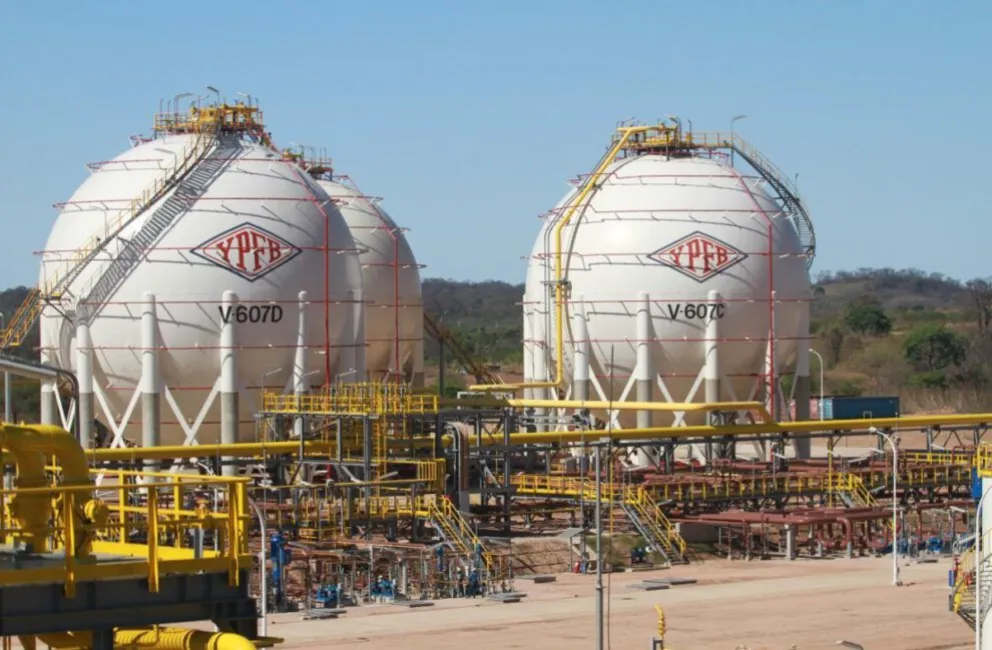
Yacimientos Petrolíferos Fiscales Bolivianos (YPFB). Photo YPFB
The approval of hydrocarbons and investment laws will yield results five years from now; meanwhile, Bolivia will have to continue importing gasoline, diesel, perhaps Liquefied Petroleum Gas (LPG), and even natural gas, warned today Raúl Velásquez, hydrocarbons expert at the Jubileo Foundation.
This opinion was expressed at a time when the national government is speaking of an energy crisis due to the decline in gas reserves during previous administrations, although it has assured that measures will be taken to avoid such a situation.
Meanwhile, several analysts warn that Bolivia is going through a pre-energy-crisis stage that is affecting fuel supplies and the country’s economic stability, caused by a shortage of dollars that makes it difficult to import diesel and gasoline.
Regarding the issue, Velásquez warned that the energy crisis that could occur in the country will be deeper and longer-lasting. He explained that the approval of a new Hydrocarbons Law could solve the structural problem, which is the decline in natural gas production, but that this will take time, he told Radio Compañera.
“If Bolivia manages to develop a good Hydrocarbons Law and we achieve something that is not contained in the law, which is legal certainty, because legal certainty goes far beyond a law, investment will come to Bolivia and will produce results, once approved, five years from now and beyond,” he stated.
In the meantime, the country will have to continue importing fuel and probably LPG and even natural gas, he said.
“Unfortunately, Bolivia will have to continue importing gasoline, diesel, perhaps LPG, and also natural gas, and to import these energy products you need two conditions: the first is dollars; it does not matter whether YPFB does it or a private company does it, either one requires dollars in the economy in order to import those energy products,” he warned regarding the shortage of foreign currency.
As a second requirement, he maintained that real prices are needed to import fuels, meaning that subsidies will have to be set aside. “Nobody is going to import gasoline or diesel at US$1.50 and sell it in Bolivia at US$1; nobody imports at a loss, they simply do not do it, so prices must be liberalized,” he explained.
For that reason, he stated that it would be better for Bolivia to stop subsidizing gasoline and diesel and instead try to maintain a certain subsidy on LPG, because LPG reaches middle- and low-income populations that have no other alternative.
Velásquez considered that the country has reached this extreme situation because many things were done incorrectly in recent years, referring to the decisions made by governments of the Movement Toward Socialism (MAS), which governed the country for the last 20 years.
He said that one of the mistakes made throughout this period was failing to guarantee legal certainty for foreign investment; therefore, he recommended that it now be guaranteed in order to avoid the crisis that is approaching.
“A great deal has been done wrong and (…) that is why I was speaking about legal certainty. It is not only the responsibility of the government currently in office, but the government that ruled the country for 20 years had enormous responsibility—the MAS governments—for what we are experiencing today,” he stated.
He explained that, in the hydrocarbons sector, unlike what happens in other sectors such as tourism and industry, there must be shared responsibility between the government and the population in guaranteeing legal certainty in hydrocarbons policy, something that did not occur in the country.
“We must remember the social movements of 2003, which nearly burned half the country down, with the ‘Gas War’; then came the 2004 referendum, where nationalization was demanded, more state control was demanded, a state monopoly was demanded, greater revenues were demanded, and we forgot about the long term,” he lamented.
The so-called “Gas War,” which took place in 2003, led to the resignation of then-President Gonzalo Sánchez de Lozada, and the office was assumed by then-Vice President Carlos Mesa, who called a referendum to determine the future of the gas sector.
Velásquez said that the natural resource has been used for everything. “Gas has been viewed as a generator of revenue, revenue that we also squandered and wasted; we did not even use it to invest and think about the long term,” he said.
He stated that the country is now paying the consequences of those actions and that, because “we thought gas was eternal,” it was used indiscriminately.
“Gas for industry, gas for vehicles, gas for homes, gas for electricity; during peak periods, such as in February, as much as 82% of electricity is generated by thermoelectric plants that operate with natural gas—and subsidized natural gas at that,” he questioned.
He considered that the current situation facing the country is dramatic because, in electricity generation, this winter 70% is produced by thermoelectric plants that use subsidized natural gas, while less and less gas is being produced.
“We estimate that in 2028 or 2029 Bolivia will have to begin importing natural gas, at least part of the natural gas it consumes. It is just around the corner; we are talking about two or three years from now, when it will also be necessary to start importing natural gas,” he stated.
And that, he said, comes down to the same problem: foreign currency and real prices, and in the case of natural gas, determining where it will be imported from.
Por Germaine Barriga, Vision 360:
Analista: Nuevas leyes de hidrocarburos e inversiones darán resultados en 5 años; mientras, se deberá importar combustible, GLP y gas natural
Las condiciones para la importación de esos energéticos son divisas y precios reales, advirtió el experto Raúl Velásquez.
Yacimientos Petrolíferos Fiscales Bolivianos (YPFB). Foto YPFB
La aprobación de las leyes de hidrocarburos e inversiones darán resultados de acá a cinco años, mientras tanto, Bolivia va a tener que seguir importando gasolina, diésel, quizá Gas Licuado de Petróleo (GLP) e inclusive gas natural, advirtió hoy el experto en hidrocarburos de la Fundación Jubileo, Raúl Velásquez.
Ese criterio fue expresado en una coyuntura en la que se habla de una crisis energética, por parte del Gobierno nacional, debido a la caída de las reservas de gas en pasadas gestiones, aunque aseguró que se tomarían acciones para evitar esa situación.
Mientras que varios analistas advierten que Bolivia atraviesa una precrisis energética, que afecta el abastecimiento de combustibles y la estabilidad económica del país, provocada por la escasez de dólares que dificulta la importación de diésel y gasolina.
Velásquez, respecto al tema, advirtió que la crisis energética que se podría registrar en el país será más profunda y larga. Explicó que la aprobación de una nueva Ley de Hidrocarburos podría resolver el problema estructural, que es la caída de la producción de gas natural, pero eso tomará tiempo, a Radio Compañera.
“Si Bolivia logra trabajar una buena Ley de Hidrocarburos y logramos algo que no está en la ley, que es la seguridad jurídica, porque la seguridad jurídica va mucho más allá que una ley, habrá inversión que venga a Bolivia y dará resultados, una vez que se apruebe, de acá a cinco años hacia adelante”, manifestó.
Entretanto, el país deberá continuar con la importación de combustible y probablemente de GLP y hasta gas natural, dijo.
“Lamentablemente, Bolivia va a tener que seguir importando gasolina, diésel, quizás GLP y también gas natural y, para importar estos energéticos requieres dos condiciones: la primera, dólares; no importa si lo hace YPFB o lo hace un privado, cualquiera de los dos requiere dólares en la economía para poder importar esos energéticos”, advirtió respecto a la escasez de la moneda extranjera.
Como segundo elemento, sostuvo que se requieren precios reales para poder importar los combustibles, es decir, que deberá dejarse de lado la subvención. “Nadie va a importar gasolina o diésel a $us 1.50 para venderlo en Bolivia a $us 1; nadie importa a pérdida, no lo hace simplemente, entonces hay que liberar precios”, precisó.
Por ello, afirmó que es mejor que Bolivia deje de subvencionar la gasolina y el diésel y trate de mantener cierta subvención en el GLP, porque el GLP llega a la población de ingresos medios y bajos, que no tienen otra alternativa.
Velásquez consideró que el país llegó a esta extrema situación debido a que, en el último tiempo, se hicieron mal muchas cosas, en relación a las decisiones asumidas por los gobiernos del Movimiento al Socialismo (MAS), que gobernaron el país los últimos 20 años.
Dijo que uno de los errores que se cometieron en todo este tiempo es no garantizar la seguridad jurídica a las inversiones extranjeras; por ello, recomendó que ahora se debe garantizarla para evitar esta crisis que se avecina.
“Hay mucho que se ha hecho mal y, (…) por eso hablaba de la seguridad jurídica, no es responsabilidad solamente de un gobierno de turno, como el que gobernó el país por 20 años, que tuvo una enorme responsabilidad, los gobiernos del MAS sobre lo que estamos viviendo”, sostuvo.
Explicó que, en el área de hidrocarburos, a diferencia de lo que pasa en otros sectores, como el turismo y la industria, debe haber una corresponsabilidad del Gobierno con la población en garantizar la seguridad jurídica en la política hidrocarburífera, lo que no sucedió en el país.
“Hay que recordar los movimientos sociales de 2003, que casi queman la mitad del país, no es cierto, con la ‘guerra del gas’; luego vino el referéndum del 2004, se pedía una nacionalización, se pedía más Estado, monopolio estatal, se pedía más renta y nos olvidamos del largo plazo”, lamentó.
La llamada “guerra del gas”, registrada en 2003, provocó la renuncia del entonces presidente de Bolivia, Gonzalo Sánchez de Lozada, y el cargo fue asumido por el entonces vicepresidente, Carlos Mesa, quien convocó a un referéndum para definir el destino del gas.
Velásquez dijo que el recurso natural se ha usado para todo, “se ha visto en el gas un generador de renta, de renta que además la hemos malgastado, la hemos despilfarrado, ni siquiera la hemos utilizado para invertir y pensar en el largo plazo”, precisó.
Afirmó que ahora estamos pagando las consecuencias de esas acciones y, como además “pensábamos que el gas era eterno”, se hizo un uso indiscriminado de ese recurso.
“Gas para la industria, gas vehicular, gas domiciliario, gas para electricidad, en horas pico, como en febrero, hasta el 82% de la electricidad se genera con termoeléctricas que funcionan con gas natural y, un gas natural, subvencionado, además”, cuestionó.
Consideró que la situación actual que enfrenta el país es dramática, porque la parte de la electricidad, en este invierno, el 70% se genera con termoeléctricas que utilizan gas natural subvencionado, pero cada vez se produce menos gas.
“Estimamos que el 2028, el 2029, Bolivia va a tener que empezar a importar gas natural, una parte del gas natural que se consume. Estamos a la vuelta de la esquina, estamos hablando de acá a dos, tres años en los que hay que empezar a importar también gas natural”, afirmó.
Y eso, dijo, pasa por el mismo problema: divisas y precios reales, y en el caso del gas natural, de dónde se va a importar.


Leave a Reply