
By Germaine Barriga, Vision 360:
Analyst Warns Economic Recovery Will Be Very Difficult Without Punishment for Those Who Promoted Road Blockades
As long as there is no certainty that this will not happen again, it will be very difficult to convince people to invest in La Paz and establish businesses in Bolivia, at least in the La Paz region. For this reason, analyst Ramiro Cavero warned that the situation is highly complex.
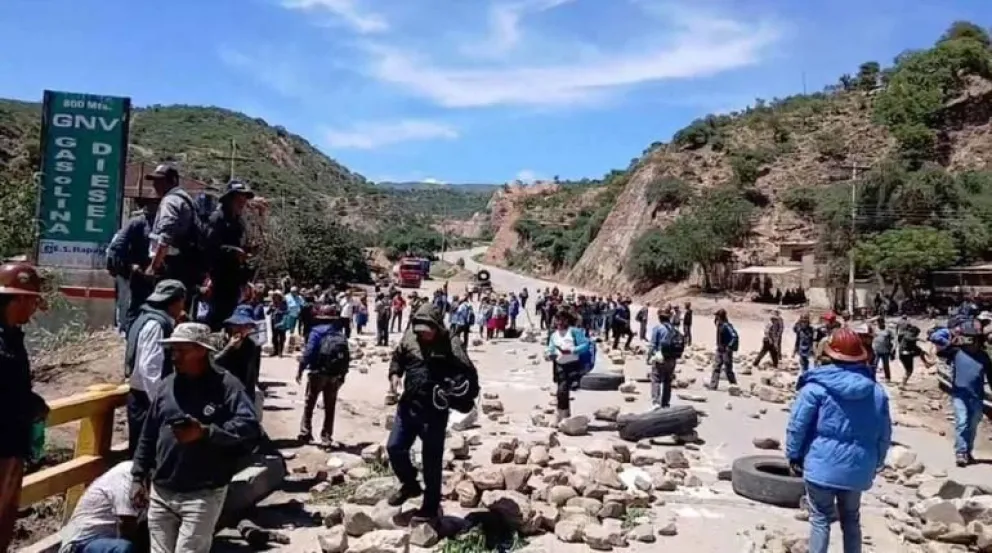
The blockades caused major losses for the department of La Paz. Photo: APG
Economic recovery after more than 50 days of blockades is unlikely unless those responsible for the damage are sanctioned for closing highways and preventing the normal development of activities throughout the country, according to economic analyst Ramiro Cavero.
He noted that if there are no penalties, there is a risk that new blockades could occur in the near future for any reason—or no reason at all—lasting 20 or 50 days and once again affecting La Paz, which suffered the most from this protest measure.
Cavero, a former advisor to the Free Alliance, warned that the city of La Paz suffered incalculable losses. One of them, he said, is the decline in property values, which has likely occurred because, after the blockades, many people want to move elsewhere.
“One loss that has not been mentioned because it is impossible to quantify is the value of property. In La Paz it has surely fallen because many people want to leave, many are putting their homes up for sale, and nobody wants to move to La Paz,” he warned.
As an example, he said that if real estate was worth X before the blockades, it is worth less today. The extent of the decline remains to be calculated, but the value has clearly dropped, he told Radio Compañera.
The seat of government was the area most affected by the 52-day blockade, which was initially called by the Bolivian Workers’ Central (COB) to demand responses to its list of demands and later to demand the resignation of President Rodrigo Paz.
During that period, the city was effectively surrounded by road closures carried out by the La Paz Departmental Peasants Federation Túpac Katari. The action caused shortages of basic goods, oxygen, and fuel, as well as industrial supplies, forcing many companies to suspend operations.
Other consequences included economic losses in productive sectors, the loss of markets, and the failure to fulfill contracts. According to the National Chamber of Industries, more than 70% of the 13,000 industries in the department of La Paz either halted operations or reduced production capacity.
The chamber also reported that more than 1.6 million people were affected, and over one-third of them are now in a survival situation due to declining purchasing power and the shutdown of economic activities in the department.
According to Cavero, until there is certainty that such events will not happen again, it will be extremely difficult to persuade people to invest in La Paz or establish businesses in Bolivia, particularly in the La Paz region. He therefore described the situation as highly complex.
He said that uncertainty about when new blockades might once again isolate La Paz—and the fact that the crisis ended only because the protesters became exhausted rather than because a solution was found—provides little confidence for potential investors.
He warned that unless blockades are prohibited and clearly punished as “an irrational form of protest,” there will be neither investment nor economic recovery, since many businesses have already lost suppliers and markets.
“If someone sold a product, they were unable to deliver it and their customer will say, ‘I’d rather buy from someone else.’ If someone exported goods, they lost buyers because they are no longer considered reliable. They asked customers to wait a week, but they ended up waiting 50 days and the products never arrived,” he explained.
Cavero also referred to the agreement signed between the government and the COB, arguing that it is open to many interpretations. For example, one clause states that no strategic company will be privatized, but it does not define which companies are considered strategic. According to him, the COB might consider even a potato-chip company strategic, reflecting the view previously held by the Arce administration, while the government may have a different interpretation.
As a result of the agreement and the differing interpretations that the COB and the government may give it, he warned that international investment is unlikely to arrive, making it difficult for the country to emerge quickly from the current crisis.
He also pointed out that the agreement says nothing about whether blockades will be allowed in the future. Therefore, he warned that anyone could decide to resort to such measures again and “we are ruined.”
For Cavero, the principle of authority was lost during these 50 days because “the government simply allowed the blockades to continue. Its concern was protecting Plaza Murillo, the airports, and a few other places, but that is no way for a country to function.”
He added that he had spoken with tourism operators who told him that not only were contracts canceled for this year, but also for 2027. Some clients reportedly said they would wait to see how Bolivia evolves before considering doing business again in 2028.
Por Germaine Barriga Velarde, Vision 360:
Analista advierte que la reactivación económica será muy difícil si no hay sanción a promotores de bloqueos
Mientras no se tenga certeza de que esto no va a volver a ocurrir, será muy difícil convencer a la gente de que venga a invertir en La Paz y que ponga una empresa en Bolivia, por lo menos en la zona de La Paz. Por ello, advirtió que la situación es muy compleja el analista Ramiro Cavero.
Los bloqueos provocaron grandes pérdidas al departamento de La Paz. Foto: APG
La reactivación de la economía, después de los más de 50 días de bloqueo, es poco probable si no se sanciona a los que provocaron el daño, cerrando carreteras e impidiendo el normal desarrollo de las actividades en el país, según el analista económico Ramiro Cavero.
Observó que, si no hay una sanción, existe el riesgo de que en poco tiempo se vuelva a bloquear por algún otro motivo, con razón o sin razón, por 20 días, 50 días, y eso afectará sobre todo a La Paz, que fue la más afectada con esta medida de protesta.
Cavero, exasesor de la Alianza Libre, advirtió que la ciudad de La Paz sufrió pérdidas incalculables; una de ellas es la pérdida de valor de la propiedad, que seguramente ha caído, porque después de los bloqueos la gente quiere irse a otro lugar.
“Algo que no se ha mencionado dentro de las pérdidas, porque es incalculable, es el valor de la propiedad. En La Paz seguramente ha caído, porque mucha gente quiere irse y mucha gente está poniendo su casa en venta y nadie quiere venirse a La Paz”, advirtió.
Como ejemplo, sostuvo que, si los bienes inmuebles valían X antes de esto, hoy día valen menos; cuánto menos habrá que calcularlo, pero claramente valen menos, dijo a Radio Compañera.
La sede de Gobierno resultó la más afectada por los 52 días de bloqueo, que fue instruido por la Central Obrera Boliviana (COB), en principio en demanda de respuestas a su pliego petitorio y posteriormente exigiendo la renuncia del presidente, Rodrigo Paz.
En esos días, la ciudad quedó cercada por el cierre de vías, ejecutado por la Federación Departamental de Campesinos de La Paz Túpac Katari, lo que provocó el desabastecimiento de productos básicos, oxígeno y combustible, además de insumos para empresas que se vieron obligadas a suspender sus actividades.
Otra de las consecuencias fueron las pérdidas económicas en los sectores productivos, la pérdida de mercados y el incumplimiento de contratos. Según la Cámara Nacional de Industrias, solamente en el departamento de La Paz, más del 70% de las 13 mil industrias existentes han paralizado o reducido su capacidad productiva.
Otro dato revelador de esa institución sostiene que más de 1,6 millones de personas han sido afectadas y, de esa cantidad, más de un tercio está en una situación de sobrevivencia, ante la caída del poder adquisitivo del salario y la cesación de actividades en el departamento.
Para Cavero, mientras no se tenga certeza de que esto no va a volver a ocurrir, será muy difícil convencer a la gente de que venga a invertir en La Paz, de que ponga una empresa en Bolivia, por lo menos en la zona de La Paz. Por ello, advirtió que la situación es muy compleja.
Dijo que la duda sobre cuándo volverán los bloqueos a cercar La Paz y las soluciones que se dieron —en este caso, el cansancio de los bloqueadores, sin que se haya dado una solución a este problema— no da certidumbre a los posibles inversores.
Advirtió que, si no se prohíben y no se sancionan claramente los bloqueos “como una forma no racional de protesta”, no va a haber inversión ni reactivación, porque mucha gente ha perdido proveedores y mercados.
Si alguien vendía algo, no ha podido enviar el producto y va a decir “prefiero venderle a otro”. Si alguien exportaba, ha perdido gente que le compraba, porque ya no es creíble; pidió que se le espere una semana, pero se le esperó 50 días y no pudo mandar los productos comprometidos, manifestó.
También se refirió al acuerdo suscrito entre el Gobierno y la COB; sostuvo que está sujeto a muchas interpretaciones. Como ejemplo, mencionó que uno de los puntos dice que no se privatizará ninguna empresa estratégica, pero no dice cuáles son las empresas estratégicas. Probablemente para la COB hasta la empresa de papas fritas sea estratégica, porque esa era la idea que tenía el Gobierno de Arce; probablemente para el Gobierno estratégicas son otras.
A raíz de ese acuerdo y de las interpretaciones que puedan darle la COB y el Gobierno, advirtió que es probable que no lleguen inversiones internacionales y, debido a ello, el país no podrá salir de esta crisis rápidamente.
También observó que en el acuerdo no se dice nada sobre si van a estar permitidos los bloqueos; por lo tanto, advirtió que a cualquiera se le ocurrirá asumir esa medida y “estamos arruinados”.
Para Cavero, se perdió el principio de autoridad en estos 50 días, porque “lo que ha hecho el Gobierno es dejar que se bloquee; lo que me interesa aquí es la Plaza Murillo, la protejo, los aeropuertos y algunas cosas, y así no puede funcionar”.
Dijo que conversó con operadores de turismo y le dijeron que no solo les cancelaron contratos este año, sino también para 2027; les dijeron que iban a ver cómo estaba Bolivia para ver si volvían a trabajar con ellos en 2028.


Leave a Reply