By Gabriel Romano, EFE; Vision 360:
Experts agree that the Government must improve its management, revive the economy, and rebuild ties with social sectors in order to prevent a new escalation of conflict.
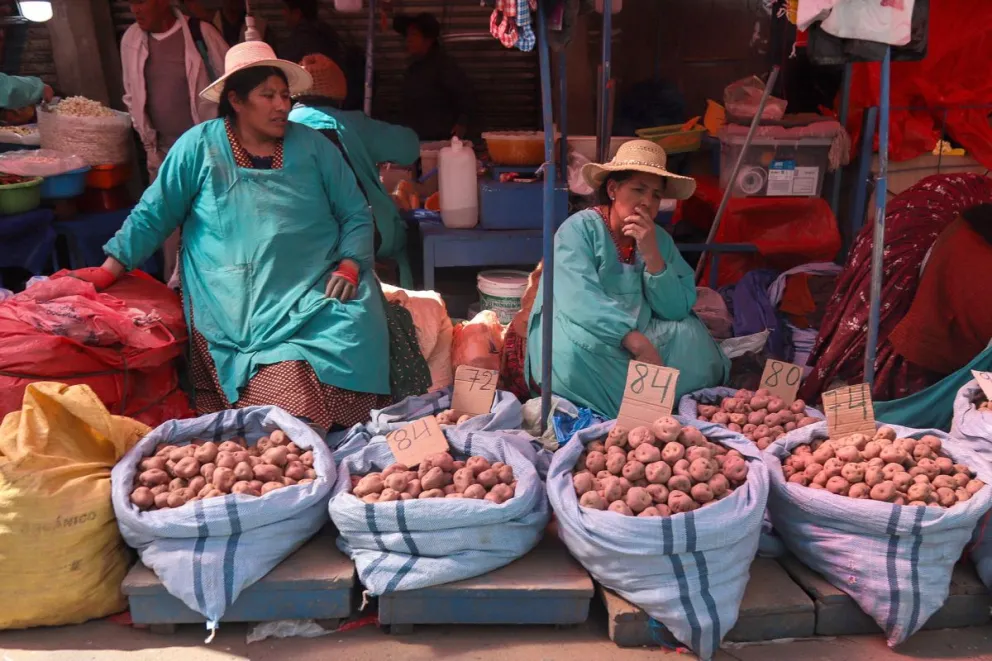
People offering their products at a market in La Paz, Bolivia. Photo: EFE
With road blockades now lifted after 50 days of protests, the government of Bolivian President Rodrigo Paz faces the challenge of restoring economic activity and repairing its relationship with the social sectors that drove the mobilizations, in a context where the underlying causes of the conflict remain unresolved.
The road blockades, which began on May 6 and were organized by labor unions and peasant groups demanding Paz’s resignation, ended this week after disrupting supplies of food, fuel, and medical oxygen in several cities, while also halting transportation and part of the country’s economic activity.
Experts consulted by EFE agreed that the Government must improve its governance, revive the economy, and rebuild its ties with social sectors to avoid another escalation of unrest following a crisis that left at least 16 people dead—13 of them due to a lack of timely medical care caused by the blockades—and resulted in losses exceeding $3 billion.
“Everyone Has Lost”
President Paz stated on Tuesday that the blockade “has been defeated and cannot return,” adding that the state of emergency will remain in place because Bolivia “must be brought back into order” to prevent a recurrence of the situation. He also said that the country must now “build and develop a nation where all Bolivians feel they have the opportunity to prosper.”
Political scientist Franklin Pareja told EFE that, to avoid a similar scenario, the Government must begin showing “signs of macroeconomic recovery,” combat corruption, and implement “deep equity programs” in rural areas. Otherwise, he warned, new expressions of social discontent could emerge with greater public support.
According to analyst Ricardo Paz, there are “no winners” in this conflict; rather, “everyone has lost,” from the Government—which he said made “several mistakes”—to the unions and groups linked to former President Evo Morales(2006–2019), which, in his view, emerged “badly weakened, diminished, and discredited.”
In that regard, he argued that the administration must make a “shift” in its political leadership, “significantly improve public management and implement the necessary reforms more efficiently,” while also drastically transforming its communication strategy.
The protests began in the department of La Paz, home to Bolivia’s executive and legislative branches, but later spread to nearly all of the country’s departments. At their peak, roadblocks approached one hundred locations, mainly concentrated in the Andean region and central Bolivia.
Protest leaders argued that Paz, who has been in office for seven months, excluded them from decision-making despite their support for his candidacy in the 2025 general election. They also accused him of seeking to privatize state-owned companies and increase the cost of basic services—claims the Government denied.
Initially, the demonstrations coincided with demands from other sectors, including teachers, Amazonian Indigenous groups, transport workers, and mining cooperatives, many of which gradually ended their protests after reaching agreements with the Government.
On May 11, groups aligned with Morales joined the mobilizations through a march that began in the Bolivian highlands and arrived in La Paz a week later. In response, the Government accused the former president of financing the protests with proceeds from drug trafficking, an allegation Morales denied.
Preventing New Conflicts
After seven weeks of unrest and following agreements with sectors such as the Bolivian Workers’ Central (COB), Paz declared a state of emergency on Saturday, allowing police and military forces to jointly clear the roads. The measure remained in effect until Tuesday and was carried out with virtually no incidents, as most conflict zones no longer had demonstrators present.
Pareja argued that if the Government succeeds in advancing economic recovery and implementing equity policies, “the mobilization capacity of radical groups will decline.” However, he warned that if the root causes of the conflict are not addressed, “new expressions of popular discontent could re-emerge with greater social support.”
“We cannot say there are winners when the social, political, and economic costs have been so high (…) the conflict may be coming to an end, but the underlying problem remains,” Pareja added.
Por Gabriel Romano Burgoa, EFE; Vision 360:
Expertos coinciden en que el Gobierno debe mejorar su gestión, recuperar la economía y reconstruir los vínculos con los sectores sociales para evitar una nueva escalada de la conflictividad.
Personas ofreciendo sus productos en un mercado en La Paz (Bolivia). Foto: EFE
Con los bloqueos de carreteras ya levantados tras 50 días de protestas, el Gobierno del presidente de Bolivia, Rodrigo Paz, encara el reto de recuperar la actividad económica y recomponer su relación con los sectores sociales que impulsaron las movilizaciones, en un contexto en el que persisten las causas que dieron origen al conflicto.
Los bloqueos de carreteras, iniciados el 6 de mayo por organizaciones sindicales y campesinas que exigían la renuncia de Paz, concluyeron esta semana después de afectar el abastecimiento de alimentos, combustibles y oxígeno medicinal en varias ciudades, además de paralizar la movilidad y parte de la actividad económica en gran parte del país.
Los expertos consultados por EFE coincidieron en que el Gobierno debe mejorar su gestión, recuperar la economía y reconstruir los vínculos con los sectores sociales para evitar una nueva escalada de la conflictividad, después de una crisis que dejó al menos 16 muertos, 13 de ellos por falta de atención médica oportuna por los bloqueos, y pérdidas superiores a los 3.000 millones de dólares.
“Todos han perdido”
El presidente Paz señaló este martes que el bloqueo “ha sido derrotado, no puede retornar” y que el estado de excepción continuará porque Bolivia “se tiene que ordenar” para no repetir esta situación. También sostuvo que ahora se debe “construir y desarrollar un país donde todos los bolivianos se sientan con la oportunidad de crecer”.
El politólogo Franklin Pareja dijo a EFE que, para evitar un escenario similar, el Gobierno debe comenzar a mostrar “señales de recuperación macroeconómica”, combatir la corrupción y desarrollar “programas profundos de equidad” en las zonas rurales. De lo contrario, advirtió, podrían surgir nuevas expresiones de descontento social con un mayor respaldo ciudadano.
Para el analista Ricardo Paz, en este conflicto “no hay ganadores”, sino que “todos (los actores) han perdido”, desde el Gobierno, al que atribuyó “varios errores”, hasta los sindicatos y los grupos vinculados al expresidente Evo Morales (2006-2019), que, a su juicio, quedaron “muy golpeados, disminuidos y deslegitimados”.
En ese sentido, consideró que el Ejecutivo debe dar un “giro” a su conducción política, “mejorar significativamente la gestión pública y ejecutar con mayor eficiencia las reformas necesarias”, además de transformar de “manera drástica” su política de comunicación.
Las protestas comenzaron en la región de La Paz, sede de los poderes Ejecutivo y Legislativo, aunque posteriormente se extendieron a casi todos los departamentos del país y los puntos de bloqueo llegaron al centenar, concentrados principalmente en la zona andina y el centro de Bolivia.
Los sectores movilizados argumentaron que Paz, que lleva siete meses en el poder, los marginó de la toma de decisiones pese a haber respaldado su candidatura en las elecciones generales de 2025. También lo acusaron de pretender privatizar empresas estatales y encarecer los servicios básicos, señalamientos que el Gobierno rechazó.
Inicialmente, las protestas coincidieron con reclamos de otros sectores, entre ellos maestros, indígenas amazónicos, transportistas y mineros cooperativistas, que levantaron progresivamente sus medidas de presión tras alcanzar acuerdos con el Ejecutivo.
El 11 de mayo, grupos afines a Morales se sumaron a las movilizaciones con una marcha iniciada en el altiplano boliviano que llegó una semana después a La Paz. A raíz de ello, el Gobierno acusó al exmandatario de financiar las manifestaciones con recursos procedentes del narcotráfico, acusación que el exgobernante negó.
Evitar nuevos conflictos
Tras siete semanas de conflicto y luego de alcanzar acuerdos con sectores como la Central Obrera Boliviana (COB), Paz decretó el sábado el estado de excepción para permitir la intervención conjunta de policías y militares con el fin de despejar las carreteras. La medida se ejecutó hasta el martes y prácticamente sin incidentes, ya que en la mayoría de los puntos conflictivos ya no había manifestantes.
Pareja consideró que, si el Gobierno logra avanzar en la recuperación económica y en políticas de equidad, “la capacidad de movilización de los grupos radicales disminuirá”. Sin embargo, advirtió que, si no se atienden las causas de fondo del conflicto, “es posible que resurjan nuevas expresiones de descontento popular con mayor respaldo social”.
“No podemos afirmar que existan ganadores cuando el costo social, político y económico ha sido tan elevado (…) el conflicto puede estar terminando, pero el problema de fondo persiste”, agregó Pareja.


Leave a comment