By Baldwin Montero, Vision 360:
Tension Focuses on the Chapare: Government Points to a Narcoterrorist Movement and Coca Growers Announce Civil Disobedience
“The Tropics region will organize itself, we will defend ourselves, we have no other choice. If the government truly wants to subdue us, it will have to kill the more than 250,000 members we have in the Tropics,” warned coca-grower leader Gastón Ledezma.
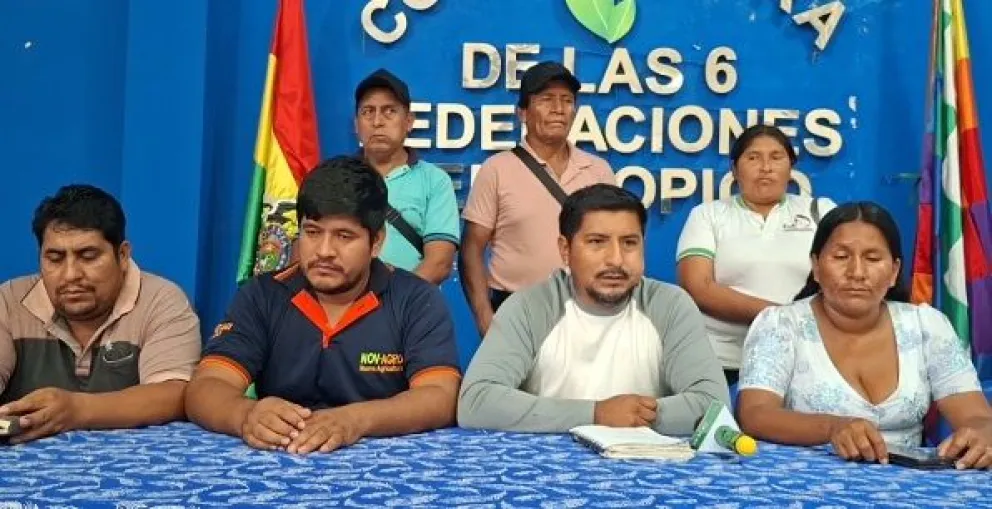
Leaders of the Six Federations of Coca Growers of the Cochabamba Tropics during a press conference on Monday, June 8, 2026.
In the sixth week of social protests involving road blockades in six of Bolivia’s nine departments, social tensions have become concentrated in the Cochabamba Tropics (Chapare), the stronghold of former president Evo Morales, whom the Government has identified as the leader of a narcoterrorist movement seeking to overthrow the president elected at the ballot box just over six months ago.
Although the protests extend to other regions, the center of tension today was that area, considered a red zone for drug trafficking.
In the morning, while enacting the Law on States of Exception, President Rodrigo Paz Pereira warned that the “violent groups” and the “narcoterrorists” have “their days numbered,” after stating that some of them operate from the Cochabamba Tropics.
The response came in the afternoon from the Six Federations of Coca Growers of the Cochabamba Tropics during an emergency assembly. There, coca-grower leaders announced that they would not engage in dialogue with a government that threatens them, reiterated their demand for the president’s resignation, and stated that they would defend themselves and declare “civil disobedience” in the event of a state of exception.
“The Tropics region will organize itself, we will defend ourselves, we have no other choice. If the government truly wants to subdue us, it will have to kill the more than 250,000 members we have in the Cochabamba Tropics (…) We are determined to ensure that in the Tropics region we will not accept that state of exception; we will call for civil disobedience. How is it possible that we should respect a narco-government?” announced Gastón Ledezma, general secretary of the Carrasco Tropical Federation.
He asserted that the Cochabamba Tropics is a productive region and that the government is the one truly linked to drug trafficking, citing cases such as timber impregnated with drugs found at Chilean ports and the 32 suitcases that arrived from the United States. Nevertheless, that area contains the largest number of drug-production laboratories in Bolivia and has recorded a steady increase in coca cultivation (14,275 hectares in 2024), most of it destined for illicit markets.

At the same press conference, Víctor Mencia, general secretary of the Federation of the Cochabamba Tropics, stated that they are neither terrorists nor drug traffickers, as the Executive claims, and said that the Government would be solely responsible for anything that might happen to their members and to former president Morales, who was not present at the conference, although he remains the principal leader of the region’s coca growers.

“We warn and hold this government responsible if anything happens to the life of our brother Evo Morales,” he declared.
Last Friday, President Rodrigo Paz directly targeted Morales, accusing him of using illicit resources from Chapare drug trafficking (Cochabamba) to mobilize social sectors with the aim of breaking the constitutional order. This Monday, during his speech enacting the Law on States of Exception, he questioned why there were so many people from Chapare in the areas experiencing the greatest social conflict and said that he respects “all those clean sectors” of that region of the country, “but not those linked to narcoterrorism.”
“Has the department of La Paz now become an annex of Chapare?” he asked, referring to leaders from that region who traveled to the city of El Alto to join groups of blockaders demanding the president’s resignation.
“We must fight for our social, indigenous, labor, and peasant organizations. Our social organizations cannot be contaminated by politics, and even less by politics linked to narcoterrorism,” Paz Pereira stated.
Yesterday, Public Works Minister Mauricio Zamora accused Evo Morales of being “sick with power” and thinking only of himself without caring about the suffering of the poorest people, before concluding: “We are going to defeat drug trafficking, corruption, and those who seek to subject the country to their personal ambitions.”
Morales has been “self-exiled” in the Cochabamba Tropics for more than a year, protected by groups of supporters who take turns guarding him.

Por Baldwin Montero Plaza, Vision 360:
La tensión se focaliza en el Chapare: Gobierno señala movimiento narcoterrorista y cocaleros anuncian desobediencia civil
“La región del Trópico nos vamos a organizar, nos vamos a defender, no nos queda otra. Si el gobierno realmente quiere someternos tendrá que matar a los más de 250.000 afiliados”, advirtió el dirigente cocalero Gastón Ledezma.
Dirigentes de las seis Federaciones de Cocaleros del Trópico de Cochabamba en conferencia de prensa, este lunes 8 de junio de 2026
En la sexta semana de protestas sociales que mantienen bloqueos en seis de los nueve departamentos de Bolivia, la tensión social se focaliza en el Trópico de Cochabamba (Chapare), la trinchera del expresidente Evo Morales, a quien el Gobierno ha identificado como cabecilla de un movimiento narcoterrorista que pretende derrocar al presidente electo en urnas hace poco más de seis meses.
Si bien las protestas abarcan a otras regiones, el foco de la tensión se ubicó hoy en esa región, considerada zona roja del narcotráfico.
En la mañana, al promulgar la Ley de Estados de Excepción, el presidente Rodrigo Paz Pereira advirtió que los “violentos” y los “narcoterroristas” tienen “los días contados”, luego de señalar que algunos de ellos operan desde el Trópico de Cochabamba.
En la tarde llegó la respuesta desde las Seis Federaciones de Cocaleros del Trópico de Cochabamba, en un ampliado de emergencia. Allí, los dirigentes cocaleros anunciaron que no dialogarán con un gobierno que los amenaza, reiteraron su exigencia de renuncia del Jefe de Estado y anticiparon que se defenderán y declararán “desobediencia civil” ante un eventual estado de excepción.
“La región del Trópico nos vamos a organizar, nos vamos a defender, no nos queda otra. Si el gobierno realmente quiere someternos tendrá que matar a los más de 250.000 afiliados que estamos en el Trópico de Cochabamba (…) Estamos decididos a garantizar que en la región del Trópico no vamos a aceptar ese estado de excepción, vamos a llamar a la desobediencia civil. ¿Cómo es posible que a un gobierno narco podamos respetar?”, anunció Gastón Ledezma, secretario general de la Federación Carrasco Tropical.
Aseguró que el Trópico de Cochabamba es una región productiva y que el que verdaderamente está vinculado con el narcotráfico es el Gobierno, por casos como los de la madera impregnada con droga hallada en puertos chilenos y las 32 maletas que llegaron procedentes de Estados Unidos. No obstante, esa zona concentra la mayor cantidad de laboratorios de fabricación de droga en Bolivia y registró un constante crecimiento de cultivos de hoja de coca (14.275 hectáreas en 2024) la mayor parte destinados a mercados ilícitos.
En la misma conferencia de prensa, el secretario general de la Federación del Trópico de Cochabamba, Víctor Mencia, afirmó que ellos no son ni terroristas ni narcotraficantes, como afirma el Ejecutivo, y dijo que el Gobierno será el único responsable de lo que les pueda pasar a sus afiliados y al expresidente Morales, quien no estuvo en la conferencia, aunque es el principal líder de los cocaleros de la zona.
“Advertimos y responsabilizamos a este gobierno si pasa algo con la vida de nuestro hermano Evo Morales”, aseveró.
Ya el pasado viernes el presidente Rodrigo Paz fue directo contra Morales, a quien denunció por recurrir a recursos ilícitos, provenientes del narcotráfico del Chapare (Cochabamba), para usar a sectores sociales con el fin de romper el orden constitucional. Este lunes, en su discurso al promulgar la Ley de Estados de Excepción, preguntó por qué había tanto chapareño en las zonas de mayor conflicto social y dijo que respeta a “todos aquellos sectores limpios” de esa zona del país, “pero no a aquellos vinculados con el narcoterrorismo”.
“¿Es acaso ahora el departamento de La Paz un anexo del Chapare?”, preguntó, en referencia a los dirigentes de esa zona que llegaron hasta la ciudad de El Alto para formar parte de los grupos de bloqueadores que piden la renuncia del Presidente.
“Tenemos que luchar por las organizaciones sociales, indígenas, obreras, campesinas. Nuestras organizaciones sociales no pueden ser contaminadas por la política y menos por la política vinculada al narcoterrorismo”, aseveró Paz Pereira.
Ayer, el ministro de Obras Públicas, Mauricio Zamora, acusó a Evo Morales de estar “enfermo de poder” y de pensar sólo en él sin importarle el sufrimiento de los más humildes, para luego h rematar: “Vamos a vencer al narcotráfico, a la corrupción y a quienes pretenden someter al país a sus ambiciones personales”.
Morales se encuentra “autoexiliado” en el Trópico de Cochabamba desde hace más de un año, protegido por grupos de sus seguidores que hacen turnos para protegerlo.
 Bolivian Thoughts | Pensamientos Bolivianos (Bilingual/Bilingüe)
Leave a comment