By César del Castillo, El Deber:
Inflation
The largest increase was recorded in La Paz. The rebound breaks the trend observed since February 2026.
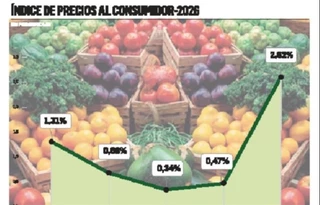
After three months of relative calm, inflation accelerated again in May, raising concerns about the Bolivian economy. The Consumer Price Index (CPI) posted a positive variation of 2.13%, the highest of 2026 and fifteen times higher than the 0.14% reported in April, according to data from the National Institute of Statistics (INE).
The figure pushed cumulative inflation to 2.62% during the first five months of the year and reflects the rising cost of basic goods that make up the household basket of millions of Bolivians.
Inflationary pressure once again centered on food. According to the INE, the products that contributed most to the increase in prices were boneless beef, tomatoes, chicken, bone-in beef, carrots, and bananas. These are staple goods consumed on a massive scale and have an immediate impact on household budgets.
The data are particularly significant because they come after three months of moderate performance. In February, inflation recorded a negative variation of 0.62%; in March, it fell by 0.34%; while in April it reached only 0.14%. The jump observed in May breaks that trend and places renewed pressure on household finances.
The largest price increase was recorded in the metropolitan area of La Paz, where the CPI rose 5.41% during the month. It was followed by Tarija with 2.20%, Oruro with 1.47%, and Potosí with 1.11%. The increase in La Paz far exceeded the national average and reflected more intensely the supply difficulties experienced during May.
In addition to food, price increases affected the sectors of health care, transportation, housing and basic services, communications, recreation, and culture, indicating that inflationary pressures have begun to spread to other areas of the economy.
The May performance coincided with a period marked by supply shortages and transportation difficulties for goods in different parts of the country. The largest increases were recorded precisely in widely consumed food products, explaining much of the acceleration seen in the CPI.
With inflation reaching 2.13% in May, price behavior has once again moved to the center of economic attention. Food prices led the increases and were the main factor behind the largest monthly rise recorded so far in 2026. The data come in a year in which the government projected inflation of 14% in the General State Budget (PGE), one of the highest forecasts in recent decades.
KEY DATA
An Inflationary Month
2.13% – Inflation recorded in May was fifteen times higher than the 0.14% reported by the INE in April.
The Most Affected Department
5.41% – The metropolitan region of La Paz recorded the largest CPI increase, far exceeding the national average.
Expensive Food
Beef, chicken, tomatoes, carrots, and bananas led the price increases that had the greatest impact on the CPI.
Por César del Castillo, El Deber:
Inflación
La mayor variación se registró en La Paz. El repunte rompe la tendencia observada desde febrero de 2026
Después de tres meses de relativa calma, la inflación volvió a acelerar en mayo y encendió una señal de alerta para la economía boliviana. El Índice de Precios al Consumidor (IPC) registró una variación positiva de 2,13%, la más alta de 2026 y quince veces superior al 0,14% reportado en abril, según datos del Instituto Nacional de Estadística (INE).
La cifra elevó la inflación acumulada a 2,62% en los primeros cinco meses del año y refleja el encarecimiento de productos básicos que forman parte de la canasta familiar de millones de bolivianos.
La presión inflacionaria volvió a concentrarse en los alimentos. De acuerdo con el INE, los productos que más incidieron en el incremento de precios fueron la carne de res sin hueso, el tomate, la carne de pollo, la carne de res con hueso, la zanahoria y el plátano. Se trata de productos de consumo masivo que tienen un efecto inmediato sobre el presupuesto de los hogares.
El dato adquiere relevancia porque llega después de tres meses de comportamiento moderado. En febrero la inflación registró una variación negativa de 0,62%; en marzo cayó 0,34%; mientras que en abril apenas alcanzó el 0,14%. El salto observado en mayo rompe esa tendencia y devuelve presión a la economía doméstica.
La mayor variación de precios se registró en la zona metropolitana de La Paz, donde el IPC subió 5,41% durante el mes. Le siguieron Tarija con 2,20%, Oruro con 1,47% y Potosí con 1,11%. El comportamiento paceño superó ampliamente el promedio nacional y reflejó con mayor intensidad las dificultades de abastecimiento registradas durante mayo.
Además de los alimentos, el incremento alcanzó a los rubros de salud, transporte, vivienda y servicios básicos, comunicaciones, recreación y cultura, lo que evidencia que las presiones sobre los precios comenzaron a extenderse a otros sectores de la economía.
El comportamiento de mayo coincide con un periodo marcado por problemas de abastecimiento y dificultades para el transporte de mercancías en distintos puntos del país. Los mayores incrementos se registraron precisamente en alimentos de consumo masivo, lo que explica buena parte de la aceleración observada en el IPC.
Con una inflación de 2,13% en mayo, el comportamiento de los precios volvió a ubicarse en el centro de la atención económica. Los alimentos lideraron las alzas y fueron el principal factor detrás del mayor incremento mensual registrado en lo que va de 2026. El dato se produce en un año en el que el Gobierno proyectó una inflación de 14% en el Presupuesto General del Estado (PGE), una de las previsiones más elevadas de las últimas décadas.
DATOS CLAVE
Un mes inflacionario
2,13%. La inflación registrada en mayo fue quince veces superior al 0,14% reportado por el INE durante abril.
El departamento más afectado
5,41%. La región metropolitana de La Paz registró la mayor variación del IPC y superó ampliamente el promedio nacional.
Alimentos caros
Carne de res, pollo, tomate, zanahoria y plátano encabezaron las alzas que más incidieron en el IPC.
https://eldeber.com.bo/economia/inflacion-dispara-alza-alimentos_1780883419


Leave a Reply