Editorial Pensamientos Bolivianos:
Hay una escena demasiado común en Bolivia: un ciudadano entra a una oficina pública para resolver un trámite sencillo y termina atrapado entre sellos, formularios, fotocopias, observaciones, filas y ventanillas. Lo mandan a otra institución, luego a otra, luego a volver mañana. Cuando finalmente cree haber reunido todo, descubre que falta un requisito nuevo o que el funcionario responsable no está.
Durante años asumimos que eso era simplemente parte de la vida boliviana, una molestia menor, una rutina inevitable. Pero no lo es. Esa burocracia cotidiana es una de las razones por las que Bolivia se ha convertido en un país donde la gente trabaja cada vez más para obtener cada vez menos.
La reciente visita a La Paz de Federico Sturzenegger, ministro argentino de Desregulación y Transformación del Estado, tuvo relevancia porque puso sobre la mesa una verdad que en Bolivia suele evitarse: ningún país puede crecer si el propio aparato público dificulta sistemáticamente la actividad productiva. Invitado por el gobierno de Rodrigo Paz para respaldar el programa “Tranca Cero”, Sturzenegger resumió la idea con claridad: desregular significa liberar a la gente de trabas innecesarias para que pueda emprender y crecer (1).
En Bolivia, esa afirmación no suena técnica. Suena disruptiva.
Porque aquí el ciudadano no percibe al Estado como facilitador, sino como una instancia que controla, demora y exige. Y esa dinámica no es reciente.
Durante dos décadas, el modelo político dominante amplió la presencia estatal a través de más oficinas, más controles, más certificaciones y más permisos, bajo la premisa de que una mayor intervención equivalía a mayor capacidad de conducción. El resultado, sin embargo, fue un aparato más pesado, más lento y menos orientado al servicio. No se fortaleció la producción en la misma medida; se expandió la intermediación administrativa.
Hoy el propio gobierno reconoce que ese “Estado tranca” le cuesta a Bolivia alrededor del 6% del Producto Interno Bruto en ineficiencia, tiempo perdido y procesos redundantes (2). En la Bolivia actual —marcada por escasez de divisas, desaceleración económica y creciente migración— ese costo adquiere otra dimensión. Rodrigo Paz ha señalado además que muchos ciudadanos deben pasar por múltiples instituciones para completar una sola gestión pública (3). El problema, por tanto, no es solo económico: es también de funcionamiento. Y ese funcionamiento tiene consecuencias directas.
El pequeño comerciante que quisiera formalizarse enfrenta una cadena de requisitos antes de vender un solo producto. El agricultor debe gestionar autorizaciones para movilizar o comercializar su producción. El importador queda sujeto a procedimientos aduaneros complejos. El ciudadano que intenta regularizar un inmueble entra en procesos largos entre notarías, catastros y registros públicos.
En todos esos casos, la experiencia es similar: producir implica primero navegar el sistema.
Por eso Bolivia ha desarrollado una economía informal de gran escala. Cerca del 85% de la actividad económica se mueve fuera de la formalidad, según datos citados por el propio presidente Paz (4). Esta cifra no refleja únicamente evasión, sino también una relación tensa entre el ciudadano y el sistema formal. Para muchos, formalizarse implica asumir costos, tiempos y riesgos que no siempre se compensan con beneficios claros.
Al mismo tiempo, esa informalidad amplia genera espacios donde operan no solo actividades de subsistencia, sino también dinámicas más complejas: contrabando, flujos de dinero difíciles de rastrear y circuitos paralelos de financiamiento. Cuanto más difícil es la formalización, mayor es el incentivo a permanecer fuera del sistema, y eso reduce la transparencia general de la economía.
En ese contexto, ciertos actores se adaptan —e incluso se benefician— de la complejidad existente. Intermediarios que facilitan trámites, redes de cobros informales, economías ligadas al contrabando y estructuras de movilización política encuentran ahí un terreno funcional. Durante años, además, sectores organizados —como parte de la Central Obrera Boliviana, interculturales y otros grupos movilizados— han tenido un rol activo en la dinámica política, muchas veces bajo dirigencias cuestionadas por prácticas internas poco transparentes y por una dependencia cada vez mayor de recursos que circulan fuera de la economía formal.
Esto ayuda a entender por qué los cambios estructurales suelen enfrentar resistencias que van mucho más allá de lo administrativo.
A ello se suma un clima de inseguridad creciente que, en algunos casos, ha alcanzado a operadores del propio sistema institucional. El reciente asesinato del decano del Tribunal Agroambiental, Jorge Luis Murillo, se inscribe en una cadena de hechos que han generado preocupación sobre el alcance de la violencia y su efecto amedrentador sobre autoridades, jueces, fiscales, policías y funcionarios. Cuando el entorno se percibe así, la toma de decisiones se vuelve más lenta, más cautelosa y más vulnerable a la presión.
En un país donde la burocracia ya genera fricción, ese tipo de señales profundiza la sensación de bloqueo.
Por eso la visita de Sturzenegger debería interpretarse menos como un evento protocolar y más como una oportunidad de contraste. En otros contextos, procesos de desregulación han buscado precisamente reducir cargas innecesarias para reactivar la actividad económica. Bolivia enfrenta hoy un escenario en el que esa discusión deja de ser teórica.
El Decreto Supremo 5595 y el programa Tranca Cero representan un primer paso (5), pero Bolivia ya no está en condiciones de conformarse con modernizaciones superficiales. Digitalizar formularios o habilitar canales de denuncia servirá de poco si el ciudadano sigue dependiendo de la lentitud de oficinas que nunca responden a tiempo y de normas acumuladas que convierten cualquier iniciativa en una carrera de resistencia.
La señal verdadera tendría que sentirse en cosas simples: que un trámite tenga fecha de conclusión y no duración indefinida; que un pequeño negocio pueda formalizarse sin pasar meses atrapado entre impuestos, licencias y observaciones; que permisos y certificados que hoy solo sostienen escritorios desaparezcan; que la legalidad deje de parecer una amenaza para quienes apenas intentan crecer.
Eso es, en el fondo, lo que Sturzenegger vino a recordar: cuando el Estado deja de consumir la energía del ciudadano, esa energía vuelve a la producción.
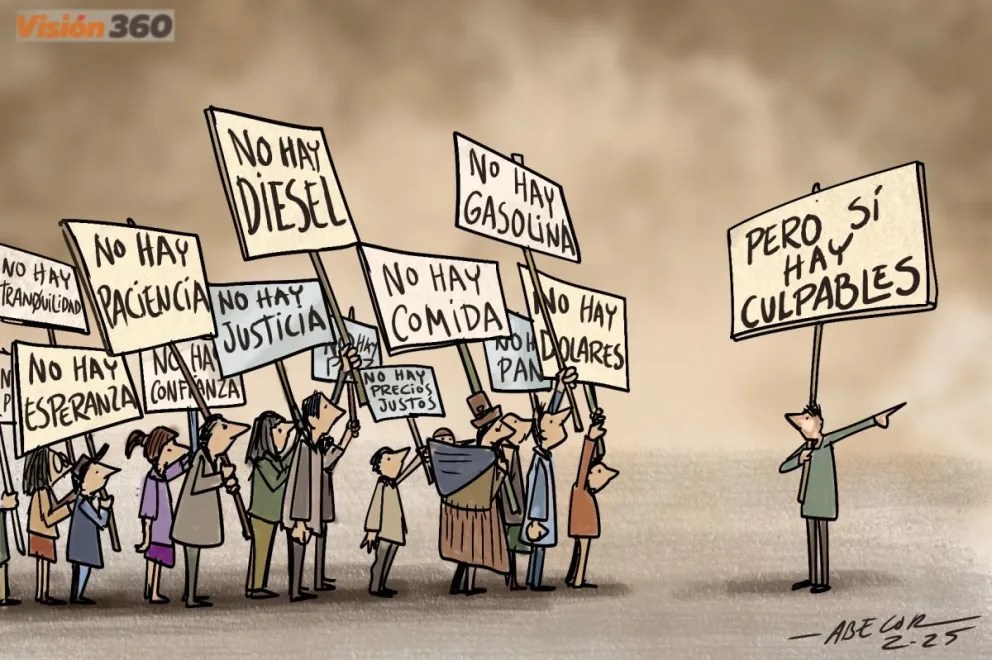
Bolivia necesita precisamente eso, porque el país ya no solo enfrenta una economía debilitada, sino una peligrosa acumulación de cansancio social. Faltan dólares, sobran negocios estancados, aumenta la emigración y crece la sensación de que cualquier esfuerzo adicional termina absorbido por una maquinaria que pide tiempo, papeles y paciencia, pero devuelve muy poco.
En ese contexto, seguir administrando demoras no es una simple torpeza burocrática. Es prolongar la parálisis.
Y prolongar la parálisis, en una Bolivia asediada por intereses que se acomodan al desorden, significa seguir dejando espacio a quienes viven mejor cuanto más difícil se vuelve producir dentro de la ley.
Por eso la discusión ya no es si la burocracia incomoda.
La discusión es si el país está dispuesto a dejar de proteger un sistema que hace del agotamiento ciudadano su forma más cotidiana de control.
Mientras abrir un folder siga siendo más fácil que abrir una empresa, Bolivia seguirá viendo el mismo resultado: gente que trabaja, gente que aguanta, pero un país que nunca termina de despegar.
FUENTES DOCUMENTALES
(1) Declaraciones de Federico Sturzenegger sobre desregulación y eliminación de trabas al emprendimiento.
(2) Estimaciones oficiales y de organismos multilaterales sobre el costo del “Estado tranca” en Bolivia.
(3) Reconocimiento gubernamental sobre la multiplicidad de instituciones en trámites públicos.
(4) Datos sobre informalidad económica citados por el Ejecutivo boliviano.
(5) Decreto Supremo 5595 y programa Tranca Cero.
Editorial, Bolivian Thoughts:
There is a scene far too common in Bolivia: a citizen walks into a public office to solve a simple matter and ends up trapped between stamps, forms, photocopies, objections, lines, and service windows. He is sent to another institution, then another, then told to come back tomorrow. When he finally believes he has gathered everything, he discovers a new requirement is missing or the responsible official is unavailable.
For years, we assumed this was simply part of Bolivian life — a minor annoyance, an unavoidable routine. But it is not. That daily bureaucracy is one of the reasons Bolivia has become a country where people work harder and harder for less and less return.
The recent visit to La Paz by Federico Sturzenegger, Argentina’s Minister of Deregulation and State Transformation, mattered because it placed on the table a truth Bolivia usually avoids confronting: no country can grow if its own public apparatus systematically obstructs productive activity. Invited by Rodrigo Paz’s government to support the “Tranca Cero” program, Sturzenegger summarized the issue clearly: deregulation means freeing people from unnecessary obstacles so they can build businesses and grow (1).
In Bolivia, that statement does not sound technical. It sounds disruptive.
Because here, citizens do not perceive the State as a facilitator, but as a force that controls, delays, and demands. And that dynamic is not new.
For two decades, the dominant political model expanded the State through more offices, more controls, more certifications, and more permits under the premise that greater intervention meant greater governing capacity. The result, however, was a heavier, slower, and less service-oriented apparatus. Productive activity did not strengthen at the same pace; administrative mediation did.
Today, the government itself acknowledges that this so-called “State bottleneck” costs Bolivia roughly 6% of its Gross Domestic Product in inefficiency, wasted time, and redundant processes (2). In today’s Bolivia — marked by foreign currency shortages, economic slowdown, and growing emigration — that cost becomes even more serious. Rodrigo Paz has also pointed out that many citizens must pass through multiple institutions just to complete a single public procedure (3). The problem, therefore, is not only economic: it’s also operational. And that operational aspect has direct consequences.
A small merchant trying to formalize a business faces a chain of requirements before selling a single product. A farmer must obtain permits to move or commercialize production. An importer is subjected to cumbersome customs procedures. A citizen attempting to regularize property enters a maze of notaries, land registries, and public records.
In all these cases, the experience is similar: before producing, one must first survive the system.
That is why Bolivia has developed a massive informal economy. Roughly 85% of economic activity operates outside formality, according to figures cited by the government itself (4). This number reflects not merely tax evasion, but a strained relationship between citizens and the formal system. For many Bolivians, entering legality means assuming costs, delays, and risks that are rarely compensated with clear benefits.
At the same time, such broad informality creates fertile spaces not only for subsistence activity, but also for more complex dynamics: contraband, difficult-to-trace money flows, and parallel financing circuits. The harder formalization becomes, the greater the incentive to remain outside the system, and the less transparent the national economy becomes.
Within that environment, certain actors adapt — and even benefit — from persistent complexity. Intermediaries who “solve” paperwork, informal collection networks, economies tied to contraband, and political mobilization structures all find functional ground there. Over the years, organized sectors — including elements of the Central Obrera Boliviana, intercultural groups, and other permanently mobilized organizations — have played an active role in national politics, often under leadership increasingly questioned for opaque internal practices and growing dependence on resources circulating outside the formal economy.
This helps explain why structural reforms in Bolivia often face resistance that goes far beyond simple administrative inertia.
To this must be added a climate of rising insecurity that, in some cases, has already reached operators within the institutional system itself. The recent murder of the dean of Bolivia’s Tribunal Agroambiental, Jorge Luis Murillo, forms part of a chain of events that has heightened concern over the reach of violence and its intimidating effect on authorities, judges, prosecutors, police, and public officials. When the environment is perceived this way, decision-making becomes slower, more cautious, and more vulnerable to pressure.
In a country where bureaucracy already creates friction, such signals deepen the sensation of paralysis.
That is why Sturzenegger’s visit should be interpreted less as a diplomatic event and more as a moment of contrast. In other contexts, deregulation efforts have sought precisely to reduce unnecessary burdens in order to reactivate economic life. Bolivia today faces a scenario in which that discussion is no longer theoretical.
Supreme Decree 5595 and the Tranca Cero program represent a first step (5), but Bolivia is no longer in a position to settle for superficial modernization. Digitizing forms or opening complaint channels will do little if citizens continue to depend on offices that never respond on time and on accumulated regulations that turn any initiative into an endurance contest.
The real signal would have to be felt in simpler things: public procedures with firm completion dates instead of indefinite duration; small businesses able to formalize without spending months trapped between taxes, licenses, and objections; permits and certificates that exist only to sustain desks and gatekeepers finally disappearing; legality no longer feeling like a threat to those merely trying to grow.
That is, in essence, what Sturzenegger came to remind Bolivia of: when the State stops consuming the citizen’s energy, that energy returns to production.
Bolivia needs exactly that, because the country no longer faces only a weakened economy, but a dangerous accumulation of social exhaustion. Dollars are scarce, stagnant businesses are everywhere, emigration is rising, and the feeling grows that any additional effort is absorbed by a machinery that demands time, papers, and patience while giving very little back.
Under those conditions, continuing to administer delay is not simply bureaucratic clumsiness. It is prolonging paralysis.
And prolonging paralysis, in a Bolivia besieged by interests that adapt comfortably to disorder, means continuing to leave room for those who prosper precisely when lawful production becomes more difficult.
The question, then, is no longer whether bureaucracy is inconvenient.
The question is whether Bolivia is willing to stop protecting a system that has turned citizen exhaustion into one of its most ordinary forms of control.
As long as opening a file folder remains easier than opening a business, Bolivia will continue to produce the same result: people who work, people who endure, but a country that never quite manages to move forward.
DOCUMENTARY SOURCES
(1) Federico Sturzenegger’s statements in La Paz on deregulation and removing obstacles to entrepreneurship.
(2) Official and multilateral estimates on the cost of Bolivia’s bureaucratic “State bottleneck.”
(3) Government acknowledgment that citizens often pass through multiple institutions for a single public procedure.
(4) Official figures placing Bolivia’s informal economy near 85%.
(5) Supreme Decree 5595 and the launch of the Tranca Cero program.


Leave a Reply