By El Diario:
Three Reflections Proposed for the Country to Begin Its Reactivation
- As will be recalled, Bolivia closed 2025 with a recession of -1.58% and for the current fiscal year, the Government estimates the figure will be -1.28%,
- with inflation at 14.95%,
- a fiscal deficit of -9.2%,
- and public investment of $2.965 billion.
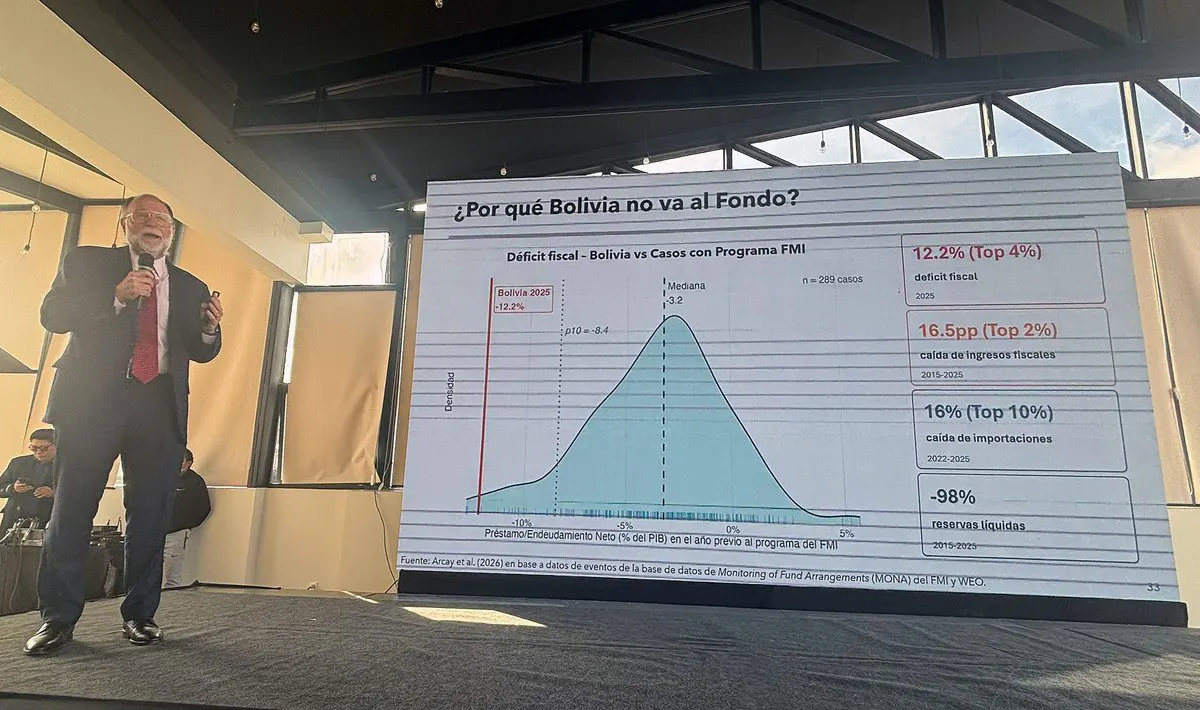
Bolivia has been mired in an economic and energy crisis since 2025, the year in which the situation worsened despite the partial elimination of the subsidy; developments in the Middle East caused that measure to be rolled back. The Growth Lab of Harvard Kennedy School published a report that was presented by economist Ricardo Hausmann, in which he lays out three reflections for the country to begin reactivating: speed up the pace (of reforms), build a political coalition to approve the reforms, and construct a narrative to justify the changes.
Citizens are observing the Government’s lack of communication with civil society and social sectors, since the absence of information has caused marches to return and intensify.
The Growth Lab of Harvard Kennedy School Growth Lab published a new series of reports evaluating Bolivia’s deep economic challenges and offering a detailed recovery plan. These are the result of a 15-month applied research project that included intensive consultations with government officials, international organizations, business and community leaders, as well as academic experts in Bolivia.
The document synthesizes the main findings and recommendations of the research series: An Economic Turnaround for Bolivia.
Bolivia’s macroeconomic collapse is the most visible symptom of a deeper crisis following institutional deterioration that weakened private investment, export capacity, and productivity growth throughout the economy, according to Hausmann’s presentation.
In addition to the three reflections pointed out by the economist, he also presented a comprehensive reform plan based on five pillars: credible fiscal consolidation that promotes growth; an effective and targeted social compensation network; restoration of external balance and monetary credibility; a renewed capacity to attract investment for export sectors; and an institutional foundation that fosters the development of new productive capabilities.
Proposals
Fiscal consolidation will drive growth, but to achieve this Bolivia must complete reform of energy subsidies, whose cost is currently estimated at as much as 14.5% of Gross Domestic Product (GDP) when implicit costs are included, and establish a transparent, market-based fuel pricing mechanism.
Historically, energy subsidies in Bolivia have been regressive, and wealthier households have received a disproportionate share of their benefits.
Social protection must also be a priority. To that end, they propose redirecting resources from broad subsidies toward well-targeted cash transfers and vouchers for low-income households, protecting the most vulnerable Bolivians from the impact of price adjustments. A comprehensive reform of Bolivia’s social protection architecture would improve the coverage, targeting, and adequacy of transfers.
Likewise, monetary and external stability with support from the International Monetary Fund is considered a necessity, with the objective of securing a formal program from the international institution to rebuild foreign currency reserves, stabilize the boliviano, and restore monetary credibility, while maintaining adequate capital controls during the transition period.
This had already been anticipated by Chilean economist Felipe Larraín, when he said that the international organization would be called upon for that task: to stabilize the exchange rate and reserves.
To this must be added sectoral reform, that is, modernizing the regulatory frameworks governing hydrocarbons, mining, lithium, agriculture, and tourism in order to attract private investment and expand export capacity.
This can be seen in agencies such as the National Hydrocarbons Agency (ANH), the Electricity Agency, among others, which did not faithfully fulfill their oversight role.
Finally, Bolivia must promote new productive capabilities. To that end, they recommend developing the institutions, infrastructure, human capital, and knowledge networks necessary to diversify the Bolivian economy over time, including an agency dedicated to investment promotion, a structured diaspora engagement strategy, a national productive infrastructure plan, and education and training reform oriented toward demand.
The reports conclude that Bolivia’s underlying assets remain largely intact and that the current moment represents a genuine opportunity for transformation, provided decisive measures are taken.
Evaluation
The country’s challenges stem from a broader institutional failure that weakened private investment, export capacity, and productivity growth across the entire economy. As a result, natural gas production has collapsed, no new large-scale mines have opened since 2014, agricultural yields remain among the lowest in the region, and exceptional tourist destinations lack basic infrastructure, the document notes.
The consequences are evident. Beyond signs of macroeconomic distress, Bolivia’s ranking in the Economic Complexity Index fell from 106th place in 2000 to 123rd in 2024, evidencing limited diversification and difficulties in attracting sustained private investment.
“Bolivia has many assets on which it can build and return to the path of economic prosperity. However, to materialize this potential it will be necessary to confront head-on the country’s deeply rooted problems,” said Hausmann, director of the Growth Lab and Rafik Hariri Professor of the Practice of International Political Economy at Harvard Kennedy School.
Por El Diario:
Plantean tres reflexiones para que el país comience su reactivación
- Como se recordará, Bolivia cerró el 2025 con una recesión de -1,58% y para la presente gestión, el Gobierno estima que la cifra será de -1,28%,
- una inflación de 14,95%,
- un déficit fiscal de -9,2%
- y una inversión pública de 2.965 millones de dólares.
Bolivia sumida en la crisis económica y energética desde el 2025, año en que se agudizó la situación a pesar de la eliminación parcial del subsidio, la situación en Medio Oriente hizo retroceder la medida. El Growth Lab de la Escuela Kennedy de Harvard, publicó un informe y fue presentado por el economista, Ricardo Hausmann, en la cual deja tres reflexiones para que el país empiece a reactivarse: apurar la marcha (de las reformas), construir una coalición política para aprobar las reformas y construir una narrativa para justificar los cambios.
La ciudadanía observa la falta de comunicación del Gobierno con la sociedad civil y los sectores sociales, pues la ausencia de información provocó que las marchas vuelvan y se vayan agudizando.
El Growth Lab de la Escuela Kennedy de Harvard publicó una nueva serie de informes que evalúan los profundos desafíos económicos de Bolivia y ofrecen un plan de recuperación detallado. Estos son el resultado de un proyecto de investigación aplicada de 15 meses, que incluyó consultas intensivas con funcionarios gubernamentales, organizaciones internacionales, líderes empresariales y comunitarios, además de expertos académicos en Bolivia.
El documento sintetiza los principales hallazgos y recomendaciones de la serie de investigaciones: Un giro económico para Bolivia.
El colapso macroeconómico de Bolivia es el síntoma más visible de una crisis más profunda tras un deterioro institucional que debilitó la inversión privada, la capacidad exportadora y el crecimiento de la productividad en toda la economía, de acuerdo con la presentación de Hausmann.
A parte de las tres reflexiones señaladas por el economista, también presentó un plan integral de reformas basado en cinco pilares: una consolidación fiscal creíble y que impulse el crecimiento; una red de compensación social eficaz y focalizada; el restablecimiento del equilibrio externo y de la credibilidad monetaria; una renovada capacidad de atracción de inversiones para sectores exportadores; y una base institucional que fomente el desarrollo de nuevas capacidades productivas.
Propuestas
La consolidación fiscal impulsará el crecimiento, pero para ello se debe completar la reforma de los subsidios a la energía, cuyo costo se estima actualmente en hasta un 14,5% del Producto Interno Bruto (PIB) al incluir los costos implícitos y establecer un mecanismo de precios de combustible transparente, basado en el mercado.
Históricamente, los subsidios a la energía en Bolivia han sido regresivos y los hogares más ricos han recibido una parte desproporcionada de sus beneficios.
También la protección social debe ser una prioridad, para ello plantean reorientar los recursos de los subsidios generales hacia transferencias monetarias y vales bien dirigidos a hogares de bajos ingresos, protegiendo a los bolivianos más vulnerables del impacto de los ajustes de precios. Una reforma integral de la arquitectura de protección social de Bolivia mejorará la cobertura, la focalización y la suficiencia de las transferencias.
Asimismo, la estabilidad monetaria y externa con apoyo del Fondo Monetario Internacional (FMI), es una necesidad, con el objetivo de garantizar un programa formal del ente internacional para reconstruir las reservas de divisas, estabilizar el boliviano y restaurar la credibilidad monetaria, manteniendo controles de capital adecuados durante el período de transición.
Ya lo anticipó el economista de Chile, Felipe Larraín, cuando dijo que el organismo internacional es llamado para esa tarea, estabilizar el tipo de cambio y las reservas.
A eso se debe aplicar una reforma sectorial, es decir modernizar los marcos regulatorios que rigen los hidrocarburos, la minería, el litio, la agricultura y el turismo para atraer inversión privada y ampliar la capacidad exportadora.
Eso se puede observar con la Agencia Nacional de Hidrocarburos (ANH), la Agencia de Electricidad, entre otras, que no cumplieron fielmente su labor de fiscalizar.
Finalmente, Bolivia debe impulsar nuevas capacidades productivas. Para ello recomiendan desarrollar las instituciones, la infraestructura, el capital humano y las redes de conocimiento necesarias para diversificar la economía boliviana a lo largo del tiempo, incluyendo una agencia dedicada a la promoción de inversiones, una estrategia estructurada de participación de la diáspora, un plan nacional de infraestructura productiva y una reforma de la educación y la capacitación orientada a la demanda.
Los informes concluyen que los activos subyacentes de Bolivia permanecen en gran medida intactos y que el momento actual representa una verdadera oportunidad para la transformación, siempre que se tomen medidas decisivas.
Evaluación
Los desafíos del país se derivan de una falla institucional más amplia que debilitó la inversión privada, la capacidad de exportación y el crecimiento de la productividad en toda la economía. Como resultado, la producción de gas natural se desplomó, no se han abierto nuevas minas a gran escala desde 2014, los rendimientos agrícolas siguen estando entre los más bajos de la región y los destinos turísticos excepcionales carecen de infraestructura básica, señala el documento.
Las consecuencias son evidentes. Más allá de los indicios de dificultades macroeconómicas, la clasificación de Bolivia en el Índice de Complejidad Económica descendió del puesto 106 en 2000 al 123 en 2024, lo que evidencia una diversificación limitada y dificultades para atraer inversión privada sostenida.
“Bolivia cuenta con muchos activos sobre los que puede construir y retomar la senda de la prosperidad económica. Sin embargo, para materializar este potencial será necesario abordar de frente los problemas profundamente arraigados del país”, afirmó Hausmann, director del Growth Lab y profesor Rafik Hariri de Práctica de Economía Política Internacional en la Escuela Kennedy de Harvard.


Leave a Reply