
By Erbol, El Diario:
Nine out of ten, according to a Cedib study
- Three out of four women assessed have total mercury levels in hair associated with cardiovascular risk.
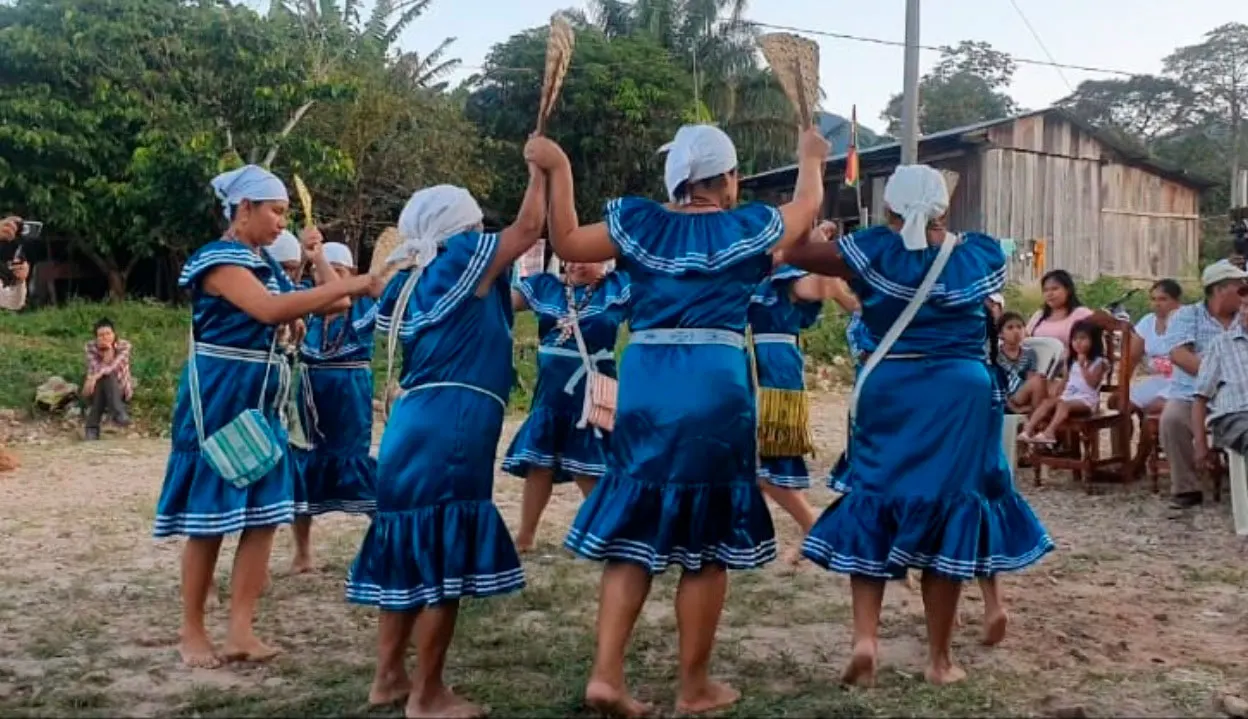
A pilot study on mercury exposure and the health status of women from indigenous communities living along the Beni and Madre de Dios river basins in the Amazon revealed that nine out of ten indigenous women of childbearing age show concentrations above safe limits, predisposing them to multiple associated diseases.
This study, carried out by the Center for Documentation and Information Bolivia (Cedib) with the participation of the Seladis Institute of the Universidad Mayor de San Andrés (UMSA) and the Toxicology Institute of the University of Cartagena, Colombia, between November and December 2023, provided important findings on contamination levels in indigenous women. The results were shared in La Paz, during a public event at the La Paz Press Association (APLP).
“Nine out of ten women assessed had total mercury levels in hair above the maximum recommended for health protection, of one part per million (1 ppm), according to international agencies. The average (…) roughly for the Beni river basin is 5.2 ppm and for Madre de Dios 3.2 ppm,” explained toxicologist Jesús Olivero before an almost full audience.
The specialist noted that in the Beni river basin the maximum mercury concentration in Amazonian women reached 22 ppm, while in the Madre de Dios basin it was 9 ppm. For the study, samples were taken from 119 women between the ages of 30 and 40.
He also detailed that one out of four women exceeded two parts per million, meaning they face risks associated with cardiovascular problems. “This is like a thermometer of mercury effects according to exposure level, measured as hair mercury concentration,” he said.
Between 1 and 2 ppm, he explained, are associated with subtle neurodevelopmental effects, which cannot be detected in a simple medical check-up. Between 2 and 5 ppm, mercury levels are associated with cardiovascular risks; between 5 and 10 ppm, with prenatal neurobehavioral alterations; between 10 and 20 ppm, with cognitive and motor deficits in children.
Three out of four women evaluated had total hair mercury levels associated with cardiovascular risk.
“Remember that the maximum concentration we had was 21 ppm, so we already have a series of reported effects, and if we want to observe them, we need to carry out more detailed evaluations,” he mentioned.
BLOOD ANALYSES
The results of blood analyses in volunteers with the highest mercury levels showed a worrying picture, according to both Jesús Olivero and Róger Carvajal of UMSA, since the indicators suggest liver damage and alterations in blood biomarkers.

“We decided to look at some biochemical and hematological markers, blood characteristics in women with the highest mercury exposure levels, and reviewed their health. What you see here in red corresponds particularly to elevated liver enzymes—there are problems with liver function,” explained Olivero, who confessed to having 0.3 ppm of mercury in his own body because he often eats tuna.
The specialist pointed out that indigenous women live in conditions of extreme poverty, with little access to basic services and clean water, facilitating the spread of preventable infectious diseases. “A high percentage show alterations in the size, shape, and color of red blood cells, linked to poor nutrition. They are not receiving proper nutrition—something we can address. Many have lost teeth, also preventable, which we can work on.”
One in five suffer from hearing problems, affecting communication and daily life. Headaches and miscarriages also appear more frequently than in the general population. On average, women from the Beni river basin have higher mercury concentrations than those from Madre de Dios, confirming earlier findings.
“The indigenous women of the Beni and Madre de Dios river basins—ancestral caretakers of the Amazon—are facing mercury exposure, with almost all surpassing the safe exposure limit, putting their health and that of their children at serious risk,” he reflected.
Olivero stressed that poverty and lack of basic services mean that preventable diseases, malnutrition, and problems such as tooth loss or hearing loss are part of their everyday lives. “These data are not just numbers in a report; they reflect the harsh reality these communities live daily, and they represent an urgent call to action for both authorities and society as a whole,” he stated.
Ruth Alípaz Cuqui, indigenous leader of the Uchupiamona people and spokesperson for the National Coordinator for the Defense of Indigenous Peasant Territories (Contiocap), drew attention to the impacts suffered by six indigenous nations of the middle Beni river basin, covering the municipalities of Rurrenabaque and San Buenaventura.
She recounted that it was only in 2018 that communities learned that gold mining used mercury. They requested Cedib’s support as well as that of the University of Cartagena to measure mercury impacts on riverine populations, but also on fish—the main food source of Amazonian peoples.
“Our country, a poor one that survives on resource extraction, kills its own population. We are sustaining an economy based on the death of historically vulnerable, marginalized, and discriminated communities (…). The economy is built on the death of people, children, women—the very ones who guarantee the continuity of our species and, in the case of indigenous peoples, our culture,” she commented.
She also criticized the National Action Plan (NAP) for mercury reduction, developed by the government together with the mining sector and supported by Planet Gold and the United Nations Industrial Development Organization (UNIDO), but without indigenous participation, despite them being the main victims of illegal gold mining. The plan, she noted, has a productive vision, not a health-based one, as required by the Minamata Convention, to which Bolivia is a signatory.
Cedib director Óscar Campanini explained during the event that the purpose of presenting this information publicly was not only to socialize the study, but above all to ensure the State acknowledges the situation and adopts solutions to the reality faced by Amazonian indigenous communities affected by gold mining.
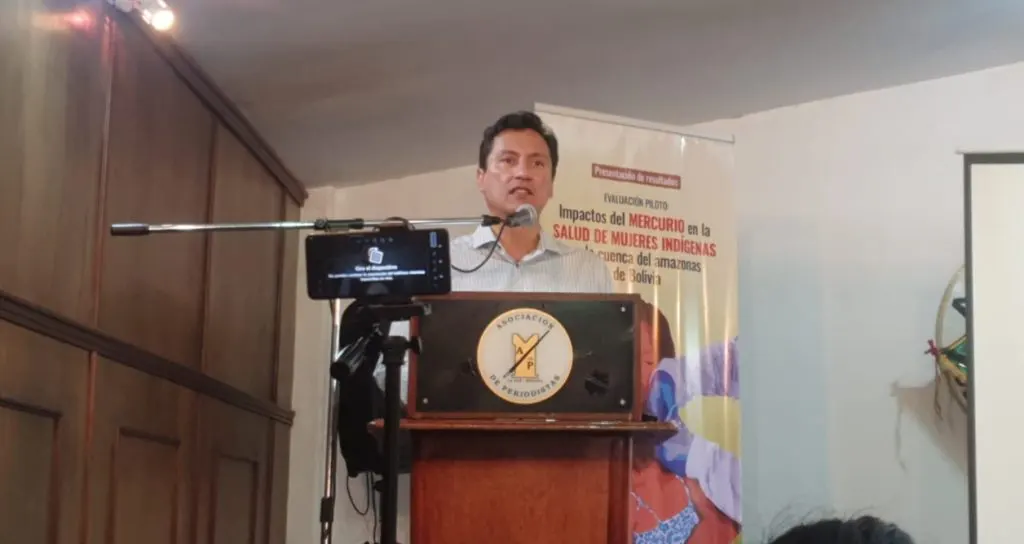
“This presentation is addressed to the State, which must take action and provide solutions to these health problems. The responsibility lies with the institutions. That’s why this workshop was organized—we invited government authorities, the Health Ministry, the Foreign Ministry, the Vice-Presidency, as well as academics and institutions working on this issue,” said Campanini.
He recalled that this pilot study, specifically carried out on women of childbearing age, has a prior background. Since 2015, Bolivia has been a protagonist in mercury trade, reflected in the 2018–2019 study titled The Mercury Business in Bolivia, which is now being updated.
“We saw concern from populations not even involved in mining activities, even hundreds of kilometers away from mining zones, but still affected by mercury impacts,” he noted.
He highlighted that organizations like Contiocap promoted the study on mercury impacts, conducted with the support of the University of Cartagena and Cedib. Later, the Multiethnic Indigenous Territory TIM-II, with the support of the Center for Legal Studies and Social Research (CEJIS) and UMSA, also carried out a study.
The study also provides a series of recommendations for the State to assume its responsibilities: strengthen local health services, improve access to clean water and sanitation, develop nutrition and food security programs, launch initiatives to combat malnutrition and improve diets in affected communities, implement intercultural environmental and health education, conduct continuous monitoring and care for vulnerable groups, reduce mercury pollution at its source, and promote intersectoral coordination and community participation. (Environmental News Agency/Erbol)
Por Erbol, El Diario:
Son nueve de cada 10, según un estudio del Cedib
- Tres de cada cuatro mujeres evaluadas poseen niveles de mercurio total en cabello asociadas con riesgo cardiovascular.
Un estudio piloto sobre la exposición a mercurio y el estado de salud de mujeres de comunidades indígenas que habitan en las cuencas de los ríos Beni y Madre de Dios en la Amazonía reveló que nueve de cada 10 mujeres indígenas en edad fértil presentan concentraciones superiores a los límites seguros, lo cual las predispuso a múltiples enfermedades asociadas.
Dicho estudio realizado por el Centro de Documentación e Información Bolivia (Cedib) con la participación del Instituto Seladis de la Universidad Mayor de San Andrés (UMSA) y el Instituto de Toxicología de la Universidad de Cartagena, Colombia, entre noviembre y diciembre de 2023, dio importantes hallazgos sobre los niveles de contaminación en mujeres indígenas, los cuales fueron socializados en la ciudad de La Paz, en un evento público realizado en la Asociación de Periodistas de La Paz (APLP).
“Nueve de cada diez mujeres evaluadas posee niveles de mercurio total en cabello superiores a las máximas recomendadas para la protección de la salud, de una parte por millón (1 ppm), de acuerdo con agencias internacionales, el promedio (…). Más o menos la división estándar para la cuenca del río Beni es de 5.2 ppm y para Madre de Dios de 3.2 ppm”, expuso el toxicólogo Jesús Olivero ante un auditorio casi lleno.
El especialista precisó que para el caso de la cuenca del río Beni la concentración máxima de mercurio en las mujeres amazónicas fue de 22 ppm, mientras que en la del Madre de Dios de 9 ppm. Para el caso concretó se tomaron muestras de 119 mujeres comprendidas entre 30 y 40 años.
En esa línea también detalló que una de cada cuatro mujeres está por encima de dos partes por millón; es decir, presenta riesgos asociados con problemas cardiovasculares. “Este es como un termómetro de los efectos en mercurio de acuerdo con el nivel de exposición, medido como la concentración de mercurio en cabello”, dijo.
Entre 1 y 2 ppm, explicó que están asociados a los efectos sutiles en neurodesarrollo, efectos sutiles, esto no lo vamos a mirar con una simple evaluación médica, entre 2 y 5 ppm de mercurio están asociados a riesgos cardiovasculares, entre 5 y 10 ppm a alteraciones neuroconductuales prenatales, entre 10 y 20ppm a déficit cognitivo y motor en niños.
Tres de cada cuatro mujeres evaluadas poseen niveles de mercurio total en cabello asociadas con riesgo cardiovascular.
“Recuerden que la concentración máxima que tuvimos nosotros fue de 21 ppm, entonces tenemos una serie de efectos que ya parecen reportados y que si queremos observarlos pues tenemos que efectivamente hacer unas evaluaciones un poco más detalladas”, mencionó.
ANÁLISIS SANGUÍNEOS
Los resultados de los análisis sanguíneos en las voluntarias con los niveles más altos de mercurio mostraron un panorama preocupante, según coincidieron Jesús Olivero y Róger Carvajal de la UMSA, pues los indicadores sugieren manifestaciones de daño en el hígado y alteraciones en biomarcadores sanguíneos.
“Decidimos mirar algunos marcadores bioquímicos y hematológicos, características de la sangre en mujeres con los niveles de exposición a mercurio más elevados y revisamos cómo estaban de salud y esto que ustedes están observando aquí en rojo, corresponde particularmente a enzimas hepáticas que están elevadas, hay problemas en la función hepática, en la función del hígado”, explicó Olivero, quien confesó tener 0.3 ppm de mercurio en su organismo porque suele comer atún.
El especialista llamó las mujeres indígenas viven en condiciones de extrema pobreza, con poco acceso a servicios básicos y agua potable, esto facilita la aparición de enfermedades infecciosas que pueden ser prevenibles y ahí es donde tenemos que intervenir, un alto porcentaje presenta alteraciones en el tamaño, la forma y el color de los glóbulos rojos, esto está asociado con nutrición, no están teniendo una nutrición adecuada, esto también es posible intervenir, han perdido piezas dentales, también prevenibles, se puede trabajar.
Una de cada cinco, tiene problemas de audición, esto puede afectar su comunicación y su vida diaria, dolores de cabeza, abortos espontáneos, parecen presentarse con mayor frecuencia que lo que ocurre en la comunidad en general, esto de acuerdo con la visión de los médicos y en promedio las mujeres de la Cuenca y río Beni tienen concentraciones de mercurio más altas que la de Madre de Dios, que era lo que habíamos visto también en la primera aproximación.
“Las mujeres indígenas de las cuencas de los ríos Beni y Madre de Dios –cuidadoras ancestrales de la Amazonía– están enfrentando exposición a mercurio, con casi todas superando el límite seguro de exposición, lo que pone en grave riesgo su salud y la de sus hijos”, reflexionó.
Olivero dijo que la pobreza y la falta de servicios básicos significan que enfermedades prevenibles, desnutrición y problemas como la pérdida de dientes o la disminución de la audición forman parte de su vida cotidiana. “Estos datos no son solo cifras en un informe; reflejan una dura realidad que viven día a día comunidades enteras, y representan un llamado urgente a la acción tanto para autoridades como para la sociedad en su conjunto”, señaló.
Ruth Alípaz Cuqui, lideresa indígena del pueblo Uchupiamona y portavoz de la Coordinadora de Defensa Nacional de Territorios Indígena Originario Campesino (Contiocap) llamó la atención por los impactos que sufren seis naciones indígenas de la cuenca media del río Beni, que abarca los municipios de Rurrenabaque y San Buenaventura.
Relató que recién el año 2018 se enteraron las comunidades que la minería del oro empleaba el mercurio, por lo que se solicitó al Cedib su apoyo así como la de la Universidad de Cartagena, para medir los impactos del mercurio en las poblaciones ribereñas, pero también en los peces, principal alimento de los pueblos amazónicos.
“Nuestro país que es un pobre país que vive de la extracción de recursos que mata a su población; estamos haciendo economía basada en la muerte de poblaciones vulnerables históricamente, relegadas, discriminadas (…). La economía está basada en la muerte de personas, niños, mujeres que somos quienes vamos a garantizar la continuidad de nuestra especie y en el caso de los pueblos indígenas, de nuestra cultura”, comentó.
Cuestionó además el Plan de Acción Nacional (PAN) para la reducción del mercurio, elaborado por el Gobierno en coordinación con el sector minero y el apoyo de Planet Gold, la Organización de Naciones Unidas para el Desarrollo Industrial (Onudi) y sin la participación de los pueblos indígenas, principal afectado por la minería ilegal del oro, que tiene una visión productiva y no de salud, como exige el Convenio de Minamata, al cual se adscribió el Estado boliviano.
El director del CEDIB, Óscar Campanini, explicó durante el evento, que el propósito de presentar la información de manera pública, no es sólo la socialización del estudio, sino sobre todo para que sea de conocimiento del Estado, para que adopte soluciones a la realidad que atraviesan las comunidades indígenas amazónicas impactadas por la minería del oro.
“Esta presentación va a dirigida al Estado, que tiene que tomar acciones y dar soluciones a estos problemas de salud; pasa por las manos de las instituciones, este taller es para eso, hemos invitado a autoridades de Gobierno, de Salud, de Cancillería, de la Vicepresidencia para que puedan escuchar estos resultados, a actores académicos, institucionales que trabajan con el tema”, sostuvo Campanini.
Recordó que el estudio piloto específicamente realizado en mujeres en edad fértil tiene un antecedente previo, ya que desde el 2015, el país fue el protagonista del comercio del mercurio, reflejado en el estudio realizado entre 2018 y 2019 titulado: El negocio del mercurio en Bolivia, el cual está siendo actualizado.
“Vimos la preocupación de la población que ni siquiera participa de la actividad minera y que incluso a está a cientos de kilómetros de la zona minera, pero es afectada por los impactos del mercurio”, indicó.
Destacó que entonces organizaciones como la Coordinadora de Defensa Nacional de Territorios Indígena Originario Campesino (Contiocap) impulsó el estudio sobre los impactos del mercurio, realizado con el apoyo de la Universidad de Cartagena y el Cedib, posteriormente fue el Territorio Indígena Multiétnico TIM-II con el apoyo del Centro de Estudios Jurídicos e Investigación Social (CEJIS) que también efectuó su estudio con apoyo de la UMSA.
El estudio también ofrece una serie de recomendaciones al Estado para que asuma sus responsabilidades: fortalecer los servicios de salud locales, mejorar el acceso a agua potable y saneamiento básico, desarrollar programas de nutrición y seguridad alimentaria, lanzar iniciativas para combatir la desnutrición y mejorar la dieta en las comunidades afectadas, implementar educación ambiental y sanitaria intercultural, realizar monitoreo continuo y atención a grupos vulnerables, reducir la contaminación por mercurio en el origen, además de promover la articulación intersectorial y participación comunitaria. (Agencia de Noticias Ambientales/Erbol)
https://www.eldiario.net/portal/2025/09/27/mujeres-indigenas-con-altas-concentraciones-de-mercurio/

 Bolivian Thoughts | Pensamientos Bolivianos (Bilingual/Bilingüe)