
By Daniel Salazar Castellanos, Bloomberg Linea:
Bolivia derailed its inflation path and is now among the highest in the region. In March, year-on-year inflation stood at 14.63%.
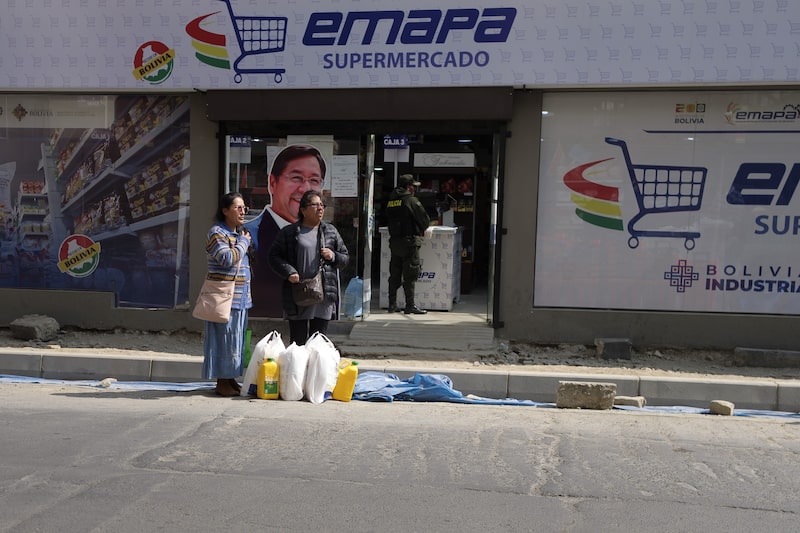
Customers in front of a subsidized grocery store in La Paz, Bolivia, on Thursday, September 26, 2024. Bolivia, once a natural gas powerhouse, is facing an economic crisis after years of miscalculations and unsustainable policies. (Bloomberg/Manuel Seoane)
Bloomberg Línea — Bolivia went from being part of the club of countries with the lowest inflation in the region to suffering from rising prices amid a scenario marked by shortages of foreign currency and fuel, against the backdrop of declining gas exports.
The Andean country, once considered a stable market thanks to gas revenues that allowed it to sustain economic growth along with controlled inflation, is now under pressure. In 2024, accumulated inflation reached its highest level since 2008, standing at 9.97%. This past March, year-on-year inflation reached 14.63%, according to data published by the National Institute of Statistics (INE).
“The recent inflationary acceleration in Bolivia, evident since the end of 2024, is not an isolated phenomenon nor does it respond to an unexpected external shock,” says Jonathan Fortun, economist at the Institute of International Finance (IIF).
Thus, the rapid increase in inflation in Bolivia would be due to a series of structural economic imbalances that persisted for years, but which had been contained until now under a framework characterized by a fixed exchange rate, widespread subsidies, and an oversized state.
The reliance on imported inputs reinforces this effect, given that Bolivia imports more than half of its productive inputs, including food, fertilizers, industrial parts, and fuel. Moreover, it imports virtually all the diesel and gasoline it consumes, but sells them domestically at prices far below the acquisition cost.
The difference is covered by the Treasury, which in 2024 generated spending exceeding US$2.3 billion in a context of depleted reserves, according to figures provided by the IIF.
The Treasury deficit reached 9.7 percent of GDP in 2023 and likely exceeded 10.5 percent in 2024, although the government has avoided publishing recent consolidated figures. If the operating deficit of state-owned companies is included—especially YPFB, which went from being a foreign currency generator to a net importer of fuels—the consolidated public sector deficit exceeds 15 percent of GDP.
Jonathan Fortun, economist at the IIF.
For Jonathan Fortun, what has begun to show up in price indexes in recent months “is not a one-off disruption, but the manifestation of an economic regime that has started to overflow.”
He explains that the consumer price index is still calculated using a consumption basket based on the 2016 spending survey. “This is inflation that, rather than being contained, has been deferred and statistically smoothed,” he pointed out.
In this context, the Institute of International Finance has estimated that a methodological update could raise reported inflation by at least 40 to 60 basis points per month.
The fixed exchange rate is faltering

Maintaining the Bs$6.9 per dollar exchange rate in Bolivia, fixed since 2011 during Evo Morales’ government, has become increasingly difficult.
For more than ten years, the fixed exchange rate regime functioned as a nominal anchor, but its viability depended on the accumulation of reserves that are now vanishing.
According to the IIF, by the end of 2024 the Central Bank’s net liquid reserves were below US$2 billion, most of which are non-liquid.
Without access to external financing and with a saturated domestic market, the government has turned to the Central Bank and quasi-fiscal mechanisms to cover its cash needs, which reinforces inflation expectations in an environment where there are no longer any reliable anchors.
Jonathan Fortun, economist at the IIF.
What is happening in Bolivia is that “we are experiencing significant depreciation that continues to grow in the country,” analyst Jaime Dunn told Bloomberg Línea. And in this context, “the Central Bank is aggressively increasing the money supply.”
He explains that meeting the high demand for loans from the General Treasury of the State, through the Central Bank, also involves a substantial amount of bolivianos.
According to Dunn, last year the Central Bank financed the Treasury with more than Bs$4 billion (around US$580 million), which has had effects that are beginning to be felt months later.
As the national currency loses value, all goods and services priced in bolivianos become more expensive.
In this way, Bolivia has become the fourth most inflationary country in Latin America, after Argentina, Venezuela, and Cuba, despite having been one of the countries with the lowest inflation in the world during the pandemic years.
The political crisis also marks a turning point.
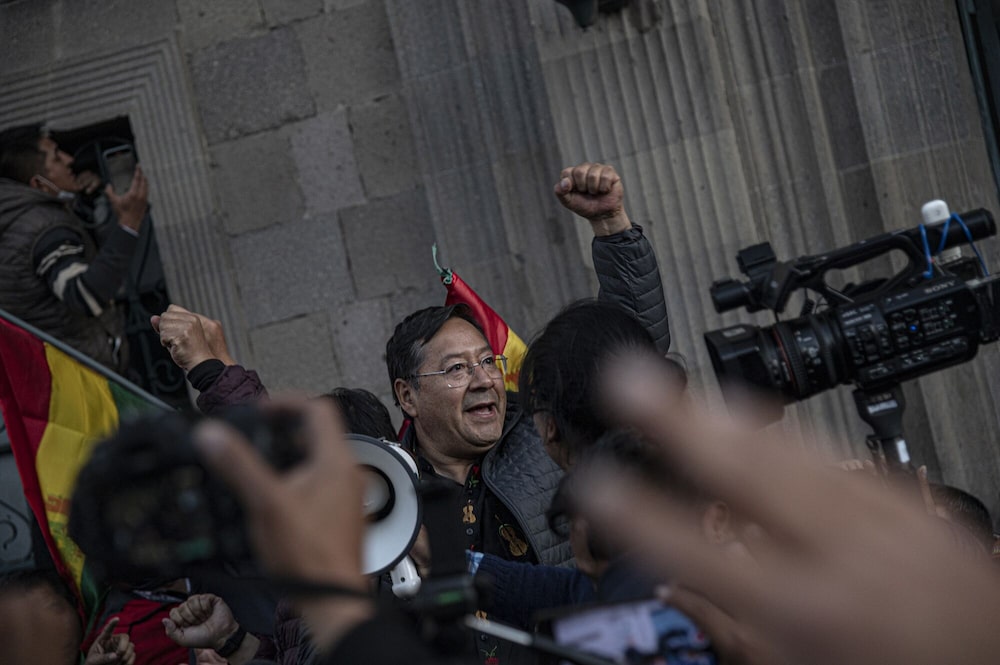
In June 2024, the head of the Bolivian Army, General Juan José Zúñiga, led an insurrection against the government, which President Luis Arce described as an attempt at a “coup d’état,” but Evo Morales, now an opponent, considered it more of a “self-coup.”
In the view of analysts, the political crisis in Bolivia also served as a catalyst to strengthen institutional control over an economy that was already showing signs of exhaustion.
The government has imposed controls on the use of dollars and other financial operations to try to sustain the economy amid a shortage of foreign currency, opening the door to alternatives such as cryptocurrencies.
In 2023, Bolivia managed to avoid a financial crisis by passing a law that allowed the central bank to sell part of its gold reserves, although the Senate recently approved a project to safeguard them.
“This bill seeks to protect the gold reserves and ensure they remain a solid backing for the country’s economic stability,” said the President of the Bolivian Senate, Andrónico Rodríguez.
Fortun states that after last year’s political crisis, official inflation did not spike immediately, but there was a notable shift in government strategy, reflected in “more aggressive controls, delays in sensitive adjustments, greater opacity in data publication, and an explicit effort to preserve the perception of stability.”
Por Daniel Salazar Castellanos, Bloomberg Linea:
Bolivia descarriló el rumbo de la inflación y ahora está entre las más altas de la región. En marzo, la inflación se ubicó en el 14,63% interanual.
Bloomberg Línea — Bolivia pasó de estar en el club de los países con la menor inflación en la región a padecer por el aumento de los precios en medio de un panorama marcado por la escasez de divisas y de combustible, con el trasfondo del declive de las exportaciones de gas.
El país andino, otrora considerado un mercado estable gracias al soporte del gas, que le permitió mantener el crecimiento económico junto con una inflación bajo control, ahora está bajo presión. En 2024, la inflación acumulada llegó a su nivel más alto desde el 2008 y se situó en el 9,97%. En marzo pasado, la inflación se ubicó en el 14,63% interanual, según datos publicados por el Instituto Nacional de Estadística (INE).
“La reciente aceleración inflacionaria en Bolivia, evidente desde fines de 2024, no es un fenómeno aislado ni responde a un shock externo inesperado”, diceJonathan Fortun, economista del Instituto Internacional de Finanzas (IIF).
Así, el acelerado aumento de la inflación en Bolivia respondería a una serie de desequilibrios económicos estructurales que se extendieron por años, pero que hasta el momento habían sido contenidos bajo un esquema caracterizado por un tipo de cambio fijo, subsidios generalizados y un Estado sobredimensionado.
La dependencia de insumos importados refuerza este efecto, dado que Bolivia importa más de la mitad de sus insumos productivos, incluyendo alimentos, fertilizantes, repuestos industriales y combustibles. Además, importa prácticamente todo el diésel y la gasolina que consume, pero los vende internamente a precios muy por debajo del costo de adquisición.
La diferencia es cubierta por el Tesoro, lo que generó en 2024 un gasto superior a los US$2.300 millones en un contexto de reservas agotadas, de acuerdo a cifras aportadas por el IIF.
El déficit del Tesoro alcanzó el 9,7 por ciento del PIB en 2023 y probablemente superó el 10,5 por ciento en 2024, aunque el gobierno ha evitado publicar cifras consolidadas recientes. Si se incorpora el déficit operativo de las empresas estatales, especialmente YPFB, que pasó de ser generadora de divisas a importadora neta de combustibles, el déficit consolidado del sector público supera el 15 por ciento del PIB. Jonathan Fortun, economista de IIF.
Para Jonathan Fortun, lo que comenzó a reflejarse en los índices de precios en los últimos meses “no es una disrupción puntual, sino la manifestación de un régimen económico que ha comenzado a desbordarse”.
Explica que el índice de precios al consumidor sigue calculándose con una canasta de consumo basada en la encuesta de gasto de 2016. “Se trata de una inflación que, más que contenida, ha sido diferida y estadísticamente suavizada”, señaló.
En este marco, el Instituto Internacional de Finanzas ha calculado que una actualización metodológica podría elevar la inflación publicada en al menos 40 a 60 puntos básicos mensuales.
El tipo de cambio fijo se tambalea
Mantener la paridad de Bs$6,9 por dólar en Bolivia, fijada desde el 2011 en el gobierno de Evo Morales, se ha vuelto cada vez más complicado.
Durante más de diez años, el régimen de tipo de cambio fijo funcionó como ancla nominal, pero su viabilidad dependía de la acumulación de reservas que se evaporan.
Según el IIF, a fines de 2024 las reservas netas líquidas del Banco Central estaban por debajo de los US$2.000 millones, en su mayoría no realizables.
Sin acceso a financiamiento externo y con un mercado interno saturado, el Gobierno ha recurrido al Banco Central y a mecanismos cuasifiscales para cubrir sus necesidades de caja, lo que refuerza las expectativas de inflación en un entorno donde ya no hay anclas confiables.Jonathan Fortun, economista de IIF.
Lo que está pasando en Bolivia es que “tenemos una importante depreciación que cada vez está aumentando en el país”, dijo a Bloomberg Línea el analista Jaime Dunn. Y en este contexto, “el Banco Central está incrementando agresivamente la masa monetaria”.
Expone que satisfacer la alta demanda de préstamos por parte del Tesoro General del Estado, a través del Banco Central, también implica una cantidad importante de bolivianos.
Según Dunn, el año pasado, el Banco Central financió al Tesoro con más de Bs$4.000 millones (unos US$580 millones), lo que ha tenido efectos que comienzan a sentirse meses después.
Al perder valor la moneda nacional, todos los bienes y servicios en bolivianos se vuelven más caros.
De esta manera, Bolivia se ha consolidado como el cuarto país más inflacionario de América Latina, después de Argentina, Venezuela y Cuba, a pesar de que en los años de la pandemia era uno de los países con menor inflación en el mundo.
La crisis política también marca un punto de inflexión
En junio del 2024, el jefe del Ejército boliviano, el general Juan José Zúñiga, lideró una insurrección contra el Gobierno calificada como un intento de “golpe de Estado” por el presidente Luis Arce, pero Evo Morales, ahora convertido en opositor, consideró que se trató más bien de un “autogolpe”.
En visión de los analistas, la crisis política en Bolivia también sirvió como un catalizador para fortalecer el control institucional sobre una economía que ya mostraba signos de agotamiento.
El Gobierno ha impuesto controles al uso de dólares y otras operaciones financieras para tratar de sostener la economía en medio de la escasez de divisas, abriendo la puerta a otras alternativas como las criptomonedas.
El 2023, Bolivia logró evitar una crisis financiera al aprobar una ley que permitió al banco central vender parte de sus reservas de oro, aunque el Senado recientemente aprobó un proyecto para poder resguardarlas.
“Este proyecto de ley busca proteger las reservas de oro y garantizar que se mantengan como un respaldo sólido para la estabilidad económica del país”, dijo el presidente de la Cámara de Senadores boliviano, Andrónico Rodríguez.
Fortun dice que luego de la crisis política del año pasado la inflación oficial no se disparó inmediatamente, pero sí se produjo un cambio notable en la estrategia del gobierno, reflejada en “controles más agresivos, retrasos en ajustes sensibles, mayor opacidad en la publicación de datos y un esfuerzo explícito por preservar la percepción de estabilidad”.

 Bolivian Thoughts | Pensamientos Bolivianos (Bilingual/Bilingüe)