
By Erbol:
ADVISE CONSEQUENCES
Industrialists suggest freezing the salary increase to avoid deepening the economic crisis
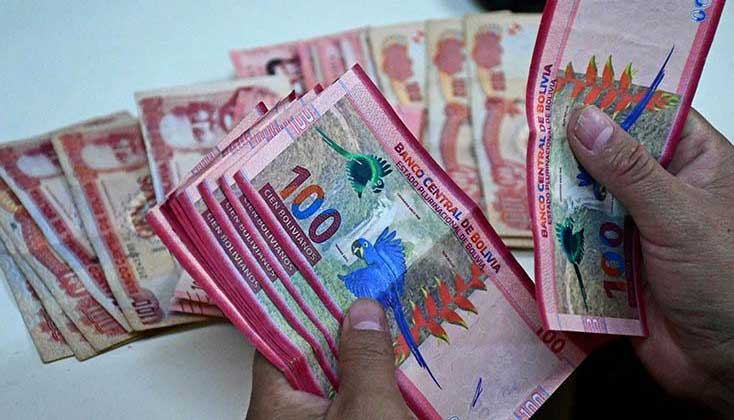
A person counts money. Photo: archive
Through a statement, the National Chamber of Industries (CNI) proposed this Friday to freeze the basic wage and the National Minimum Wage (SMN) to prevent the economic crisis facing the country from “deepening.”
With this measure, the CNI believes that it will also stop the “inflationary spiral” in Bolivia, which further drives the decline in investment, production, exports, and formal employment.
If the salary increase is approved, as demanded by the Bolivian Workers’ Central (COB) in its request to the Government, it will “further” increase future inflation and deteriorate economic growth.
Regarding the National Minimum Wage, the CNI noted that it has been one of the highest in South America for years, promoting “loss of competitiveness, greater informality, and smuggling.”
“Private companies are struggling due to the rising costs of the U.S. dollar and the shortage of diesel and gasoline. Furthermore, the salary increase will lead to a larger fiscal deficit and will become a factor of macroeconomic instability,” the statement adds.
The scenario that makes the salary increase unfeasible is the decline in economic activity, according to the CNI. Furthermore, the growth of the Gross Domestic Product (GDP) in 2024 is 2.14% as of September, one of the lowest in recent years.
“In 2024, social conflicts (blockades) caused losses and increased legal insecurity and country risk. Over 1,200 social conflicts occurred in 2024, with losses exceeding $3.5 billion, which affected companies’ revenue flow,” it recalled.
On the other hand, it pointed out that the creation of companies is slowing down due to the economic crisis. In 2024, the business base grew by 2.8%, the lowest in the last 4 years. “At the current rate, no new companies will be created by 2026,” it added.
Last year, a 5.85% increase in the National Minimum Wage and a 3% increase in the basic wage were agreed upon. ///agc
Por Erbol:
ADVIERTEN CONSECUENCIAS
Industriales sugieren congelar el incremento salarial para evitar que se ‘profundice’ la crisis económica
Una persona cuenta dinero. Foto: archivo
Mediante un comunicado, la Cámara Nacional de Industrias (CNI) propuso este viernes congelar el haber básico y el Salario Mínimo Nacional (SMN) para evitar que se “profundice” la crisis económica que atraviesa el país.
Con la medida asumida, la CNI consideró que además se frenará la “espiral inflacionaria” en Bolivia que impulse “aún más la caída de la inversión, la producción, las exportaciones y el empleo formal”.
De aprobarse el incremento salarial, como demanda la Central Obrera Boliviana (COB) en su pliego al Gobierno, implicará “aún más” la inflación a futuro y deterioro del crecimiento económico.
En el caso del Salario Mínimo Nacional, la CNI consideró que, desde hace años atrás, es uno de los más altos en Sudamérica, promoviendo “pérdida de competitividad, mayor informalidad y contrabando”.
“Las empresas privadas están en problemas por el alza de costos en la divisa norteamericana y la escasez de diésel y gasolina, además que el incremento salarial impulsará un mayor déficit fiscal y se constituirá en un factor de inestabilidad macroeconómica”, añade el documento.
El escenario que inviabiliza el incremento salarial es el descenso de la actividad económica, según la CNI, además, que el crecimiento del Producto Interno Bruto (PIB) 2024 es de 2,14% a septiembre, uno de los más bajos de los últimos años.
“En 2024, los conflictos sociales (bloqueos) generaron pérdidas y aumentaron la inseguridad jurídica y el riesgo país. Se generaron más de 1.200 conflictos sociales en 2024 con pérdidas superiores a los $us 3.500 millones que afectó al flujo de ingresos de las empresas”, recordó.
Por otro lado, consideró que se ralentiza la creación de empresas por la crisis económica. En 2024 la base empresarial creció 2,8%, la más baja de los últimos 4 años. “Al ritmo actual en 2026 no se crearán empresas nuevas”, añadió.
En el pasado año, se acordó un incremento de 5,85% al Salario Mínimo Nacional y 3% al haber básico. ///agc

 Bolivian Thoughts | Pensamientos Bolivianos (Bilingual/Bilingüe)