
By Odilia Llanos, El Dia:
Faced with fuel shortages, Santa Cruz civic leaders warn of economic collapse and demand answers from the government
The long lines of tankers at the Palmasola refinery highlight the severity of the problem.
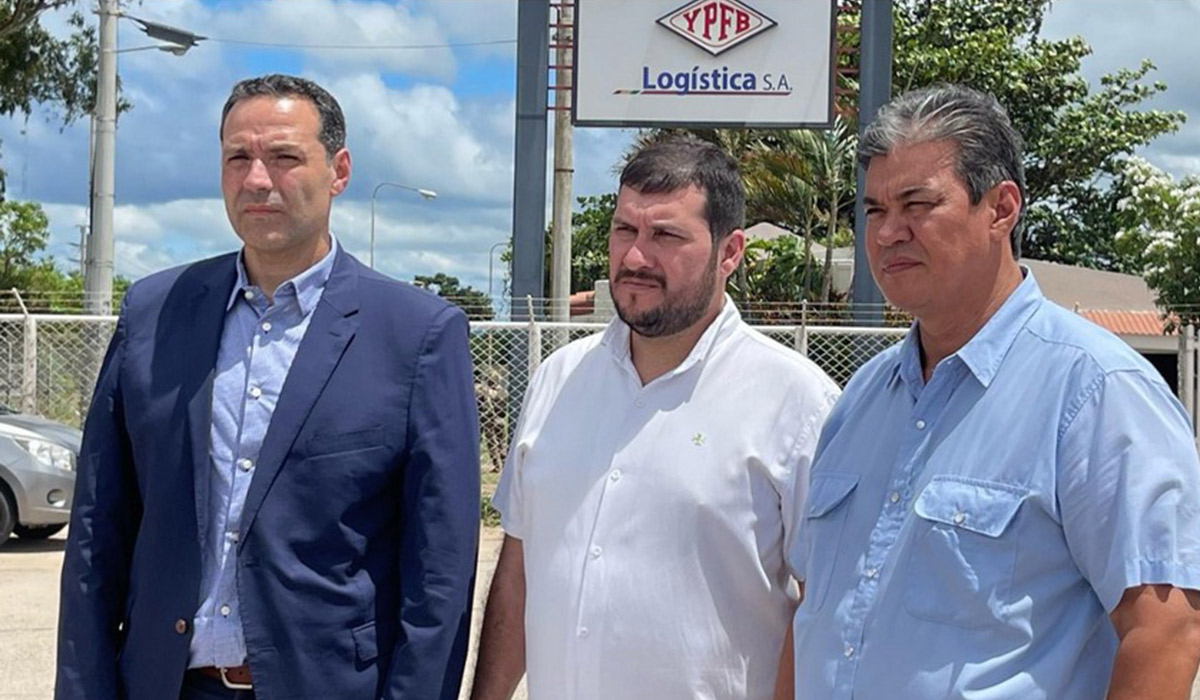
Leaders of the Comité pro Santa Cruz.
The crisis caused by the diesel shortage in Bolivia is worsening, raising alarm across various productive sectors. In Santa Cruz, civic leaders denounced that the country has collapsed and demanded immediate government solutions to prevent widespread shortages.
The long lines of tankers at the Palmasola refinery highlight the severity of the problem. Dozens of trucks are waiting to load fuel as uncertainty grows among transporters, market vendors, and agricultural entrepreneurs.
The president of the Comité pro Santa Cruz, Stello Cochamanidis, criticized the lack of information from YPFB and the national government.
“Bolivia has collapsed. Hundreds of tankers are waiting for fuel, but Yacimientos remains silent. Let Luis Arce come out, let the head of Yacimientos come out and say whether there is money to buy fuel or not,” Cochamanidis stated after an inspection in Palmasola.
The situation affects not only transporters but also merchants and producers. Erland Melgar, from the Cámara de Transporte del Oriente (CTO), warned that the crisis could directly impact the harvest of essential products such as sugarcane, corn, soybeans, and rice. “We need between 70 and 90 million liters of fuel to ensure the harvest over the next 45 days. The question is: is the government in a position to guarantee this?” he asked.
Market vendors have also expressed concern. Edgar Álvarez, a sector leader in Santa Cruz, warned that the diesel shortage could halt the production and distribution of consumer goods, directly affecting household economies.
“If we don’t have products to sell, our families have no income. It’s a chain reaction that impacts all Bolivians,” he stated.
The situation at gas stations is also critical. Since mid-February, heavy transport and interdepartmental bus drivers have reported long waits to refuel, sometimes exceeding two days.
In Santa Cruz, transporters must wait up to 48 hours for fuel, while in Cochabamba, stations stop selling even before 4 p.m.
More than 600 tankers are stranded in Paraguay, and at least 250 are stuck at YPFB Santa Cruz due to payment delays and Bolivia’s economic crisis. The fuel shortage and lack of U.S. dollars have led to a collapse in heavy transport, affecting both imports and exports of essential goods.
Héctor Mercado, president of the Heavy Transport Chamber, denounced that stations are limiting diesel sales to amounts between 1,000 and 1,500 bolivianos, further complicating transporters’ work.
“This is no longer a matter for the ANH or YPFB; it’s a problem with the country’s economy,” Mercado stated.
The transport leader revealed that between 600 and 700 trucks are stranded in Paraguay due to unpaid fuel suppliers, while at least 250 are stuck at YPFB Santa Cruz, unable to unload.
“There are no U.S. dollars in Bolivia, and that directly affects fuel imports,” he explained.
“We have hundreds of units stuck in San Ignacio de Velasco, PFC, Frigor, and Fridosa. This means paying extra fees for containers and refrigerated trucks that are sitting idle,” Mercado detailed.
The transport sector has proposed several solutions to the government, including freeing up access to U.S. dollars to facilitate diesel imports and speeding up export permits. However, according to Mercado, the government is not taking effective action.
“The government is solving the problem by hiding,” he lamented.
Mercado emphasized that the economic crisis is reflected in rising prices and a lack of cash flow in the country, which, according to him, will increasingly impact the general population.
“The solutions are in the government’s hands, but they refuse to act,” he concluded.
Por Odilia Llanos, El Dia:
Ante escasez de combustible, cívicos cruceños advierten colapso económico y exigen respuestas al Gobierno
Las largas filas de cisternas en la refinería de Palmasola reflejan la gravedad del problema.
Líderes del Comité pro Santa Cruz.
La crisis por la falta de diésel en Bolivia se agudiza y genera alarma en distintos sectores productivos. En Santa Cruz, los cívicos denunciaron que el país ha colapsado y exigieron al Gobierno soluciones inmediatas para evitar un desabastecimiento generalizado.
Las largas filas de cisternas en la refinería de Palmasola reflejan la gravedad del problema. Decenas de camiones esperan cargar combustible, mientras la incertidumbre crece entre transportistas, gremiales y empresarios del agro.
El presidente del Comité pro Santa Cruz, Stello Cochamanidis, cuestionó la falta de información por parte de YPFB y del Gobierno nacional.
“Bolivia ha colapsado. Existen centenares de cisternas esperando combustible, pero Yacimientos no da la cara. Que salga Luis Arce, que salga el de Yacimientos y digan si hay plata o no para comprar combustible”, manifestó Cochamanidis tras una inspección en Palmasola.
La situación no solo afecta a los transportistas, sino también a los comerciantes y productores. Desde la Cámara de Transporte del Oriente (CTO), Erland Melgar alertó que la crisis podría impactar directamente en la cosecha de productos esenciales como caña de azúcar, maíz, soya y arroz. “Necesitamos entre 70 y 90 millones de litros de combustible para garantizar la cosecha en los próximos 45 días. La pregunta es: ¿el Gobierno está en condiciones de garantizarlo?”, cuestionó.
Los gremiales también expresaron su preocupación. Edgar Álvarez, dirigente del sector en Santa Cruz, advirtió que la falta de diésel podría paralizar la producción y distribución de bienes de consumo, afectando directamente a la economía familiar.
“Si no tenemos productos que vender, no hay ingresos para nuestras familias. Es una cadena que impacta a todos los bolivianos”, señaló.
El panorama en las estaciones de servicio también es crítico. Desde mediados de febrero, los conductores de transporte pesado y buses interdepartamentales han reportado largas esperas para abastecerse de combustible, llegando incluso a permanecer más de dos días en fila.
En Santa Cruz, los transportistas deben esperar hasta 48 horas para cargar combustible, mientras que, en Cochabamba, las estaciones dejan de vender incluso antes de las 4 de la tarde.
Más de 600 cisternas están varadas en Paraguay y al menos 250 unidades están detenidas en YPFB Santa Cruz debido a la falta de pago y la crisis económica que atraviesa Bolivia. La escasez de combustible y la falta de dólares han generado un colapso en el transporte pesado, afectando tanto la importación como la exportación de bienes esenciales.
Héctor Mercado, presidente de la Cámara de Transporte Pesado, denunció que los surtidores están limitando la venta de diésel a montos de entre 1.000 y 1.500 bolivianos, lo que dificulta aún más el trabajo de los transportistas.
“Este ya no es un tema de la ANH ni de YPFB, es un problema de la economía del país”, expresó Mercado.
El dirigente del transporte reveló que hay entre 600 y 700 camiones varados en Paraguay debido a la falta de pago a los proveedores de combustible, mientras que, en YPFB Santa Cruz, al menos 250 unidades están detenidas sin poder descargar.
“No hay dólares en Bolivia y eso afecta directamente la importación de combustible”, explicó.
“Tenemos cientos de unidades paradas en San Ignacio de Velasco, PFC, Frigor y Fridosa. Esto implica pagar sobreestadías por contenedores y refrigerados que están detenidos”, detalló Mercado.
Desde el sector del transporte, se han planteado diversas soluciones al Gobierno, incluyendo la liberación del dólar para facilitar la importación de diésel y la agilización de los permisos de exportación. Sin embargo, según Mercado, el Gobierno no está tomando medidas efectivas.
“El Gobierno soluciona el problema no dando la cara”, lamentó.
Mercado destacó que la crisis económica se refleja en el encarecimiento de productos y la falta de flujo de dinero en el país, lo que, según el dirigente, impactará cada vez más a la población en general.
“Las soluciones están en manos del Gobierno, pero no las quiere dar”, concluyó.

 Bolivian Thoughts | Pensamientos Bolivianos (Bilingual/Bilingüe)