
By El Diario/Brújula Digital:
There is a serious risk of entering “default”
Bolivia’s country risk is the second worst in the region, according to JP Morgan
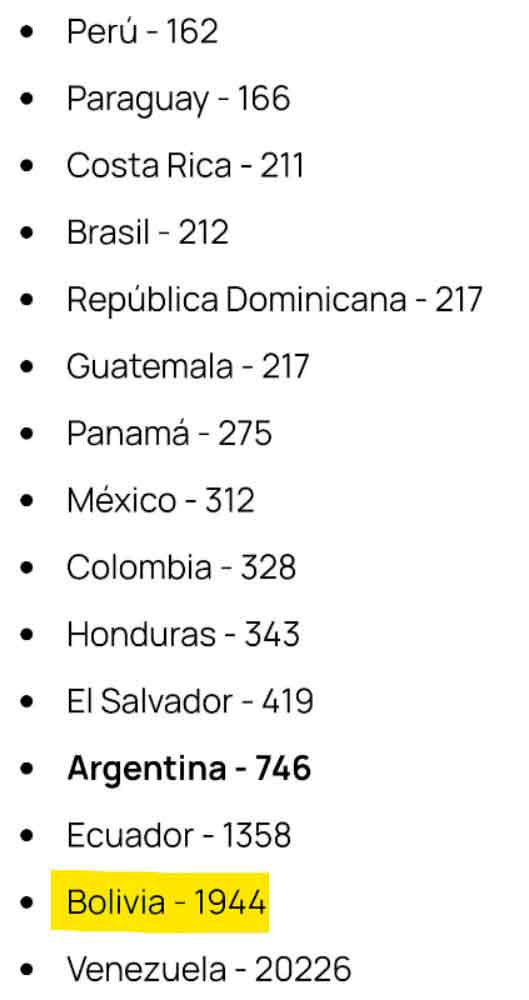
Bolivia faces a severe deterioration in its economic situation, evidenced by an increase in its country risk, currently at 1,942 points, making it the second highest in Latin America, surpassed only by Venezuela, whose risk stands at 20,226 points.
This indicator, compiled by JP Morgan and reflected in the Emerging Markets Bond Index (EMBI), highlights growing investor concerns about the country’s ability to meet its financial obligations.
Bolivia’s economic crisis is worsening due to a series of internal and external factors. Persistent social conflicts and a diesel shortage have significantly impacted productive activities.
Moreover, Bolivia reports a trade deficit of $329 million, with exports falling sharply to $1.6038 billion by September 2024. Net International Reserves (NIR) have dwindled to $1.97 billion, while accumulated inflation has risen to 7.26%, a level unseen since the pandemic.
In contrast to Bolivia’s situation, other countries in the region have shown notable improvement in their country risk indicators.
Argentina, which began the year with a country risk of 1,907 points, reduced it to 772 points by mid-November. Ecuador also saw a significant decrease, dropping from 2,005 points to 1,322. Brazil, meanwhile, maintains a relatively low country risk at 204 points.
Negative perceptions about Bolivia are exacerbated by a persistent public deficit that has eroded international reserves and limited foreign investment. Fuel shortages and dollar scarcity are visible symptoms of a multidimensional crisis threatening to deepen poverty and restrict economic growth.
SEVERE RISK
The Bolivian economy stands on the brink of an unprecedented crisis, with imminent risks of devaluation and default on its external debt, according to a recent analysis by Juan Pablo Spinetto published in the renowned economic news portal Bloomberg.
Spinetto notes that “the socialist economic model” that once showed signs of success in Bolivia has collapsed, and “the worst is yet to come.”
The latest sign of this crisis emerged when the aviation industry urgently requested government intervention to meet suppliers’ dollar payment demands.
Without such assistance, the country could face flight suspensions, further isolating itself in an already economically troubled region.
In an effort to mitigate the crisis, President Luis Arce Catacora has taken measures to reverse the decline in hydrocarbon production, offering incentives to foreign oil and gas companies and liberalizing the fuel market last week to try to alleviate gasoline shortages.
However, experts warn that these actions come too late and are insufficient to address the structural imbalances that have led Bolivia to its current situation.
Spinetto points out that these imbalances result from poorly managed policies during the golden era of Evo Morales’s government between 2006 and 2019, during which Arce served as his Minister of Economy. A more prudent approach would have moderated public spending, invested in ensuring that the country’s natural gas boom continued to finance national finances for decades, and slowly devalued the currency.
GOVERNMENT REJECTION
The Bolivian government has expressed its disagreement with the negative assessments by JP Morgan and Bloomberg, arguing that they do not adequately reflect the country’s resilience and potential.
According to the Ministry of Economy, JP Morgan’s report and the specialized media’s comments fail to properly consider the impact of external and internal factors that affected all economies, including the strongest ones.
Among these factors are global geopolitical tensions, rising supply chain costs, and a global economic slowdown. However, the Ministry emphasized that in Bolivia’s case, internal political conflicts and blockades have also negatively influenced the country’s economic perception.
“Blockades organized between October and November by sectors aligned with former President Evo Morales alone caused economic losses exceeding $2.2 billion, compounded by the paralysis of external credits worth more than $1.2 billion in the Plurinational Legislative Assembly,” the entity stated.
The Ministry of Economy emphasized that Bolivia maintains stable economic performance, demonstrating its ability to face both internal and external challenges.
Additionally, it reaffirmed its commitment to implementing the Social Community Productive Economic Model, which seeks to strengthen the domestic market and advance industrialization with import substitution. This approach, according to the MEFP, mitigated the adverse effects of the global situation and preserved the economic stability of Bolivian families.(EL DIARIO/Brújula Digital/agencias)
Por El Diario/Brújula Digital:
Existe grave riesgo de entrar en “default”
Riesgo país de Bolivia es el segundo peor de la región, según JP Morgan
Bolivia enfrenta un grave deterioro en su situación económica, evidenciado por el aumento de su riesgo país, que se sitúa actualmente en 1.942 puntos, convirtiéndose en el segundo más alto de América Latina, solo superado por Venezuela, cuyo riesgo alcanza los 20.226 puntos.
Este indicador, elaborado por JP Morgan y reflejado en el Índice de Bonos de Mercados Emergentes (EMBI), destaca la creciente preocupación de los inversionistas sobre la capacidad del país para cumplir con sus obligaciones financieras.
La crisis económica boliviana se agrava por una serie de factores internos y externos. Conflictos sociales persistentes y un desabastecimiento de diésel han afectado gravemente las actividades productivas.
Además, Bolivia reporta una balanza comercial negativa de 329 millones de dólares, con una caída significativa en las exportaciones que alcanzó los 1.603,8 millones de dólares hasta septiembre de 2024. Las Reservas Internacionales Netas (RIN) se han reducido a 1.970 millones de dólares, mientras que la inflación acumulada ha subido al 7,26%, un nivel no visto desde la pandemia.
En contraste con la situación de Bolivia, otros países de la región han mostrado una notable mejoría en sus indicadores de riesgo país.
Argentina, que comenzó el año con un riesgo país de 1.907 puntos, logró reducirlo a 772 puntos para mediados de noviembre. Ecuador también ha visto una disminución significativa, pasando de 2.005 puntos a 1.3221. Brasil, por su parte, mantiene un riesgo país relativamente bajo en 204 puntos.
La percepción negativa sobre Bolivia se ve exacerbada por un déficit público persistente que ha afectado las reservas internacionales y ha limitado la inversión extranjera. La falta de carburantes y la escasez de dólares son síntomas visibles de una crisis multidimensional que amenaza con profundizar la pobreza y limitar el crecimiento económico.
GRAVE RIESGO
La economía boliviana se encuentra al borde de una crisis sin precedentes, con riesgos inminentes de devaluación y default de su deuda externa, según un análisis reciente de Juan Pablo Spinetto publicado en el prestigioso portal de noticias económicas Bloomberg.
Spinetto señala que “el modelo económico socialista” que alguna vez mostró signos de éxito en Bolivia, ha colapsado y que “lo peor aún está por venir”.
El último indicio de esta crisis se evidenció cuando la industria de la aviación solicitó urgentemente la intervención del Gobierno para cumplir con las demandas de pagos en dólares de sus proveedores.
Sin esta ayuda, el país podría enfrentar la suspensión de vuelos, aislándose aún más en una región ya complicada económicamente.
En un intento por mitigar la crisis, el presidente del Estado, Luis Arce Catacora, ha tomado medidas para revertir la caída en la producción de hidrocarburos, ofreciendo incentivos a empresas extranjeras de petróleo y gas y liberalizando el mercado de combustibles la semana pasada para intentar aliviar la escasez de gasolina.
Sin embargo, expertos advierten que estas acciones llegan demasiado tarde y son insuficientes para resolver los desequilibrios estructurales que han llevado a Bolivia a su situación actual.
Spinetto señala que estos desequilibrios son el resultado de políticas mal manejadas durante la era dorada del gobierno de Evo Morales entre 2006 y 2019, periodo en el cual Arce se desempeñó como su ministro de Economía. Un enfoque más sensato habría moderado el gasto público, invertido en asegurar que la bonanza del gas natural del país continuara financiando las finanzas nacionales durante décadas y devaluado lentamente la moneda.
RECHAZO GUBERNAMENTAL
El Gobierno boliviano ha expresado su desacuerdo con las evaluaciones negativas realizadas por JP Morgan y Bloomberg, argumentando que no reflejan adecuadamente la resiliencia y potencial del país.
Según el Ministerio de Economía, el informe de JP Morgan y los comentarios del medio especializado no consideran adecuadamente el impacto de factores externos e internos que afectaron a todas las economías, incluidas las más sólidas.
Entre estos factores destacan las tensiones geopolíticas globales, el encarecimiento de las cadenas de suministro y la desaceleración económica mundial. Sin embargo, el Ministerio subrayó que en el caso de Bolivia, los bloqueos y conflictos políticos internos también han influido negativamente en la percepción económica del país.
“Solo los bloqueos organizados entre octubre y noviembre por sectores afines al expresidente Evo Morales generaron pérdidas económicas superiores a los 2.200 millones de dólares, a lo que se suma la paralización de créditos externos por más de 1.200 millones de dólares en la Asamblea Legislativa Plurinacional”, indicó la entidad.
El Ministerio de Economía destacó que Bolivia mantiene un desempeño económico estable, demostrando su capacidad para enfrentar desafíos tanto internos como externos.
Además, reafirmó su compromiso con la implementación del Modelo Económico Social Comunitario Productivo, que busca fortalecer el mercado interno y avanzar hacia la industrialización con sustitución de importaciones. Este enfoque, según el MEFP, permitió mitigar los efectos adversos de la coyuntura global y preservar la estabilidad económica de las familias bolivianas.(EL DIARIO/Brújula Digital/agencias)

 Bolivian Thoughts | Pensamientos Bolivianos (Bilingual/Bilingüe)