
ANF, Eju.tv:
Burned forests in the Bolivian Amazon will bring drought and desertification, with little water for agriculture and livestock
– The forest fires occurring across the country, which are destroying forests, especially in the Bolivian Amazon, will lead to drought and desertification, leaving little water for livestock and agriculture, warned researcher Vincent Vos.
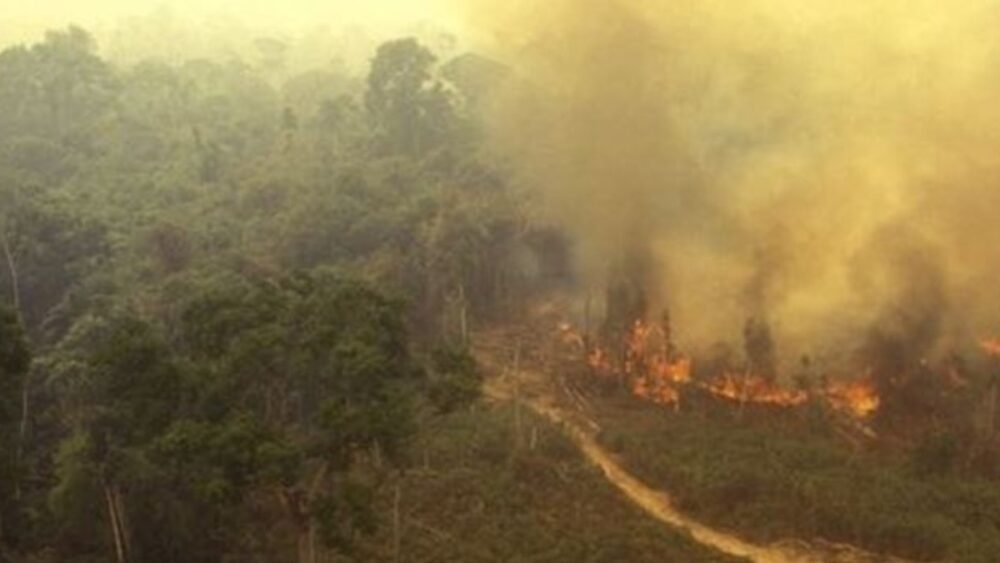
Fires in Bolivian territory. Photo: Internet
“Fires for deforestation purposes are a form of suicide, done without thought. Surely, for those burning and cutting down trees, this land will be negotiable for ranchers and farmers, but the effects will turn against them. In northern Santa Cruz, we have large areas that are totally degraded, and drought will intensify, with less water available for these activities,” stated the researcher from the Amazon Forest Research Institute in an interview with ANF.
He recalled that the Amazonian forests being “burned” are the ones that generate rainfall for the entire national territory through a natural process, with a cycle of precipitation and transpiration of the trees.
“All the rain that falls in Bolivia actually comes from the Amazon. It creates its own low-pressure zone through moisture-laden air from the Atlantic, which enters the South American continent. It falls in the Amazon, and the trees transpire it to carry their nutrients. Some trees give 100 liters of water per day, and some giant Amazonian trees up to 1,000 liters,” he clarified.
“The forests are turning into grasslands, into pampas, they could become deserts. Already in the south of the country, we have many problems with desertification. This will increasingly affect Santa Cruz, Beni, and Pando. We are really heading in that direction. Surely, they will ask again for transgenic products, with drought-adapted crops, but it won’t work because, without water, there is no growth. And agriculture is increasingly at risk,” he stated.
Loss of biodiversity
He also warned that the fires, with an estimated 7 million hectares burned, will directly impact biodiversity.
“Looking at previous estimates, there are studies on how many animals have died. If burning continues, up to 15 million mammals could be lost. If we add amphibians, reptiles, and birds, we might be talking about 50 to 100 million dead animals, not to mention insects,” he said.
He added that some species, due to the fires, “may already have gone extinct” in the Amazon.
/ERA
ANF, Eju.tv:
Bosques quemados en la Amazonía boliviana traerán sequía y desertificación, habrá poca agua para la agropecuaria
– Los incendios forestales que se registran en el territorio nacional y que acaban con los bosques, sobre todo en la amazonia boliviana, traerán sequía y desertificación, habrá poca agua para la ganadería y la agricultura, advirtió el investigador, Vincent Vos.
Incendios en el territorio boliviano. Foto: Internet
“Los incendios con fines de deforestación, es un suicidio, lo que se está haciendo sin pensar. Seguro que para los que están quemando y tumbando los árboles, serán negociables esas tierras, para ganaderos y agricultores, pero sus efectos van en contra de ellos mismos. En el norte de Santa Cruz, tenemos grandes áreas totalmente degradadas y cada vez se acentuará la sequía, y habrá poca agua para estas actividades”, señaló el Investigador del Instituto de Investigaciones Forestales de la Amazonia, en entrevista con la ANF.
Recordó que los bosques de la amazonía que se están “quemando” son los que generan las lluvias para el todo territorio nacional, mediante un proceso natural, con un ciclo de precipitación y transpiración de los árboles.
“Toda la lluvia que cae en Bolivia, en realidad viene de la amazonia, la crea su propia zona de baja presión mediante el aire cargado de humedad desde el Atlántico que entra al continente sudamericano; cae en la amazonia y los árboles lo transpiran para poder llevar sus nutrientes. Hay árboles que dan 100 litros de agua por día, algunos árboles gigantes de la amazonia hasta 1.000 litros” aclaró.
“Los bosques se están convirtiendo en pampas, en pastizales, pueden volverse desiertos, ya en el sur del país tenemos muchos problemas con la desertificación. Afectará cada vez más a Santa Cruz, Beni y Pando, realmente estamos en esa dirección. Seguro otra vez van a pedir productos transgénicos, con productos adaptados a la sequía, pero no va funcionar, porque al final sin agua, no hay crecimiento y realmente cada vez está en más en riesgo la producción agropecuaria”, sostuvo.
Pérdida de la biodiversidad
Por otra parte, anticipó que el efecto de los incendios con la estimación de 7 millones de hectáreas quemadas, directamente afectará a la biodiversidad.
“Basta ver cálculos anteriores, hay estudios, cuántos animales han muerto, si se sigue quemando, podría perderse hasta más de 15 millones de mamíferos y si sumamos anfibios, reptiles, aves, estaríamos tal vez hablando de 50 o hasta 100 millones de animales muertos y ni hablar de insectos”, dijo.
Agregó que algunas especies, debido a los incendios “tal vez” ya se han extinguido en la Amazonía.
/ERA

 Bolivian Thoughts | Pensamientos Bolivianos (Bilingual/Bilingüe)