
El Diario:
- The slowdown began in 2022, and there has been stagnation since 2024, leading to the current shortage of dollars and increased inflation, as stated by the Tarija-based economist, Luis Fernando Romero.
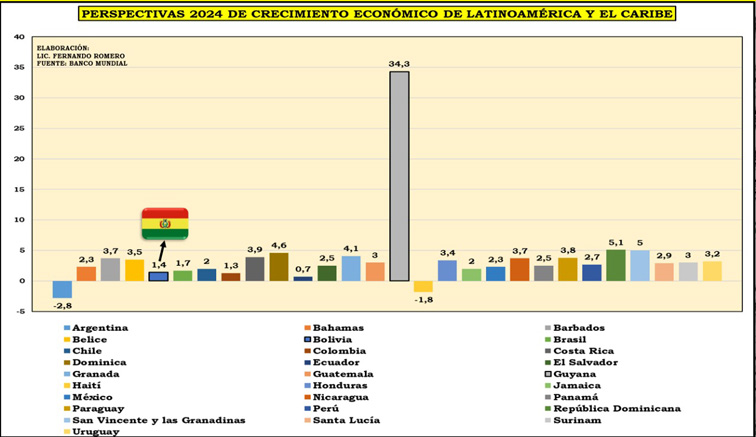
Bolivia ranks 20th out of 28 countries in the region, with a projected growth of 1.4%, which is below the growth of Latin America and the Caribbean (LAC) and the regional average of 3.72%, according to the latest report from the World Bank.
Luis Fernando Romero Torrejón, the president of the Departmental College of Economists of Tarija, stated that this slowdown, which has been occurring since 2022 and stagnation since 2024, is mainly due to fiscal issues, excessive public debt, and a deficit persisting for 11 consecutive years, resulting in the current shortage of dollars and higher inflation.
The latest World Bank report titled “Competition: the missing ingredient for growth” has determined that the GDP growth of Latin America and the Caribbean will be 1.6% for 2024, one of the lowest in recent years, stemming from an unrecovered post-pandemic economy, fiscal problems, public indebtedness, and the international situation with inflationary pressures and still high-interest rates.
Economist and university lecturer Gonzalo Chávez highlighted on his X account that the projections refute the government’s “propaganda,” emphasizing the need for corrections in economic policy, considering that fiscal revenues have declined, and there is a high public expenditure supported by increased external and internal debt.
“Projections and data indicate that we are in a rather complex situation,” Romero expressed.
- La desaceleración es desde el 2022 y estancamiento desde el 2024, derivó en la actual escasez de dólares y mayor inflación, según el economista tarijeño Luis Fernando Romero.
Bolivia, ocupa el puesto N°20, de 28 países de la región, con un crecimiento proyectado del 1,4%, el cual está por debajo del crecimiento de América Latina y el Caribe (ALC) y del promedio regional que es de 3,72%, según el último informe del Banco Mundial (BM).
El presidente del Colegio Departamental de Economistas de Tarija, Luis Fernando Romero Torrejón, sostuvo que esta desaceleración que se da desde el 2022 y estancamiento desde el 2024, se debe principalmente a temas fiscales, una sobre deuda pública y un déficit de 11 años consecutivos, que derivó en la actual escasez de dólares y mayor inflación.
En el último informe del Banco Mundial titulado “Competencia: el ingrediente que falta para crecer”, ha determinado que el crecimiento del PIB de América Latina y el Caribe será de 1,6% para el 2024, uno de los más bajos en los últimos años, derivados de una economía no recuperada pospandemia, problemas fiscales, endeudamiento público y la coyuntura internacional con presiones inflacionarias y aún elevadas tasas de interés.
El economista y docente universitario Gonzalo Chávez en su cuenta de X resaltó que las proyecciones echan por tierra la “propaganda” del Gobierno, por lo que sostiene que es necesario realizar correcciones en la política económica, considerando que los ingresos fiscales han caído y se soporta un gasto público elevado, a través de mayor deuda externa e interna.
“Las proyecciones y los datos están dando a entender que estamos en una situación bastante compleja”, manifestó Romero.
https://www.eldiario.net/portal/2024/04/12/bolivia-en-puesto-20-de-crecimiento-economico/

 Bolivian Thoughts | Pensamientos Bolivianos (Bilingual/Bilingüe)