
El Diario:
In his management report
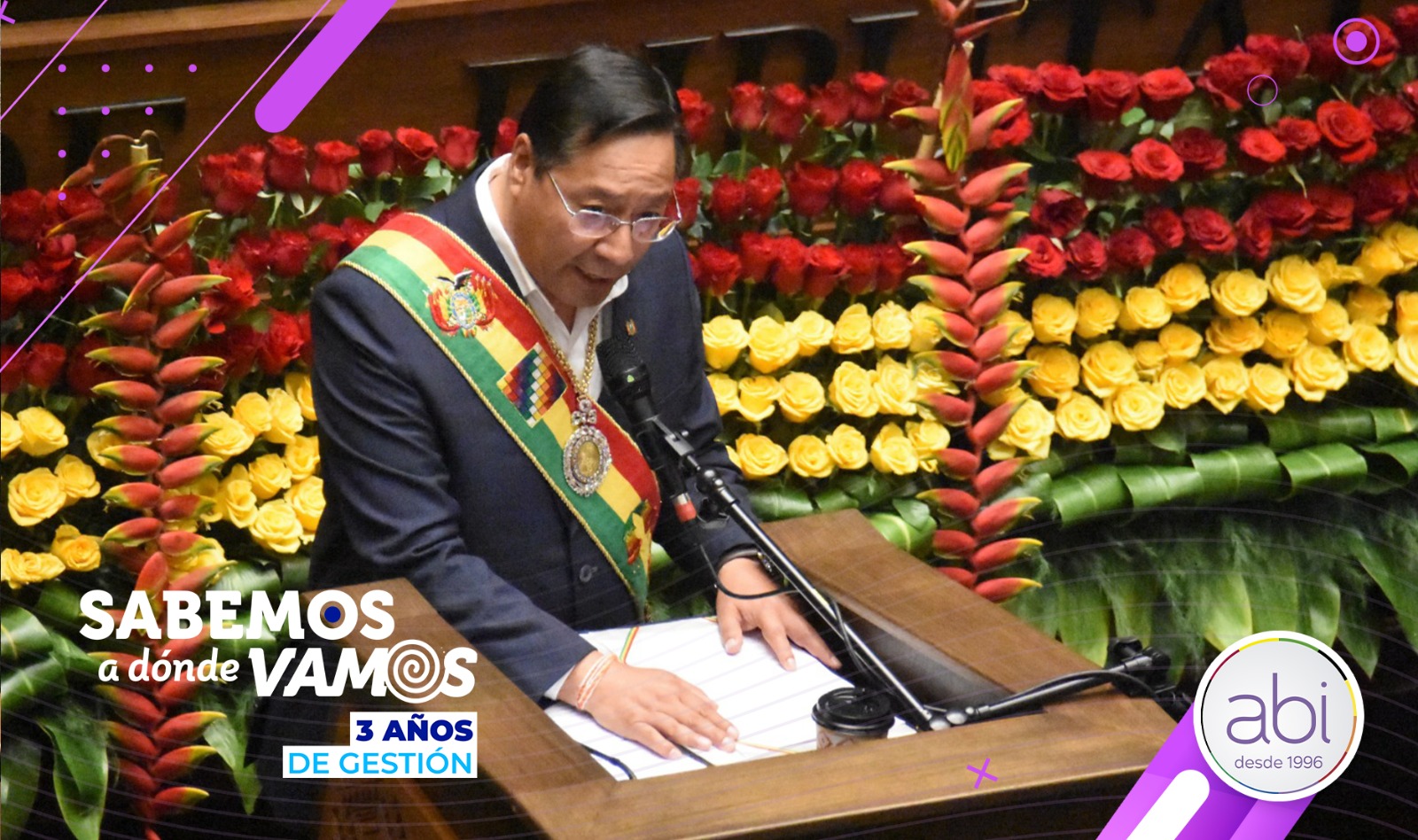
LUIS ARCE CATACORA YESTERDAY DURING HIS INTERVENTION AT THE ALP. PHOTO: RRSS
In his three-year speech, the President of the State, Luis Arce Catacora, avoided mentioning the fall in reserves and confirmed the slowdown of the economy, from 4.8% to 3%. Economists called the report half-truths.
The report presented by the President was compared with an already written script, which has been repeated since the beginning of the year and which is also disseminated in Government propaganda.
The president of the College of Economists of Tarija, Fernando Romero, said that although the Head of State speaks of a third year in terms of economic growth in South America; There are other countries in the Latin American region that will have higher growth than Bolivia.
Romero observed that he did not address the issue of the sustained trade deficit, which in August reached -47 million dollars, nor did he mention the hydrocarbon sector, where a negative balance is recorded, since 8 million dollars are required each day to import. fuels. The shortage of dollars continues in the national market.
Nor did he refer to the accelerated fall of International Reserves, whose status to date is unknown, but according to estimates by economists it would be a little more than 2,000 million dollars, after selling 17 tons of gold for a more than more than 1 billion dollars.
For Romero, there is a lot of information that was ignored, which shows the lack of transparency of the economic data, as well as the unsuccessful policies of the Central Bank of Bolivia, which generated the price of a parallel dollar.
Arce Catacora confirmed the slowdown of the Bolivian economy, indicating that for this administration they lowered the estimate from 4.8% to 3%, figures that show that the data has been falling since 2022, when it registered 3.5%, lower than 2021 which reached 6.1%, attributed to a statistical rebound, according to economists.
For this year, international organizations project Bolivia’s economic growth of 2%. For example, the Economic Commission for Latin America and the Caribbean, Bolivia will register 2.2%, the International Monetary Fund 1.8%, while the World Bank indicates 1.9%.
At the time, the economist, Gonzalo Chávez, indicated on his social networks that the slowdown comes from 2014 and culminated in 2019, a year later the economy entered a recession due to the pandemic and in 2021 it grew by rebound, but it was not enough to compensate the fall of 2020.
The Government strives to show that the Bolivian economy is solid and growing, a statement that is supported by statistics and political discourse.
The low inflation that the Government proclaims is not reflected in people’s pockets, since the street thermometer says the opposite and is reflected in the fairs and markets, where the prices of some products in the family basket increased.
The economist, Gabriel Espinoza, wrote on his Twitter, @g_espinoza: “Say what you want, but in 2020 the egg maple cost 20 – 24 bolivianos. Today you can’t get anything for less than 30. We know clearly where we are going.”
While the director of the Tierra Foundation, Gonzalo Flores, wrote on his Twitter @DonGonchi: “Luis Arce: it is dishonest to say that we have the lowest inflation, without saying that fuels are subsidized, that the exchange rate is appreciated and that Prices are set by subsidies and administrative barriers.”
And analyst Joshua Bellott Sáenz wrote on his Twitter: “@joshuabellott: imported food and beverages between 2022 and 2020 rose by 55%.”
En su informe de gestión
LUIS ARCE CATACORA AYER DURANTE SU INTERVENCIÓN EN LA ALP. FOTO: RRSS
En su discurso de tres años de gestión, el presidente del Estado, Luis Arce Catacora, evitó mencionar la caída de las reservas y confirmó la desaceleración de la economía, de 4,8% a 3%. Los economistas calificaron al informe de medias verdades.
El informe presentado por el Primer Mandatario fue comparado con un libreto ya escrito, que se viene repitiendo desde principios de año y que también se difunde en la propaganda del Gobierno.
El presidente del Colegio de Economistas de Tarija, Fernando Romero, dijo que si bien el Jefe de Estado habla de un tercer año en materia de crecimiento económico en Sudamérica; hay otros países de la región de América Latina que tendrán un crecimiento más alto que Bolivia.
Romero observó que no abordó el tema del déficit comercial sostenido, que a agosto llegó a -47 millones de dólares, tampoco mencionó al sector hidrocarburos, en donde se registra una balanza negativa, ya que se requiere de 8 millones de dólares cada día para importar combustibles. La escasez de dólares se mantiene en el mercado nacional.
Tampoco se refirió a la caída acelerada de las Reservas Internacionales, que a la fecha se desconoce el estado de las mismas, pero de acuerdo a estimaciones de economistas estaría un poco más de 2.000 millones de dólares, luego de vender 17 toneladas de oro por un más de más de 1.000 millones de dólares.
Para Romero hay mucha información que se obvió, lo que muestra la poca transparencia de los datos económicos, así como las políticas poco acertadas del Banco Central de Bolivia, que generó la cotización de un dólar paralelo.
Arce Catacora confirmó la desaceleración de la economía boliviana, al indicar que para esta gestión bajaron la estimación de 4,8% a 3%, cifras que muestran que va cayendo el dato desde el 2022, cuando registró 3,5%, menor al 2021 que alcanzó 6,1%, atribuido a un rebote estadístico, según los economistas.
Para este año, los organismos internacionales proyectan un crecimiento económico de Bolivia de 2%. Por ejemplo, la Comisión Económica para América Latina y el Caribe, Bolivia registrará 2,2%, El Fondo Monetario Internacional 1,8%, mientras el Banco Mundial señala 1,9%.
En su momento el economista, Gonzalo Chávez, indicó en sus redes sociales que la desaceleración viene de 2014 y culminó en 2019, un año después la economía ingresó en recesión debido a la pandemia y el 2021 creció por rebote, pero no fue suficiente para compensar la caída de 2020.
El Gobierno se afana en mostrar que la economía boliviana es sólida y creciente, afirmación que sostiene de la mano de las estadísticas y el discurso político.
La baja inflación que pregona el Gobierno no se refleja en el bolsillo de las personas, ya que el termómetro de la calle dice todo lo contrario y se refleja en las ferias y mercados, donde subieron los precios de algunos productos de la canasta familiar.
El economista, Gabriel Espinoza, escribió en su twitter, @g_espinoza: “Digan lo que quieran, pero en el 2020 el maple de huevo costaba 20 – 24 bolivianos. Hoy no se consigue nada por menos de 30. Sabemos claramente a dónde vamos”.
Mientras el director de la Fundación Tierra, Gonzalo Flores, escribió en su twitter @DonGonchi: “Luis Arce: es deshonesto decir que tenemos la inflación más baja, sin decir que los carburantes están subsidiados, que el tipo de cambio está apreciado y que los precios están fijados por subvenciones y barreras administrativas”.
Y el analista Joshua Bellott Sáenz escribió en su twitter: “ @joshuabellott: los alimentos y bebidas importados entre 2022 y 2020 subieron en un 55%”.


 Bolivian Thoughts | Pensamientos Bolivianos (Bilingual/Bilingüe)