By Brújula digital:
“This Is Like the Pandemic”: Chávez Foresees Deep Recession and Warns Reforms Will Be Delayed
Economic analyst Gonzalo Chávez believes reforms in hydrocarbons, mining, and the Constitution will have to wait due to a lack of political conditions.

Economic analyst Gonzalo Chávez on Brújula Streaming.
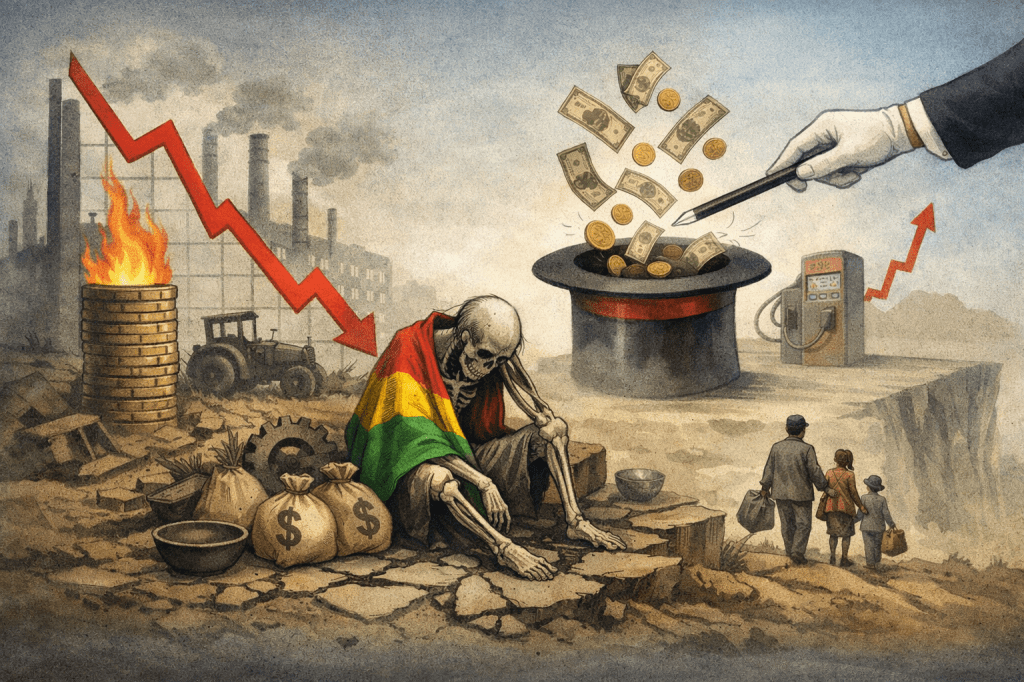
Economic analyst Gonzalo Chávez, speaking on Brújula Streaming, warned that Bolivia is facing one of its most severe economic crises in recent years. He estimates losses could reach US$2.5 billion, inflation may exceed 20%, and the country could enter a recession comparable to the economic shock caused by the COVID-19 pandemic.
Chávez states that the economic damage caused by social unrest and blockades is greater than initial estimates and will amount to between 4% and 5% of the Gross Domestic Product (GDP). “It is a much higher figure, and we are also seeing this reflected in exports—which have dropped by some $600 million—and the microeconomic impact is dramatic,” he declared on Monday.
Several productive sectors are already suffering serious consequences. Chávez claimed that 50% of restaurants in La Paz and El Alto have closed, while commerce, tourism, and the hospitality industry have also been heavily affected. He compared the current situation to a pandemic, saying it is a recession that simultaneously hurts supply—because businesses cannot sell goods and services—and demand, because consumers lack money or are unable to make purchases.
Chávez argued that Bolivia is cementing a year of recession that has been carrying over problems since 2024 and warned that economic growth could decline. “At this pace, I think we will reach what the World Bank predicted: between negative 3% and negative 4%. That is very severe and obviously affects the poorest people the most, especially through inflation,” he said. He also estimated that annual inflation could exceed 20%, which would have a strong impact on the population’s purchasing power.
Regarding the protests, Chávez calculated that sustaining the mobilizations for 46 days would have required around US$34 million, taking into account the minimum expenses per participant. “It is a gigantic amount, and there are two alternatives: either life in rural areas has improved significantly and the grassroots are willing to pay those US$34 million; or there is external financing in different forms, because it is truly a brutal amount of money,” he said.
Chávez stated that the Bolivian economy is once again in a critical situation that requires the implementation of emergency measures to prevent further deterioration. “The patient with financial problems has returned to the intensive care unit. Therefore, it is necessary to take measures to stabilize him and achieve a partial recovery,” he said.
Among the alternatives proposed, he mentioned the postponement of loan payments, the creation of support funds for affected sectors such as transportation, tourism, and hospitality, as well as possible temporary relief on utility payments and the reactivation of emergency public investment programs.
However, he warned that the damage caused will have long-term consequences and described the situation as a “crime against the economy.” “Unfortunately, this economic crime that we have committed is very complex,” he said.
He also argued that the structural reforms the country requires in strategic areas such as hydrocarbons, mining, transportation, and even constitutional reform will be postponed due to the political weakness that the crisis will leave behind. “The reforms are urgent: hydrocarbons, mining, transportation, constitutional reform. They will most likely have to wait, I don’t know for how long, because as things are going, the government will be severely affected and will have difficulties forming political coalitions that would allow the approval of these reforms,” he stated.
Chávez also warned about the consequences for the education system, arguing that the conflicts deepen structural problems affecting the education of children and young people. “In addition to the crime against the economy, you have committed a crime against education. We have failed at least three generations of children and young people because we have not been capable of creating a system in which they can learn,” he concluded.
BD/LE/MZS
Por Brújula digital:
“Esto es como la pandemia”: Chávez prevé una recesión profunda y advierte de postergación de reformas
El analista económico Gonzalo Chávez considera que las reformas en hidrocarburos, minería y en la CPE deberán esperar por la falta de condiciones políticas.
El analista económico Gonzalo Chávez en Brújula Streaming.
El analista económico Gonzalo Chávez advirtió en Brújula Streaming que Bolivia atraviesa una de las crisis económicas más graves de los últimos años, con pérdidas que alcanzarían los 2.500 millones de dólares, una inflación que podría superar el 20% y un escenario recesivo comparable a la pandemia de Covid-19.
Chávez afirma que el daño económico causado por los conflictos sociales y los bloqueos es mayor que las estimaciones iniciales y representará entre el 4% y el 5% del producto interno bruto (PIB). “Es una cifra mucho más alta, y también lo estamos viendo reflejado en las exportaciones, que han tenido que caer en unos 600 millones de dólares, y el impacto microeconómico es dramático”, declaró este lunes.
El economista señaló que varios sectores productivos ya están mostrando graves efectos. Por ejemplo, “el 50% de los restaurantes han cerrado aquí en La Paz y El Alto”, además de los daños registrados en el comercio, la gastronomía y el turismo. “Esto es como una pandemia. Es una recesión económica que afecta tanto a la oferta, con empresas que no pueden vender sus productos y servicios, como a la demanda, con personas que no tienen dinero o no pueden comprar bienes y servicios“, explicó.
Chávez argumentó que Bolivia está consolidando un año de recesión que arrastra problemas desde 2024 y advirtió que el crecimiento económico podría disminuir. “A este ritmo, creo que vamos a alcanzar lo que predijo el Banco Mundial: entre un 3% y un 4% negativo. Y eso es muy fuerte y obviamente afecta a los más pobres, especialmente a través de la inflación”, afirmó. También estimó que la inflación anual podría superar el 20%, lo que tendría un fuerte impacto en el poder adquisitivo de la población.
Respecto a las movilizaciones, Chávez calculó que mantener las protestas durante 46 días habría requerido alrededor de 34 millones de dólares, teniendo en cuenta los gastos mínimos por participante. “Es una cantidad gigantesca y hay dos alternativas: o la vida en el campo ha mejorado mucho y las bases están dispuestas a pagar esos 34 millones de dólares; o hay financiamiento externo de diferentes maneras, porque es una cantidad de dinero realmente brutal”, afirmó.
Chávez consideró que la economía boliviana se encuentra nuevamente en una situación crítica que requiere la aplicación de medidas de emergencia para evitar un mayor deterioro. “El paciente con problemas financieros ha regresado a la unidad de cuidados intensivos. Por lo tanto, es necesario tomar medidas para estabilizarlo y lograr una recuperación parcial”, afirmó.
Entre las alternativas propuestas, mencionó el aplazamiento de los créditos, la creación de fondos de apoyo para sectores afectados como el transporte, el turismo y la gastronomía, así como un posible alivio temporal en el pago de los servicios básicos y la reactivación de programas de inversión pública de emergencia.
Sin embargo, advirtió que los daños causados tendrán consecuencias a largo plazo y calificó la situación de “crimen contra la economía”. “Lamentablemente, este crimen económico que hemos cometido es muy complejo”, afirmó.
Asimismo, consideró que las reformas estructurales que el país requiere en áreas estratégicas como hidrocarburos, minería, transporte e incluso una reforma constitucional se pospondrán debido a la debilidad política que dejará la crisis. “Las reformas son urgentes: hidrocarburos, minería, transporte, la reforma constitucional. Seguramente tendrán que esperar, no sé cuánto tiempo, porque tal como van las cosas, el gobierno se verá muy afectado y tendrá dificultades para formar coaliciones políticas que permitan la aprobación de estas reformas”, indicó.
Chávez también advirtió sobre las consecuencias en el sistema educativo, considerando que los conflictos profundizan problemas estructurales que afectan la educación de niños y jóvenes. “Además del crimen de la economía, ustedes han cometido el crimen de la educación. Hemos defraudado al menos a tres generaciones de niños y jóvenes porque no estamos siendo capaces de crear un sistema donde aprendan”, concluyó.
BD/LE/MZS


Leave a Reply