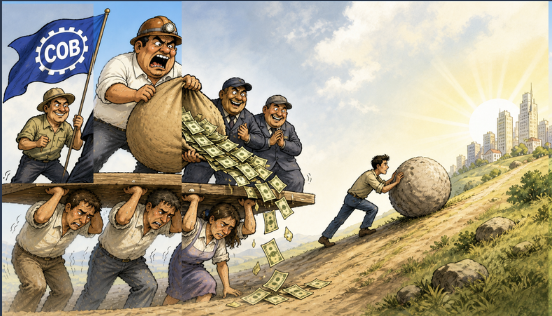
Editorial, El Dia:
Bolivia is going through one of the deepest crises in its republican history. This is not an ordinary political crisis, the kind the country has managed to resolve through pacts, negotiations, and a measure of pragmatism. What is happening now is qualitatively different: it is the organized, violent, and desperate resistance of criminal structures that, for nearly two decades, colonized the Bolivian state and that today feel, for the first time in a very long time, that someone is finally closing in on them.
The report by the Milenio Foundation documents it rigorously, but anyone who knows Bolivia closely does not need statistics to understand it: the coca-grower unions of Chapare, the social organizations blocking highways, the leaders stirring up the masses are not merely transmission belts for organized crime. They are the social façade of a business worth billions of dollars that connects laboratories in the Bolivian tropics with the streets of São Paulo, Madrid, and Shanghai.
For twenty years, that system functioned according to a perverse but coherent logic: drug trafficking financed politics, politics protected drug trafficking, and both sheltered themselves under the banner of sovereignty and indigenous rights. The expulsion of the DEA in 2008 formally opened the back door. What Bolivia is experiencing today is not social protest. It is a criminal counteroffensive.
And here lies the core of the problem: there is no easy way out. No one should fool themselves into thinking that the resignation of President Rodrigo Paz would solve anything. On the contrary, it would be the clearest signal that organized crime in Bolivia holds veto power over governments. It would repeat the script that drug trafficking has rehearsed in other latitudes, with results we already know well: more impunity, deeper institutional penetration, and more violence.
The only real way out, the only one with any chance of success, is determined and unapologetic international cooperation. Daniel Noboa understood this in Ecuador when organized crime attempted to seize power outright, when a kingpin was flown out of prison by helicopter, and when television stations were stormed by armed men. Noboa did not negotiate. He declared an internal armed conflict, called on his allies, and struck back. Ecuador today is not a paradise, but neither is it Afghanistan.
Bolivia stands at that exact crossroads. If the Paz government yields to the pressure of criminalized streets, if it retreats from cooperation with the DEA, if it abandons the Shield of the Americas strategy, the country will not simply return to the MAS “normality.” It will fall into something worse: a narco-state without even the appearance of institutional order.
History does not forgive weakness in decisive moments. Bolivia today needs what it struggles most to accept: external assistance, international cooperation without euphemisms, and the determination not to surrender to those who mistake the streets for their own battlefield. The only way out is forward. And no one walks it alone.
Editorial, El Día:
Bolivia atraviesa una de las crisis más profundas de su historia republicana. No se trata de una crisis política ordinaria, de esas que el país ha sabido resolver con pactos, negociaciones y algo de pragmatismo. Lo que ocurre ahora es cualitativamente distinto: es la resistencia organizada, violenta y desesperada de estructuras criminales que durante casi dos décadas colonizaron el Estado boliviano y que hoy sienten, por primera vez en mucho tiempo, que alguien les está pisando los talones.
El informe de la Fundación Milenio lo documenta con rigor, pero quien conoce Bolivia de cerca no necesita estadísticas para entenderlo: los sindicatos cocaleros del Chapare, las organizaciones sociales que bloquean carreteras, los dirigentes que agitan a las masas no son correas de transmisión del crimen organizado. Son la fachada social de un negocio valuado en miles de millones de dólares que conecta laboratorios en el trópico boliviano con las calles de São Paulo, Madrid y Shanghái.
Durante veinte años, ese sistema funcionó con una lógica perversa pero coherente: el narcotráfico financiaba la política, la política protegía al narcotráfico, y ambos se cubrían bajo el manto de la lucha por la soberanía y los derechos indígenas. La expulsión de la DEA en 2008 fue la apertura formal de la puerta trasera. Lo que hoy vive Bolivia no es protesta social. Es una contraofensiva criminal.
Y aquí está el nudo del problema: no hay salida fácil. Que nadie se engañe pensando que la renuncia del presidente Rodrigo Paz resolvería algo. Al contrario: sería la señal más clara de que en Bolivia el crimen organizado tiene poder de veto sobre los gobiernos. Sería la repetición del libreto que el narcotráfico ha ensayado en otras latitudes, con resultados que conocemos: más impunidad, más penetración institucional, más violencia.
La única salida real, la única que tiene alguna posibilidad de éxito, es la cooperación internacional decidida y sin complejos. Daniel Noboa lo entendió en Ecuador cuando el crimen organizado intentó tomar el poder por asalto, cuando un capo fue sacado de prisión en helicóptero y cuando cámaras de televisión fueron tomadas por hombres armados. Noboa no negoció. Declaró conflicto armado interno, llamó a sus aliados y golpeó. Hoy Ecuador no es un paraíso, pero tampoco es Afganistán.
Bolivia está en esa encrucijada exacta. Si el gobierno de Paz cede ante la presión de las calles criminalizadas, si retrocede en la cooperación con la DEA, si abandona la estrategia del Escudo de las Américas, el país no volverá simplemente a la normalidad del MAS. Caerá en algo peor: un narcoestado sin siquiera la apariencia de institucionalidad.
La historia no perdona la debilidad en los momentos decisivos. Bolivia necesita hoy lo que más le cuesta aceptar: ayuda externa, cooperación internacional sin eufemismos y la determinación de no rendirse ante quienes confunden las calles con un campo de batalla propio. La única salida es hacia adelante. Y no se camina solo.
https://eldia.com.bo/2026-05-19/editorial/la-unica-salida-.html


Leave a Reply