
By El Diario:
They Will Apply Measures Gradually and Rule Out Going to the International Monetary Fund
- They highlight the 2026 General State Budget because it reduces current spending and increases investment in education and health, while also lowering the fiscal deficit.
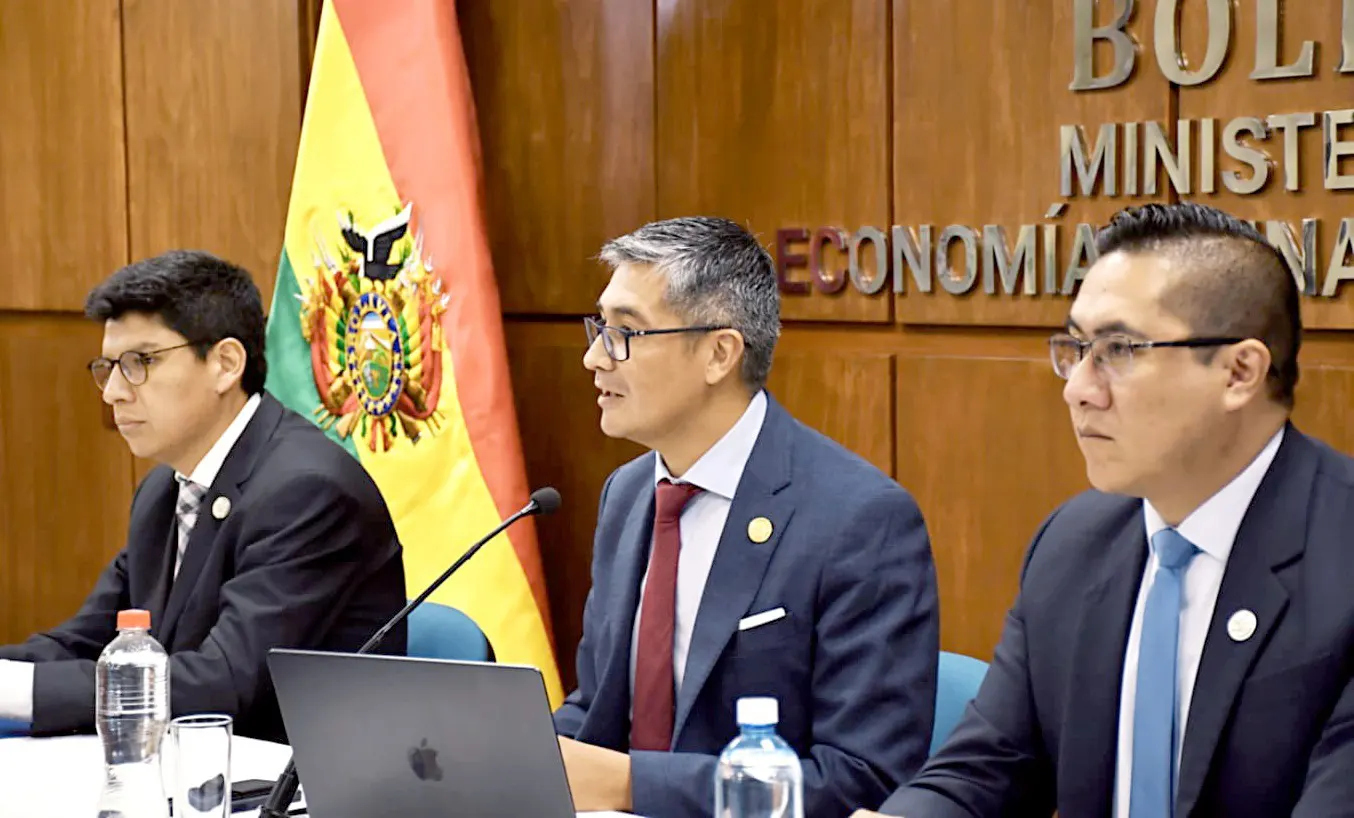
The Government will apply measures to reactivate the economy and change the model gradually, ruling out shock adjustments and also ruling out turning to the International Monetary Fund, because what is needed is not recipes but economic policies, according to the Minister of Economy and Public Finance, Gabriel Espinoza.
The official, during a press conference, explained the scope of the revised 2026 General State Budget (PGE), drafted with a closer approximation to reality, and in that same setting answered journalists’ questions on different aspects of the economy.
Asked why the Government is not going to the International Monetary Fund, Espinoza first recalled that the generation of the 1980s was left without savings because of the social cost of a brutal adjustment, which was the result of the measures adopted during that period.
With that experience, they decided not to fall into that type of adjustment. He also said that the situation of the 1980s is very different from what exists today and therefore does not warrant making that kind of decision.
Economists such as Fernando Romero and Ricardo Hausman have already suggested that Bolivia should go to the IMF in order to stabilize the dollar and the national economy.
However, Espinoza maintains that at present people are not worried about inflation even though prices rose slightly, but they are expected to come down.
He assured that his economic team is working so that the measures already applied function and remain in motion, while at the same time they continue transforming the economy.
At the same time, the investment, hydrocarbons, clean energy laws, and major advances in the mining area are already in their final stage, which will make it possible to attract investment to the country.
Accelerated
Regarding the opinion of economists and business leaders who are asking the government of Rodrigo Paz for speed in implementing laws to reactivate the economy, the official recalled that in the 1980s, under the presidency of Víctor Paz Estenssoro, despite the economic adjustment, no laws were approved and those only arrived in the 1990s.
In the case of the Fund, they are not going. At last week’s spring meetings, they proposed to attendees not recipes, but rather a policy framework.
He said they will not fall into the logic of analysts who propose reducing the fiscal deficit to zero through brutal cuts and letting everyone fend for themselves.
He clarified that the problem facing the Bolivian economy is not a matter of delay or of going to the Fund to solve it, but rather that the Government is preparing the road so Bolivia will have its own answers, not whatever a recipe dictates.
He pointed out that Bolivia’s conditions are different from those of any other country, therefore it is not good to copy recipes; consequently, they are going to build their own way of doing economics.
Stabilizing Variables
Espinoza Yáñez stated yesterday that in just over 120 days in office, the Government managed to stabilize critical variables of the Bolivian economy after receiving a scenario marked by high inflation, fuel shortages, exchange-rate distortion, falling reserves, and a high fiscal deficit.
The official said that the country inherited an “absolutely dramatic” economic situation. He stressed that the measures adopted by the Executive made it possible to begin a stabilization process without transferring the cost of adjustment to the population.
“We have worked with a very simple premise: no one can be left behind. The adjustment cannot fall on the people and we are not going to repeat recipes from the past that punished the most vulnerable,” he asserted.
Critical Reserves and Historic Debt Payment
Espinoza reported that the Government received liquid international reserves of less than 50 million dollars, in the midst of one of the most complex moments for the national economy.
In March of this year, Bolivia had to meet external obligations of more than 530 million dollars, including payment of sovereign bonds and foreign debt.
Faced with that scenario, the Government fulfilled its international obligations and managed to preserve financial stability.
“We got through March, we are ending April, and Bolivia continues to be a solvent economy that pays its debts,” he said.
He also explained that the liability management strategy made it possible to save close to 160 million dollars and improve the international perception of the economy.
As a result, country risk fell steadily, standing below 500 basis points.
Bolivia Generates Dollars Again
The minister highlighted that the country posted a trade surplus of more than 800 million dollars, driven by export growth and the recovery of private-sector activity.
He emphasized that imports barely fell by 3%, disproving versions that attributed the surplus to an alleged economic paralysis.
“Today the private sector is working again and those foreign-currency earnings are once more feeding the financial system,” he stated.
Fiscal Surplus and Lower Inflation
Espinoza detailed that the country recorded a fiscal surplus of more than 2.1 billion bolivianos in the first quarter of 2026, a result he described as historic.
He indicated that inflation fell from levels close to 20% inherited in 2025 to a current range of between 14% and 15%.
He also highlighted that deposits in the financial system grew by more than 3.7 billion bolivianos, reflecting a recovery in savings capacity.
Por El Diario:
Aplicarán medidas gradualmente y descartan ir al Fondo Monetario
- Destacan el PGE 2026 ya que reduce el gasto corriente y aumenta la inversión en educación y salud, así como reduce el déficit fiscal.
El Gobierno aplicará las medidas para reactivar la economía y cambiar el modelo de manera gradual, descarta ajustes y acudir al Fondo Monetario Internacional (FMI), pues no requiere recetas, sino políticas económicas, de acuerdo con el ministro de Economía y Finanzas Públicas, Gabriel Espinoza.
La autoridad, en conferencia de prensa, explicó los alcances del Presupuesto General del Estado (PGE) 2026 reformulado, con una aproximación a la realidad y en la misma respondió a preguntas de los periodistas sobre diferentes aspectos de la economía.
A la pregunta de porqué no acude el Gobierno al Fondo Monetario Internacional, Espinoza recordó primero que la generación de los 80 se quedaron sin ahorros, debido al costo social de un ajuste a lo bruto, que implicó las medidas asumidas en este período.
Con esa experiencia decidieron no caer en ese tipo de ajuste, además dijo que la situación de los 80 es muy diferente a la que se tiene hoy en día y, por lo tanto, no amerita tomar ese tipo de decisiones.
Ya economistas, como Fernando Romero y Ricardo Hausman, plantearon que Bolivia debe acudir al FMI para estabilizar el dólar y la economía nacional.
Sin embargo, Espinoza sostiene que, en la actualidad, la gente no está preocupada en la inflación a pesar de que los precios subieron ligeramente, pero se espera que bajen.
Aseguró que su equipo económico trabaja para que funcionen y siga en marcha las medidas aplicadas, al mismo tiempo que van transformando la economía.
Paralelamente, ya están en su etapa final las leyes de inversiones, hidrocarburos, energías limpias y un gran avance en el área de minería, que permitirán atraer inversiones al país.
Acelerado
Con respecto a la opinión de economistas y empresarios que piden celeridad al gobierno de Rodrigo Paz en la implementación de leyes para reactivar la economía, la autoridad recordó que en la década de los 80, en la presidencia de Víctor Paz Estenssoro, a pesar del ajuste económico, no se aprobaron leyes y las mismas llegaron recién en los 90.
En el caso del Fondo, no van, en las reuniones de verano de la pasada semana propusieron a los asistentes no recetas, pero sí un marco de políticas.
Dijo que no caerán en la lógica de los analistas, que plantean reducir el déficit fiscal a cero con recorte a lo bruto y que se arregle el que pueda.
Aclaró que el problema que tiene la economía boliviana no pasa por un tema de demora o ir al Fondo, para solucionarlo, sino que el Gobierno prepara el camino para que Bolivia tenga respuestas, no que la receta diga.
Apuntó que las condiciones de Bolivia son distintas a los que cualquier país, por ello no es bueno copiar recetas; por lo tanto, van a construir su propia manera de hacer economía.
Estabilizar variables
Espinoza Yáñez aseguró ayer que en poco más de 120 días de gestión, el Gobierno logró estabilizar variables críticas de la economía boliviana tras recibir un escenario marcado por alta inflación, escasez de combustibles, distorsión cambiaria, caída de reservas y un elevado déficit fiscal.
La autoridad afirmó que el país heredó una situación económica “absolutamente dramática”. Remarcó que las medidas asumidas por el Ejecutivo permitieron iniciar un proceso de estabilización sin trasladar el costo del ajuste a la población.
“Nosotros hemos trabajado con una premisa muy simple: nadie se puede quedar atrás. El ajuste no puede recaer sobre la gente y no vamos a repetir recetas del pasado que castigaban a los más vulnerables”, aseveró.
Reservas críticas y pago histórico de deuda
Espinoza informó que el Gobierno recibió reservas internacionales líquidas inferiores a 50 millones de dólares, en medio de uno de los momentos más complejos para la economía nacional.
En marzo de este año, Bolivia debía cumplir obligaciones externas por más de 530 millones de dólares, incluyendo el pago de bonos soberanos y deuda externa.
Ante ese escenario, el Gobierno cumplió sus obligaciones internacionales y logró preservar la estabilidad financiera.
“Hemos pasado marzo, estamos terminando abril y Bolivia sigue siendo una economía solvente que paga sus deudas”, expresó.
Asimismo, explicó que la estrategia de manejo de pasivos permitió ahorrar cerca de 160 millones de dólares y mejorar la percepción internacional sobre la economía boliviana.
Como resultado, el riesgo país se redujo de forma sostenida, situándose por debajo de los 500 puntos básicos.
Bolivia vuelve a generar dólares
El ministro destacó que el país registró un superávit comercial superior a 800 millones de dólares, impulsado por el crecimiento de exportaciones y la recuperación de la actividad privada.
Enfatizó que las importaciones apenas cayeron un 3%, desmintiendo versiones que atribuían el superávit a una supuesta paralización económica.
“Hoy el sector privado volvió a trabajar y esas divisas están alimentando nuevamente al sistema financiero”, afirmó.
Superávit fiscal y menor inflación
Espinoza detalló que el país registró un superávit fiscal superior a Bs 2.100 millones en el primer trimestre de 2026, resultado que calificó como histórico.
Indicó que la inflación bajó de niveles cercanos al 20% heredados en 2025 a un rango actual de entre 14% y 15%.
También destacó que los depósitos en el sistema financiero crecieron en más de 3.700 millones de bolivianos, reflejando una recuperación de la capacidad de ahorro.


Leave a Reply