By El Diario:
Dollar value responds to the market rather than the official exchange rate
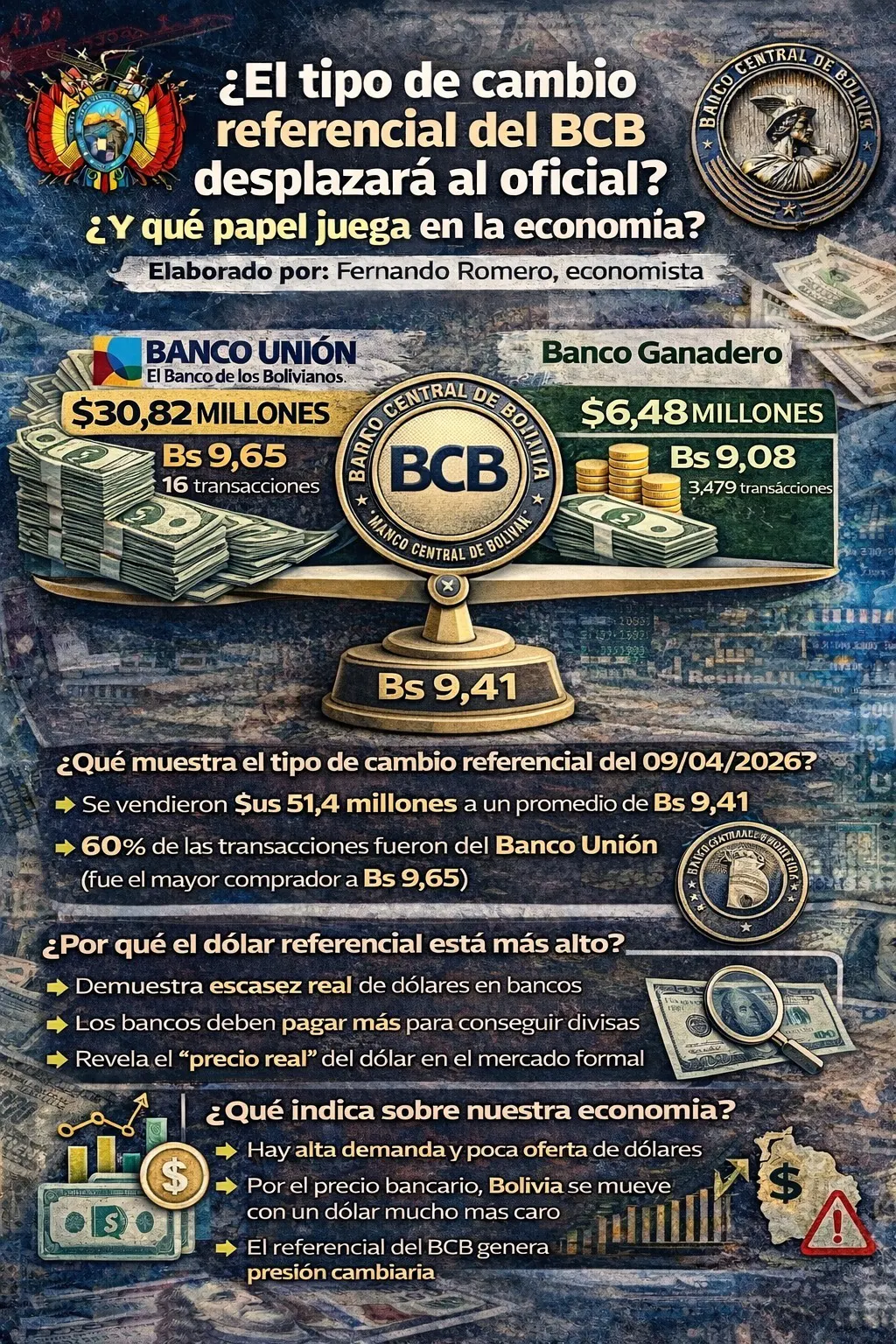
The behavior of the Central Bank of Bolivia’s (BCB) reference dollar value confirms that the Bolivian financial system is moving toward a scenario in which the price of the dollar increasingly responds to real market conditions rather than the official exchange rate, according to an analysis by researcher and economist Fernando Romero.
High demand, limited supply of foreign currency, and the strong participation of institutional actors reflect a structural exchange rate pressure that still persists. In this context, the reference value not only makes the real cost of the dollar more transparent, but is also becoming a key indicator for understanding current economic dynamics and anticipating possible adjustments in the country’s exchange rate system.
Some economists have described the government’s decision to use the reference dollar value published by the Central Bank of Bolivia (BCB) for international card transactions as a “de facto” devaluation.
As will be recalled, when the official dollar began to become scarce, parallel markets started to emerge. Exchange rate gaps even varied across urban, rural, and border areas, with prices above the official quotation.
REFERENCE VALUE
The BCB’s reference dollar value will fulfill two distinct but complementary roles: in the foreign exchange market and in the Bolivian economy.
In the first, it will act as a more realistic guiding price. Unlike the official exchange rate (fixed and controlled), the reference value is based on actual operations within the financial system, especially with the external sector. It provides a benchmark closer to the real (market) cost of the dollar, reduces dependence on the parallel market as the only signal, and supports more credible banking and financial operations, according to Romero.
In the second case, it functions as a gradual adjustment mechanism. In other words, it allows prices, contracts, and economic decisions to begin adapting to a more realistic dollar without an abrupt official devaluation.
This scenario implies: progressive price adjustments (especially for imports), greater realism in business costs, and clearer signals for investment and consumption.
“This reference value will help the economy gradually adapt to a new exchange rate reality—at least that is the intention of the BCB,” Romero’s analysis states.
STRUCTURAL OR TEMPORARY SOLUTION?
For the economist, the government’s proposal is mainly temporary. It helps improve information, transparency, and market functioning in the short term, but it does not solve the underlying problem, which is the shortage of dollars in the Bolivian economy. As long as foreign currency inflows (exports, investment, loans, confidence, among others) do not increase, the gap will persist.
He also argues that the reference rate will not replace the official rate, but will become more relevant. “The reference exchange rate will not eliminate the official one, because the latter remains a tool of state economic policy and is used in specific operations (public sector, some imports, formal records, among others). Nor will it eliminate the parallel market, because as long as there is a shortage of dollars and restrictions, there will continue to be a market where the price is freely determined,” he explains.
In summary, the formal market reflects relative scarcity, high demand, and a gradual process of exchange rate adjustment, he concludes.
Por El Diario:
Valor del dólar responde al mercado y no al tipo de cambio oficial
El comportamiento del valor referencial del dólar del Banco Central de Bolivia (BCB) confirma que el sistema financiero boliviano está transitando hacia un escenario donde el precio del dólar responde cada vez más a condiciones reales de mercado que al tipo de cambio oficial, de acuerdo al análisis del investigador y economista Fernando Romero.
La elevada demanda, la limitada oferta de divisas y la fuerte participación de actores institucionales reflejan una presión cambiaria estructural que aún persiste. En este contexto, el valor referencial no solo transparenta el costo real del dólar, sino que se consolida como un indicador clave para entender la dinámica económica actual y anticipar posibles ajustes en el sistema cambiario del país.
Algunos economistas calificaron la decisión del gobierno de tomar el valor referencial del dólar que publica el Banco Central de Bolivia (BCB), para las transacciones de tarjetas a nivel internacional, como una devaluación “defacta”.
Como se recordará, cuando empezó a escasear el dólar oficial, comenzó a crearse mercados paralelos, inclusive los valores tenían diferentes brechas cambiarias, tanto a nivel urbano, rural y en frontera, con un precio por encima de la cotización oficial.
VALOR REFERENCIAL
El valor referencial del dólar del BCB cumplirá dos roles distintos, pero complementarios: En el mercado cambiario y en la economía boliviana.
En el primero actuará como un precio guía más realista. A diferencia del tipo de cambio oficial (fijo y controlado), el valor referencial se basa en operaciones efectivas del sistema financiero, especialmente con el exterior. Permite tener una referencia más cercana al costo real (mercado) del dólar, así como reducir la dependencia del mercado paralelo como única señal y sirve para operaciones bancarias y financieras más creíbles, de acuerdo a Romero.
En el segundo caso funciona como un mecanismo de ajuste gradual. Es decir, permite que precios, contratos y decisiones económicas empiecen a adaptarse a un dólar más realista sin hacer una devaluación brusca oficial.
Ese panorama implica: Ajustes progresivos en precios (sobre todo importados), mayor realismo en costos empresariales, señales más claras para inversión y consumo.
“Este valor referencial ayudará a que la economía se adapte poco a poco a una nueva realidad cambiaria, al menos esa es la intención del BCB”, sostiene el análisis de Romero.
¿ES SOLUCIÓN ESTRUCTURAL O COYUNTURAL?
Para el economista, la propuesta del Gobierno es principalmente coyuntural. Ayuda a mejorar la información, transparencia y funcionamiento del mercado en el corto plazo, pero no soluciona el problema de fondo, que es la falta de dólares en la economía boliviana. Mientras no aumenten las divisas (exportaciones, inversión, créditos, certidumbre, otros), la brecha seguirá existiendo.
Asimismo, asegura que el cambio referencial no desplazará al oficial, pero si es más relevante. “El tipo de cambio referencial no eliminará al oficial, porque este sigue siendo una herramienta de política económica del Estado y se usa en operaciones específicas (sector público, algunas importaciones, registros formales, otros). Tampoco eliminará al paralelo, porque mientras exista escasez de dólares y restricciones, seguirá habiendo un mercado donde el precio se determine libremente”, explica.
En síntesis, el mercado formal refleja escasez relativa, alta demanda y un proceso gradual de sinceramiento cambiario, concluye.


Leave a Reply