
By Marianela Curi, Brujula Digital:
I want to think and trust that the gap between rhetoric and practice that prevailed over the past 20 years will finally be eliminated, and that coherence and strategic vision will prevail on this issue of great importance for the country.
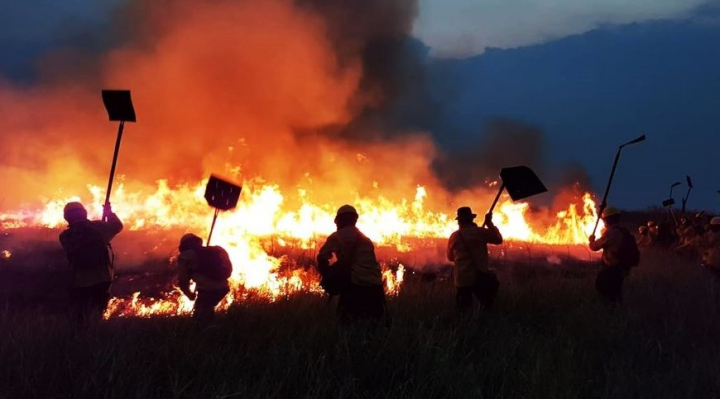
Volunteers try to extinguish a forest fire. ABI photo. Archive.
If there’s one thing the MAS did consistently and persistently during its 20 years in charge of the State, it was to attack the country’s environmental heritage—its natural resources, its forests, and the biological diversity contained within them.
From the very beginning of the MAS government, its policy of colonizing the lowlands with settlers from the highlands harmed the forests and their resources. Forest fires became a tool to clear land—first by the “interculturales,” and later, through agreements with the soy and cattle business sectors—to open up vast areas for the export-oriented monoculture of soy and for cattle production aimed at selling meat to China.
Thus, policies were systematically promoted that encouraged unprecedented burning and forest fires, destroying 16 million hectares of forest in the Chiquitano and Amazon regions, mainly.
I don’t know if these losses have ever been properly monetized, but they must be added to the 40 billion dollars of debt left by the MAS—with the aggravating fact that this is heritage and resources that can never be recovered, because the native flora and fauna species lost are irreplaceable. These damages would merit a trial for accountability.
Bolivia went from being the first country in the world in the number of natural forest hectares certified under sustainable management by the FSC (2 million hectares in 2005), to becoming the second country with the highest deforestation rate in the world. We went from pride to shame.
The Forestry Law 1700, enacted in 1996, was a benchmark for several countries in the region. Brazil, Colombia, and Peru took the Bolivian model as an example to develop their own forestry legislation. In rhetoric, the MAS appeared to be the great defender of Mother Earth and the forests—it even created the “Authority of Mother Earth” and a forest law—but the gap between words and actions was always enormous. The regime that most harmed nature and biodiversity was that of the MAS.
These damages were denounced by brave environmental defenders such as the Ríos de Pie movement and some legislators. But this is not only an environmental issue—it is also an economic and national heritage matter. It is equivalent to losing the gold reserves of the Central Bank, with the difference that gold can be replaced—forests and their richness can never be restored.
Given this background, I find it quite concerning that a proposal has been made to eliminate from the Executive Branch the ministry responsible for environmental matters. It seems to be a decision already made, since that portfolio is absent from the new cabinet. I would like to think this is to give the issue a more strategic and cross-cutting approach; however, neither during the campaign nor in the speeches of Bolivia’s new President has there been any mention of concrete actions in this regard.
“This will be the government of the green future. We will defend our rivers, our forests, and our glaciers. Economic development will go hand in hand with respect for the environment. No more divorce between growth and nature.” A fine statement—but clearer signs and concrete actions are required to show how the defense of nature and the sustainable management of our renewable natural resources—land, water, and forests, the physical foundation of national development and any development model—will be addressed. Without nature and natural resources, there is no possible development.
Bolivia once had the first Ministry of Sustainable Development in the world—an innovative measure meant precisely to unite development planning with environmental conservation. Its elimination was a step backward.
I want to think and trust that the gap between rhetoric and practice that prevailed over the last 20 years will finally be eliminated, and that coherence and strategic vision will prevail on this issue of great importance for the country.
Bolivia is among the 17 megadiverse countries on the planet, and this is a comparative advantage that should become a competitive advantage for Bolivia’s economy and national development—an advantage now at risk due to the effects of the climate crisis.
That is why I ask: what will Rodrigo Paz Pereira’s government do to make up for the environmental debt left by the MAS?
Por Marianela Curi, Brújula Digital:
Quiero pensar y confiar en que esa brecha entre discurso y práctica que imperó los últimos 20 años será eliminada y que se impondrá la coherencia y la visión estratégica sobre este tema de gran importancia para el país.
Voluntarios intentan apagar el fuego de un incendio forestal. Foto ABI. Archivo.
Si algo hizo el MAS con consistencia y persistencia, durante los 20 años que estuvo a cargo de la administración del Estado, fue atentar contra el patrimonio ambiental del país, sus recursos naturales, sus bosques y la diversidad biológica contenida en ellos.
Desde los inicios del gobierno del MAS, la política de colonización de tierras bajas por habitantes de las tierras altas atentó contra los bosques y su recursos. Los incendios forestales como práctica de habilitación de tierras por parte de los interculturales, primero, y luego, en acuerdo con el sector empresarial soyero y ganadero, para la habilitación de grandes extensiones de tierra para el monocultivo de soya de exportación y la producción ganadera para la venta de carne a China.
Y así se impulsaron sistemáticamente políticas que promovieron quemas e incendios forestales sin precedentes, que terminaron con 16 millones de hectáreas de bosque en las regiones chiquitana y amazónica, principalmente.
No sé si se han monetizado debidamente estas pérdidas, que se suman a los 40 mil millones de dólares de deuda que dejó el MAS, con el agravante de que es un patrimonio y recursos que no se recuperan nunca más, porque las especies de fauna y la flora nativa que se perdieron son irrecuperables. Estos daños ameritarían un juicio de responsabilidades.
Bolivia pasó de ser el primer país en el mundo, en número de hectáreas de bosque natural certificadas bajo manejo sostenible por el FSC (2 millones de ha en 2005), a ser el segundo país que más deforesta en el mundo. Pasamos del orgullo a la vergüenza.
La Ley Forestal 1700, promulgada en 1996, fue referente para varios países en la región. Brasil, Colombia y Perú tomaron el modelo boliviano como ejemplo para desarrollar sus respectivas legislaciones forestales. En el discurso, el MAS parecía el gran defensor de la Madre Tierra y de los bosques, creó la Autoridad de la Madre Tierra, una ley de bosques; sin embargo, la brecha entre discurso y práctica fue siempre abismal. El régimen que más atentó contra la naturaleza y su biodiversidad ha sido el del MAS.
Estos daños fueron denunciados por valientes defensores y defensoras ambientales, como el movimiento Ríos de Pie y algunas legisladoras, pero este no es solamente un tema ambiental, es un tema económico y de patrimonio del Estado, equivale a la pérdida de las reservas de oro del Banco Central, con la diferencia de que el oro se puede volver a reponer, los bosques y su riqueza nunca más.
Por estos antecedentes me llama mucho la atención el hecho de que se haya propuesto eliminar del Poder Ejecutivo al ministerio responsable del tema ambiental. Pareciera una decisión ya tomada porque en el nuevo gabinete no figura esa cartera de Estado. Quiero pensar que es para darle un enfoque más estratégico y transversal al tema; sin embargo, ni en la campaña, ni en los discursos del flamante Presidente de Bolivia se ha hecho mención a acciones concretas al respecto.
“Este será el Gobierno del futuro verde. Defenderemos nuestros ríos, nuestros bosques y nuestros glaciares. El desarrollo económico irá de la mano del respeto al medioambiente. No más divorcio entre crecimiento y naturaleza”. Bien en el discurso, pero se requieren señales más claras, con acciones concretas sobre cómo se va a encarar la defensa de la naturaleza y asegurar el manejo sostenible de nuestros recursos naturales renovables, como la tierra, el agua, los bosques, que son la base física del desarrollo nacional y de cualquier modelo de desarrollo. Sin naturaleza y recursos naturales no hay desarrollo posible.
Bolivia tuvo el primer Ministerio de Desarrollo Sostenible del mundo como una medida innovadora, precisamente para unir la planificación del desarrollo con la conservación de la naturaleza. Su eliminación fue un retroceso.
Quiero pensar y confiar en que esa brecha entre discurso y práctica que imperó los últimos 20 años será eliminada y que se impondrá la coherencia y la visión estratégica sobre este tema de gran importancia para el país.
Bolivia está entre los 17 países megadiversos del planeta y esta es una ventaja comparativa que debiera constituirse en una ventaja competitiva de la economía boliviana y del desarrollo nacional, ventaja que además se encuentra en riesgo por los efectos de la crisis climática.
Por eso pregunto ¿qué hará el gobierno de Rodrigo Paz Pereira para resarcir la deuda ambiental que deja el MAS?
Marianela Curi es ciudadana boliviana.

 Bolivian Thoughts | Pensamientos Bolivianos (Bilingual/Bilingüe)