
By Marco Antonio Belmonte, Vision 360:
Expert: New Government Must Bring $6 Billion to Guarantee Fuel and Dollars; Otherwise, It Won’t Last Until Carnival
On October 20, a team from the new government must go to YPFB to check how much fuel remains in the tanks, what volume has been contracted, and what financial resources are available. It is urgent to secure one year of imports with $2.5 billion.
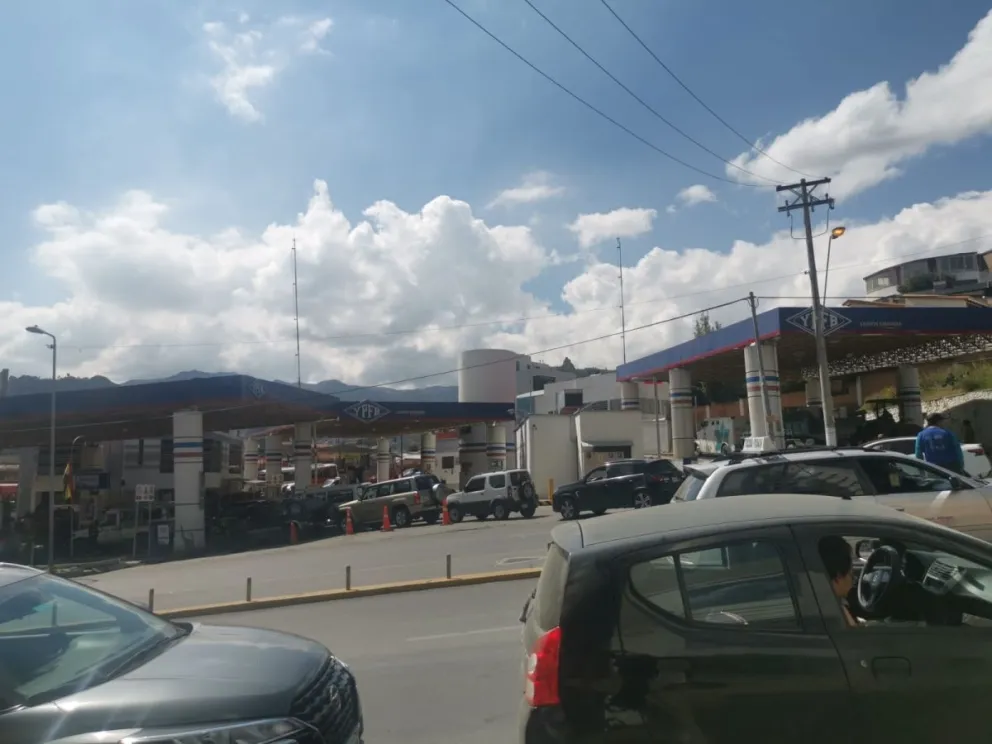
Fuel lines at the Cota Cota service station in recent weeks. Photo: Marco Belmonte.
Whether Jorge “Tuto” Quiroga or Rodrigo Paz wins the runoff, on October 20 they must send a team to Yacimientos Petrolíferos Fiscales Bolivianos (YPFB) to determine how much fuel is left and take office with $6 billion to ensure the supply of gasoline and diesel for at least one year and stabilize the exchange rate. Otherwise, “they won’t make it to Carnival,” warned former Hydrocarbons Minister Álvaro Ríos.
Due to the shortage of dollars to import fuel, YPFB President Armin Dorgathen announced that only 70% to 80% of demand can be met. This situation has generated greater anxiety among transport workers and vehicle owners, who are flocking en masse to gas stations.
Ríos, in an interview with RTP’s No Mentiras program, said the country will remain short on fuel for some time — a situation, he warned, that had been anticipated years ago when hydrocarbon production, Net International Reserves, and the availability of dollars for imports began to fall.
The expert recommended that both PDC and Alianza Libre candidates, who will face each other in the October 19 runoff, send a team to YPFB the next day, October 20, to request information on the quantities of gasoline, diesel, jet fuel, and liquefied petroleum gas (LPG) remaining in tanks and plants.
He added that it is essential to determine how much fuel has already been purchased, how much is in transit, and what financial resources or funds the company has available to contract additional fuel.
According to Ríos, the new government must take office with at least $6 billion to stabilize the economy, ensure fuel supply, and control the exchange rate, thus preventing inflation from continuing to rise.
Of that amount, $2.5 billion would be used to return people’s savings, which, according to Ríos, have been practically confiscated. Another $2.5 billion would be needed to guarantee gasoline and diesel imports for at least the next year.
“Money is also owed to suppliers, transporters, and service companies. That’s why $6 billion are needed for an energy rescue. A country without energy stops functioning—it has no economy. If the new government doesn’t arrive with money in hand, it won’t last until Carnival. People are demanding fuel supplies and exchange rate stability,” warned Ríos.
Situation at the Limit
In August of this year, the decline in natural gas production deepened, falling to 28.12 million cubic meters per day (MMmcd), and in liquids, to just 23,520 barrels per day. In addition, liquid Net International Reserves (NIR) totaled only $102.5 million as of September, according to Visión 360 on Wednesday.
Official YPFB data processed by the Departmental Secretariat of Economic Development of the Santa Cruz Governor’s Office reveal that in one year, gas output from the country’s main fields fell from 31.75 MMmcd in August 2024 to 28.12 MMmcd in August 2025.
Liquid production also dropped from 27,680 barrels per day in August 2024 to 23,520 barrels per day in August this year.
On Monday, Economy Minister Marcelo Montenegro reported that oil production has fallen by nearly 50%, from 18,640 barrels per day in 2014 to 7,579 in 2024. Likewise, natural gas production dropped from 22,188 to 11,896 million cubic meters during the same period.
According to the latest report from the Central Bank of Bolivia (BCB) on Net International Reserves, as of September 30, these rose to $3.275 billion thanks to gold contributions — an increase of $1.298 billion compared to December 2024.
However, the report also warns of a drop in foreign currency reserves, which fell from $170.7 million in August to just $102.5 million in September.
Following YPFB’s announcement that it can only meet 70% to 80% of national fuel demand this week due to lack of funds, the Ministry of Economy and Public Finance issued a statement asserting that the state oil company has a budget to cover the subsidy and fuel imports, although it is available only in bolivianos.
Rising Subsidy
The fuel subsidy currently stands at 14 billion bolivianos, representing 92.3% of the year’s assigned budget. In addition, domestic debt has reached 19% of GDP, Economy Minister Marcelo Montenegro reported Monday in a Visión 360 article.
Energy Deficit
According to the National Institute of Statistics (INE), natural gas exports between January and September amounted to $765.3 million — 34.5% less than in the same period in 2024. Bolivia currently sells most of this energy to Brazil.
Meanwhile, fuel and lubricant imports (diesel and gasoline) reached $1.941 billion — $1.931 billion in refined products and $9.8 million in raw materials.
This results in a negative (deficit) energy trade balance of $1.176 billion — a figure that has been increasing year after year.
Por Marco Antonio Belmonte, Vision 360:
Experto: Nuevo Gobierno debe traer 6 mil millones de dólares para garantizar combustible y dólares; de lo contrario, no llegará a carnavales
El 20 de octubre, un equipo del nuevo Gobierno debe acudir a YPFB para verificar cuánto combustible queda en los tanques, qué volumen se ha contratado y con qué recursos se cuenta. Urge garantizar las importaciones por un año con 2.500 millones de dólares.
Filas por combustible en la estación de servicio de Cota Cota en semanas pasadas. Foto: Marco Belmonte.
Sea Jorge Tuto Quiroga o Rodrigo Paz el ganador del balotaje, el 20 de octubre deberán enviar un equipo a Yacimientos Petrolíferos Fiscales Bolivianos (YPFB) para conocer cuánto combustible queda y asumir el gobierno con 6 mil millones de dólares, con el fin de garantizar la provisión de gasolina y diésel por al menos un año y estabilizar el tipo de cambio. De lo contrario, no llegarán a gobernar ni hasta carnavales”, advirtió el exministro de Hidrocarburos, Álvaro Ríos.
Ante la falta de dólares para importar combustible, el presidente de YPFB, Armin Dorgathen, anunció que solo se podrá abastecer entre el 70 % y el 80 % de la demanda. Esta situación ha generado mayor nerviosismo entre los transportistas y propietarios de vehículos, quienes acuden masivamente a las estaciones de servicio.
Ríos, en una entrevista con el programa No Mentiras de RTP, señaló que el país estará desabastecido de combustible por un tiempo más, una situación que, según advirtió, ya se preveía desde hace varios años, cuando comenzaron a caer la producción de hidrocarburos, las Reservas Internacionales Netas y la disponibilidad de dólares necesarios para la importación.
El experto recomendó a los dos candidatos del PDC y Alianza Libre, que disputarán el balotaje el 19 de octubre, que una vez se conozca al ganador, al día siguiente, 20 de octubre, envíen un equipo a YPFB para solicitar información sobre la cantidad de gasolina, diésel, jet fuel y Gas Licuado de Petróleo (GLP) que queda en tanques y plantas.
Además, se debe conocer cuánto combustible ya ha sido comprado, cuánto se encuentra en camino y con qué recursos o fondos cuenta la empresa para contratar más carburante.
Según Ríos, el nuevo Gobierno debe asumir con al menos 6 mil millones de dólares para estabilizar la economía, garantizar el suministro de combustible y controlar el tipo de cambio, evitando así que la inflación continúe en aumento.
De ese monto, 2.500 millones de dólares serían destinados a devolver los ahorros a la población, cuyos fondos , según Ríos, han sido prácticamente confiscados. Otros 2.500 millones se necesitarían para garantizar la importación de gasolina y diésel por lo menos durante el próximo año.
“También se debe dinero a proveedores, transportistas y empresas de servicios. Por eso se requieren 6 mil millones de dólares para un rescate energético. Un país sin energía deja de funcionar, no tiene economía. Si el nuevo Gobierno no llega con plata bajo el brazo, no llega ni a carnavales. La gente está pidiendo abastecimiento de combustible y estabilización del tipo de cambio”, alertó Ríos.
Situación al límite
En agosto de este año se acentuó la caída en la producción de gas natural, que se redujo a 28,12 millones de metros cúbicos por día (MMmcd), y de líquidos, con apenas 23.520 barriles por día. Además, las Reservas Internacionales Netas (RIN) líquidas sumaban apenas 102,5 millones de dólares hasta septiembre, según informó Visión 360 el miércoles.
Datos oficiales de YPFB, procesados por la Secretaría Departamental de Desarrollo Económico de la Gobernación de Santa Cruz, revelan que en un año la oferta de gas extraído de los principales campos del país disminuyó de 31,75 millones de metros cúbicos por día (MMmcd), registrados en agosto de 2024, a 28,12 MMmcd en agosto de 2025.
La producción de líquidos también cayó, de 27.680 barriles por día en agosto de 2024 a 23.520 barriles por día en agosto de este año.
El lunes, el ministro de Economía, Marcelo Montenegro, informó que la producción de petróleo se redujo en casi un 50 %, pasando de 18.640 barriles diarios en 2014 a 7.579 en 2024. Asimismo, la producción de gas natural cayó de 22.188 a 11.896 millones de metros cúbicos en el mismo período.
De acuerdo con el último informe del Banco Central de Bolivia (BCB) sobre las Reservas Internacionales Netas (RIN), al 30 de septiembre estas se incrementaron a 3.275 millones de dólares, gracias al aporte del oro, lo que representa un aumento de 1.298 millones en comparación con diciembre de 2024.
Sin embargo, el reporte también advierte una caída en las reservas de divisas, que bajaron de 170,7 millones de dólares en agosto a solo 102,5 millones en septiembre.
Tras el anuncio de YPFB, que informó que esta semana solo podrá abastecer entre el 70 % y el 80 % de la demanda nacional de combustibles por falta de recursos, el Ministerio de Economía y Finanzas Públicas emitió un comunicado en el que asegura que la estatal petrolera cuenta con presupuesto para cubrir la subvención e importación de carburantes, aunque este se encuentra disponible únicamente en bolivianos.
Subvención en alza
La subvención a los carburantes asciende actualmente a 14 mil millones de bolivianos, lo que representa el 92,3 % del presupuesto asignado para este año. Además, la deuda interna alcanza el 19 % del Producto Interno Bruto (PIB), informó el lunes el ministro de Economía, Marcelo Montenegro, en una nota publicada por Visión 360.
Déficit energético
De acuerdo con el Instituto Nacional de Estadística (INE), las exportaciones de gas natural entre enero y septiembre alcanzaron un valor de 765,3 millones de dólares, un 34,5 % menos que en el mismo período de 2024. Actualmente, Bolivia vende este energético principalmente a Brasil.
Por otro lado, las importaciones de combustibles y lubricantes (diésel y gasolina) registraron un valor de 1.941,3 millones de dólares, 1.931,4 millones correspondientes a productos elaborados y 9,8 millones a productos básicos.
Esto arroja una balanza comercial energética negativa (déficit) de 1.176 millones de dólares, cifra que ha ido en aumento año tras año.

 Bolivian Thoughts | Pensamientos Bolivianos (Bilingual/Bilingüe)