
By Leonel Suárez, El Pais:
While official events are being prepared in Tarija to highlight the historical struggle of the working class, the economic backdrop is clear. The College of Economists confirms the loss of purchasing power
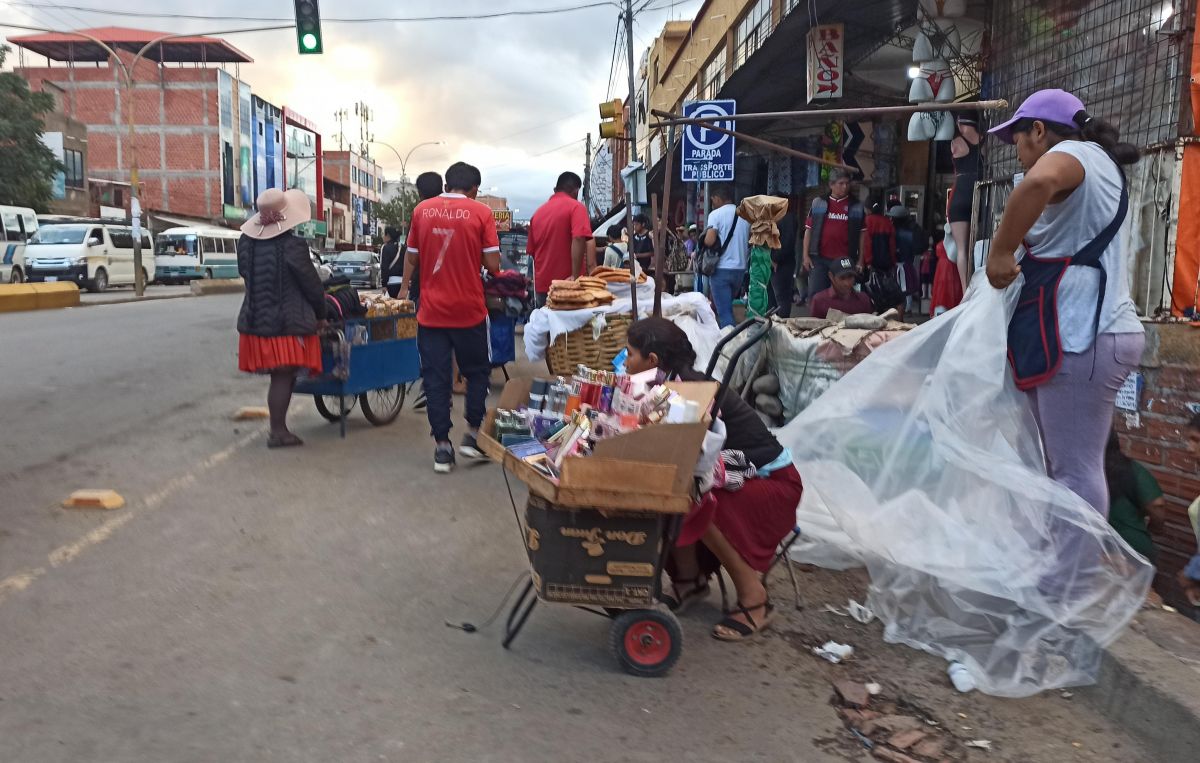
The crisis has increased informal employment in the country
This May 1st, Bolivia commemorates International Workers’ Day in a context marked by economic tensions. It is clear that this is not a day of celebration. The date finds the country facing the highest inflation in the last ten years, sustained growth of informal employment, a shortage of U.S. dollars, and an economic slowdown that has cast doubt on the sustainability of the country’s economic model, which has been promoted by the Movement Toward Socialism (MAS) since 2006.
While official events are being prepared in Tarija to highlight the historical struggle of the working class, the economic backdrop of this May 1st is evident. The once-heavily promoted narrative of a “shielded economy” by government authorities now appears weakened in the face of a reality that is hitting the wallets of thousands of Bolivian workers.
Informality on the rise
One of the most concerning indicators is labor informality, which has shown an upward trend over the last two decades. According to the National Institute of Statistics (INE), in 2006, 62.4% of jobs were informal. By 2023, a report from the International Labour Organization (ILO) placed that figure at an alarming 80.8%, the highest in all of Latin America. In comparison, the regional average stands at 48%.
The situation is even more critical among women—83% of them work informally, compared to 78% of men. This means that the majority of workers in Bolivia lack labor benefits such as health insurance, job stability, or retirement, and they depend on precarious and often unstable incomes.
Challenges This May 1st is a reminder of the pending challenges: ensuring decent employment, reducing informality, and curbing inflation
Wages vs. purchasing power
In this context, the government’s annual wage increase, set in coordination with the Bolivian Workers’ Central (COB), is once again under scrutiny. For 2025, President Luis Arce has ordered a 5% increase to the base salary and a 10% increase to the national minimum wage. However, experts warn that such measures, rather than benefiting workers, could worsen economic problems and contribute to inflationary pressure.
Economist and president of the College of Economists of Tarija, Fernando Romero, explains that this wage policy has not always aligned with economic growth or inflation. He recalls that in 2008, the wage increase was 9.9%, while annual inflation was 11.85% and economic growth reached 6.1%. Although inflation was more moderate in the years that followed, in 2024 it has surged again, reaching 9.97% cumulative, making this year the most inflationary in a decade.
“Despite the salary increases, we have seen that real purchasing power has decreased. This means that even if people have more money in hand, it is worth less, and that’s not good for the economy,” he warned.
Union defense
In response to criticism, COB executive Juan Carlos Huarachi defended the wage increases agreed upon with the government. During a press conference held in Tarija, where the traditional May 1st march will take place this Thursday, he stated that the private sector must give back to workers the benefits gained from measures promoted by the union sector.
“Many of the measures granted to the private sector must also be returned in the form of wage increases for workers, because those who do the work in the different production centers are the workers, the laborers,” he said.
Huarachi pointed to examples of these initiatives such as the anti-smuggling law, the promotion of national product consumption, and the state-run mobile wallet. He assured that the COB not only demands increases but also proposes public policies in favor of the economy.
Employers’ criticism
From the business sector, the announcement was described as an irresponsible and election-driven decision. Business representatives warned that the wage increase—especially in a time of crisis—could trigger more inflation, the closure of small and medium-sized enterprises, and job losses.
Additionally, the effectiveness of the measure has been questioned, considering that only 20% of Bolivian workers benefit from the wage increase, while the rest, stuck in informality, are left out. To this, Huarachi responded that the effect is indirect, since the increase puts more money into circulation.
“We will have a little more to spend,” he said.
Romero: The COB should fight for stability
Fernando Romero, president of the College of Economists of Tarija, stated that the Bolivian Workers’ Central (COB) and other organizations representing the country’s workers should redirect their efforts to guarantee job stability and workers’ rights, ensuring they have dignified and quality employment.
“You can’t celebrate a salary increase that everyone knows is mostly symbolic, something temporary—and if we crunch the numbers, when we compare the year-on-year inflation from May 2024 to 2025, we’ll see that according to government figures, 25% of purchasing power will have been lost,” he said.
Romero pointed out that the wage increase benefits only about 20% of the country’s workforce—around 1 to 1.5 million workers.
Por Leonel Suárez, El Pais:
Mientras los actos oficiales se preparan en Tarija para destacar la lucha histórica de la clase trabajadora, el trasfondo económico es visible. El Colegio de Economistas ratifica la pérdida del poder adquisitivo
La crisis aumentó el empleo informal en el país
Este 1 de mayo, Bolivia conmemora el Día Internacional del Trabajador en un contexto marcado por tensiones económicas. Está claro que no es una jornada de celebración. La fecha encuentra al país enfrentando la inflación más alta de los últimos diez años, un crecimiento sostenido del empleo informal, escasez de dólares y una desaceleración que ha puesto en entredicho la sostenibilidad del modelo económico del país, que fue impulsado por el Movimiento al Socialismo (MAS) desde el 2006.
Mientras los actos oficiales se preparan en Tarija para destacar la lucha histórica de la clase trabajadora, el trasfondo económico de este 1 de mayo es visible. El discurso de una “economía blindada” que en su momento defendieron con insistencia las autoridades gubernamentales, hoy luce debilitado frente a una realidad que golpea el bolsillo de miles de trabajadores bolivianos.
Aumenta la informalidad
Uno de los indicadores más preocupantes es la informalidad laboral, que ha seguido una tendencia ascendente en las últimas dos décadas. Según el Instituto Nacional de Estadística (INE), en 2006 el 62,4% de los empleos eran informales. Para 2023, un informe de la Organización Internacional del Trabajo (OIT) situó esa cifra en un alarmante 80,8%, la más alta de toda América Latina. A modo de comparación, el promedio regional es del 48%.
La situación es aún más crítica entre las mujeres, el 83% de ellas trabaja en la informalidad, frente al 78% de los hombres. Esto implica que la mayoría de los trabajadores en Bolivia carece de beneficios laborales como seguro de salud, estabilidad o jubilación, y que dependen de ingresos precarios y muchas veces inestables.
Desafíos Este 1 de mayo es un recordatorio de los desafíos pendientes: garantizar empleo digno, reducir la informalidad y frenar la inflación
Salarios vs poder adquisitivo
En este contexto, la fijación anual del incremento salarial por parte del Gobierno, en coordinación con la Central Obrera Boliviana (COB), vuelve a estar bajo la lupa. Para este 2025, el presidente Luis Arce dispuso un aumento del 5% al haber básico y del 10% al salario mínimo nacional. No obstante, voces expertas advierten que este tipo de medidas, lejos de beneficiar al trabajador, pueden agudizar los problemas económicos y coadyuvar a la pirámide inflacionaria.
El economista y presidente del Colegio de Economistas de Tarija, Fernando Romero, explica que esta política salarial no siempre ha estado alineada con el crecimiento económico ni con la inflación. Recuerda que en 2008, el incremento salarial fue del 9,9%, mientras la inflación anual fue del 11,85% y el crecimiento del 6,1%. Aunque los años siguientes la inflación fue más moderada, en 2024 ha vuelto a repuntar hasta alcanzar un 9,97% acumulado, lo que convierte a este año en el más inflacionario desde hace una década.
“A pesar de los incrementos salariales, se ha visto que el poder adquisitivo real se ha reducido. Esto quiere decir que, aunque se tenga más dinero en mano, este vale menos, y eso no es positivo para la economía”, advirtió.
Defensa sindical
Frente a las críticas, el ejecutivo de la COB, Juan Carlos Huarachi, defendió los aumentos salariales acordados con el Gobierno. Durante una conferencia de prensa realizada en Tarija, donde este jueves se llevará a cabo la tradicional marcha por el 1 de mayo, aseguró que el sector privado debe retribuir a los trabajadores los beneficios recibidos gracias a medidas impulsadas desde el sector sindical.
“Muchas de las medidas que se ha otorgado al sector privado tiene que retribuir también en un incremento salarial a los trabajadores, porque quienes hacen el trabajo de los diferentes centros de producción son los trabajadores, son los obreros”, dijo.
Huarachi mencionó como ejemplos de estas iniciativas la ley de lucha contra el contrabando, la promoción del consumo de productos nacionales y la billetera móvil estatal. Aseguró que la COB no solo exige aumentos, sino que también propone políticas públicas en favor de la economía.
Reclamo de empresarios
Desde el sector empresarial el anuncio fue calificado como una decisión irresponsable y electoralista. Representantes del empresariado advirtieron que el aumento salarial —especialmente en un contexto de crisis— podría generar mayor inflación, cierre de pequeñas y medianas empresas y pérdida de empleos.
Además, se ha cuestionado la efectividad de esta medida, considerando que solo el 20% de los trabajadores bolivianos accede a los beneficios del incremento salarial, mientras el resto, sumido en la informalidad, queda al margen. A esto, Huarachi respondió que el efecto es indirecto, ya que el incremento pone más dinero en circulación.
“Vamos a tener un poquito más para poder gastar”, afirmó.
Romero: La COB debería luchar por la estabilidad
El presidente del Colegio de Economistas de Tarija, Fernando Romero, señaló que la Central Obrera Boliviana (COB) y otras entidades que representan a los trabajadores del país, deben reorientar su lucha para garantizar la estabilidad laboral, derechos de los trabajadores, que tengan empleos dignos y de calidad.
“No se puede festejar un incremento salarial que todos saben, que es más simbólico, es algo coyuntural y si hacemos un poco de números, cuando veamos la inflación interanual de mayo del 2024 al 2025 vamos a ver que con la cifras del Gobierno se habrá perdido un 25% del poder adquisitivo”, expuso.
Romero aseguró que el incremento salarial beneficia apenas a un 20% de la fuerza laboral del país lo que ronda entre 1 a 1,5 millones de trabajadores.
https://elpais.bo/tarija/20250501_crisis-opaca-el-1-de-mayo-hay-mas-inflacion-y-menos-empleo.html

 Bolivian Thoughts | Pensamientos Bolivianos (Bilingual/Bilingüe)