
By Daniel Salazar, Bloomberg Linea:
The general elections scheduled for August 17, 2025, could mark a turning point for the country’s credit rating. Moody’s believes that “significant policy measures are unlikely to be taken before that date.”

Bloomberg Línea — Moody’s downgrade of Bolivia’s credit rating from Caa3 to Ca, placing it deeper into speculative territory, weakens the outlook on the country’s ability to meet its obligations and would hinder access to financing, meaning the current government may be “leaving a time bomb” for the next political cycle.
Moody’s downgraded Bolivia to the second-lowest level on its scale, reflecting very weak governance that has driven the country toward a heightened risk of balance of payments crisis and sovereign default. Meanwhile, internal shocks are limiting Bolivia’s ability “to stabilize already very low foreign currency reserves and stop the continued deterioration of economic and financial conditions,” Moody’s said in a statement.
The country is facing a critical need for dollar liquidity, which is essential for the government to avoid serious problems with the balance of payments, debt servicing, and fuel imports.
This situation has generated significant uncertainty and an unfavorable outlook for investors, lenders, and international market players—an element Moody’s likely considered when lowering Bolivia’s credit rating.
In other words, “the current government is leaving behind a time bomb for the next political cycle,” said Jonathan Fortun, an economist at the Institute of International Finance (IIF). “The decisions not made today will become tighter constraints tomorrow.”
Moody’s downgrade is not just a technical judgment—it’s also a political signal that, according to the IIF analyst, forewarns of a potential crisis of governance unless the country urgently redefines its fiscal framework and financial engagement.
Fortun explains that credit conditions “were already prohibitive well before this downgrade,” and now the outlook worsens because it adds pressure on current bondholders.
Some institutional investors may be forced to liquidate their holdings due to internal portfolio restrictions, which could lead to further losses on Bolivian securities in secondary markets. “The perception is no longer of an issuer facing temporary liquidity issues, but of a sovereign with a high likelihood of default,” Fortun stated.
Bolivia’s Rating Declines Further
Fitch Ratings had already downgraded Bolivia’s credit rating to CCC- from CCC in January, while S&P Global Ratings affirmed its CCC+ rating with a negative outlook in October.
The new downgrade is “a bad signal for international markets because, while the risk as indicated by Moody’s is long-term, it casts doubt—or at least greater uncertainty—on the Bolivian government’s ability to repay its external debt,” said Luis Fernando Romero Torrejón, president of the Departmental College of Economists of Tarija.
In an analysis he published on the issue, Romero noted that since 2021, Bolivia’s credit ratings “have continued to fall, showing a clear trend of downgrades year after year.” “Clearly, these downgrades in recent years are not coincidental or circumstantial, but rather causal and structural.”
Moody’s downgrade to Ca would, above all, confirm the difficulties Bolivia has faced in accessing voluntary financing in international markets for several years now.
According to Romero, it will now be even harder to obtain loans and attract foreign investment. “Few will dare take the risk in such a precarious macroeconomic, political, and social environment, where there is currently no economic or legal certainty.”
Economic Tensions for Bolivia

Aymaras walk past Bolivia’s National Congress, or Legislative Palace, after an indigenous gathering at Plaza Murillo in La Paz, Bolivia, Tuesday, September 6, 2016. (Bloomberg/Marcelo Perez del Carpio)
Bolivia is facing a scenario marked by falling international reserves, several years of fiscal deficits, a trade balance worsened by a currency crisis, high public debt, a lack of foreign currency, pressure from the fixed exchange rate, and challenges related to fuel subsidies.
For economist Jonathan Fortun, the structural backdrop justifying the downgrade involves a combination of persistent deficits, severely limited liquid reserves, and a steep drop in energy export revenues.
“Although the Central Bank reported US$2.3 billion in international reserves as of March 2025, it’s known that the liquid component is minimal and most of it consists of gold and non-liquid assets. This severely limits the State’s ability to respond to external shocks or meet short-term commitments,” said Fortun.
At the same time, debt maturities are concentrated in the coming years, putting more pressure on Bolivia’s economy.
The Institute of International Finance estimates that Bolivia has more than US$380 million in debt payments due in 2026, and over US$650 million in March 2028, mainly in capital amortizations.
What Moody’s sees is not only the lack of approved loans, but the structural inability of the State to respond to a fiscal emergency. The combination of opacity in public accounts, the absence of official data on the 2024 fiscal year-end, and a Congress that blocks even routine operations is evidence of an environment where the risk of inaction has become institutionalized.
Jonathan Fortun, economist at the Institute of International Finance.
The general elections scheduled for August 17, 2025, could mark a turning point for the country’s risk rating, although Moody’s believes that “significant policy measures are unlikely to be taken before that date.”
For Romero Torrejón, “there are measures that could be adopted by this and the next government to reverse this negative trend—it all depends on political will; not all is lost.”
These measures refer to the need to adopt effective policies to curb the country’s rampant inflation, and to facilitate exports in general—especially of non-traditional products—through administrative and fiscal improvements, including lifting the ban on external sales of soybeans and beef. He also suggests:
- Protecting international reserves: strengthening Net International Reserves (NIR), particularly foreign currency, avoiding the sale or pledging of gold.
- Ensuring fuel supply: guaranteeing fuel availability for the country’s economic and productive sectors.
- Improving foreign currency liquidity: implementing mechanisms to increase currency availability in both the public and private sectors.
- Strengthening governance and governability: promoting pragmatic dialogue between the ruling party, the opposition, social sectors, and especially the private sector..
Government’s Response to the Credit Rating Agencies
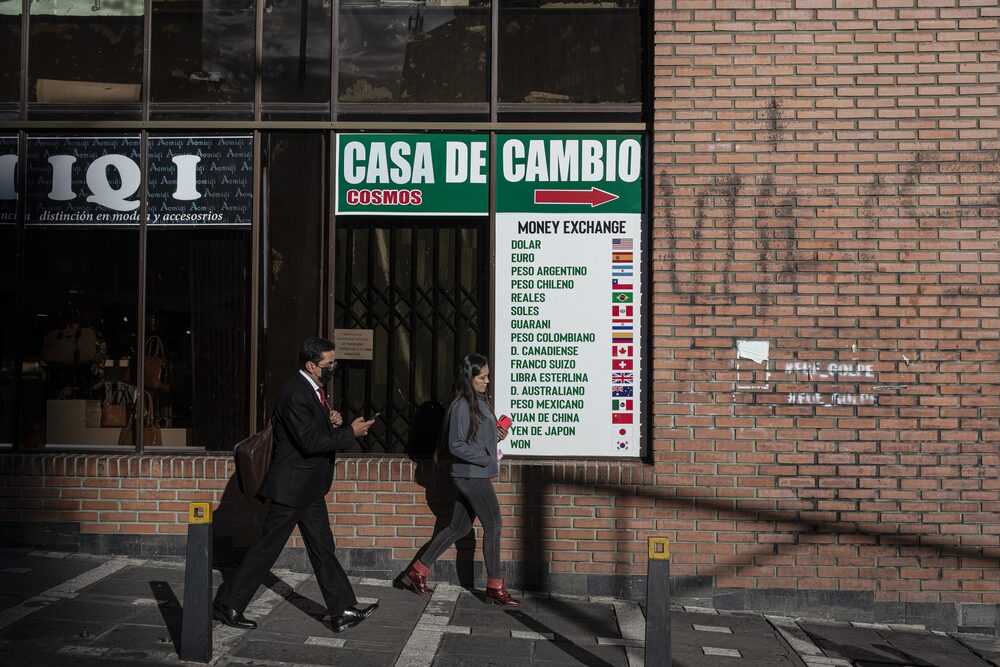
Bolivian money changers and exchange houses are also affected by the dollar shortage. An exchange house in La Paz, Bolivia, Thursday, March 30, 2023. (Bloomberg/Marcelo Perez del Carpio)
In January, when Fitch Ratings downgraded Bolivia’s rating, Economy Minister Marcelo Montenegro said in an interview with state television that “what the rating agencies say are not necessarily balanced assessments or based on a totally clear and unbiased analysis.”
Montenegro claimed that the country’s progress in reducing debt and in servicing existing debt was supposedly not taken into account at the time.
These same arguments were once again used to refute the latest Moody’s report, according to local press reports.
He also said at the time that economic indicators were improving and that the effects of internal road blockades—“which have hurt productive activity, producers’ incomes, and consumers’ wallets”—were supposedly not taken into account.
According to the most recent report from the Central Bank of Bolivia, as of February 2025, the external debt balance stood at US$13.45 billion, which the entity says represents around 24% of Bolivia’s GDP. However, it’s important to note that at the end of 2024, it was US$13.345 billion—the highest recorded since 1996—indicating a rising trend in recent years.
Luis Fernando Romero Torrejón, president of the Departmental College of Economists of Tarija.
“The economic model works,” said the Bolivian minister, responding to the warnings issued by various economists in the country about the government’s current economic framework.
According to the government, the blockade of credit approvals in the Legislative Assembly may have also affected the country’s risk perception.
The government accuses opposition members in the legislature of blocking approval of more than US$1.6 billion in external loans.
However, analysts say the legislative blockade is a visible symptom of a much deeper institutional degradation. “It’s not the root of the problem, but a clear sign of the collapse of basic governance mechanisms,” according to Fortun.
Por Daniel Salazar, Bloomberg Linea:
Las elecciones generales del 17 de agosto de 2025 podrían marcar un punto de inflexión para la calificación de riesgo del país. Moody’s cree que “no es probable que se tomen medidas políticas significativas antes de esa fecha”.
Bloomberg Línea — La rebaja de la calificación de Bolivia por parte de Moody’s desde Caa3 a Ca, situándose en el grado especulativo, deteriora la visión sobre la capacidad del país de cumplir con sus obligaciones y dificultaría el acceso a financiamiento, por lo que el actual Gobierno estaría “dejando una bomba de tiempo” instalada para el siguiente ciclo político.
Moody’s rebajó la calificación de Bolivia al segundo nivel más bajo de la escala, reflejando una gobernanza muy débil que ha llevado al país a un mayor riesgo de crisis de balanza de pagos y default soberano. Entre tanto, los choques internos le restan capacidad al país “para estabilizar las ya muy bajas reservas de divisas y frenar el continuo deterioro de las condiciones económicas y financieras”, dijo Moody ’s en un comunicado.
El país atraviesa una necesidad crítica de liquidez en dólares, esencial para que el gobierno pueda evitar dificultades graves en la balanza de pagos, el cumplimiento de la deuda y la importación de combustibles.
Esta situación ha generado una fuerte incertidumbre y un panorama poco favorable para inversionistas, prestamistas y actores del mercado internacional, un factor que Moody’s habría considerado al momento de reducir la calificación crediticia de Bolivia.
En otras palabras, “el actual gobierno está dejando una bomba de tiempo instalada para el siguiente ciclo político”, dijo Jonathan Fortun, economista del Instituto de Finanzas Internacionales (IIF). “Las decisiones que no se tomen hoy se transformarán en restricciones más duras mañana”.
La rebaja de Moody’s no solo sería un juicio técnico, sino también un marcador político que, según el analista del IIF, anticipa una crisis de gobernabilidad si el país no redefine urgentemente su régimen fiscal y su inserción financiera.
Fortun explica que las condiciones de crédito “ya eran prohibitivas mucho antes de esta degradación” y ahora el panorama se agrava porque introduce una presión adicional sobre los actuales tenedores de bonos.
Algunos inversionistas institucionales podrían verse forzados a liquidar posiciones ante restricciones internas de portafolio, lo que podría generar desvalorizaciones adicionales en los títulos bolivianos en el mercado secundario. “La percepción ya no es de un emisor con problemas temporales de liquidez, sino de un soberano con alta probabilidad de incumplimiento”, expresó Fortun
Bolivia profundiza la rebaja de la calificación
Fitch Ratings ya había recortado la calificación crediticia de Bolivia a CCC- desde CCC en enero, en tanto que S&P Global Ratings afirmó su calificación en CCC+ con perspectiva negativa en octubre.
La nueva rebaja es “una mala señal para los mercados internacionales, ya que, si bien como indica Moody’s el riesgo sería a largo plazo, pone en duda, o al menos en una mayor incertidumbre, la capacidad de pago del gobierno boliviano de su deuda externa”, dijo Luis Fernando Romero Torrejón, presidente del Colegio Departamental de Economistas de Tarija.
En un análisis que publicó sobre el tema, Romero señaló que desde el 2021 las calificaciones de Bolivia “no han parado de caer, con una tendencia clara a que las mismas se rebajen año a año”. “Evidentemente, estas calificaciones, que fueron rebajando en los últimos años, no es algo casual ni coyuntural, sino más bien causal y estructural”.
La rebaja de Moody’s a Ca sería, ante todo, la confirmación de las dificultades que ha tenido Bolivia para acceder a financiamiento voluntario en los mercados internacionales desde hace ya algunos años.
Para Romero, ahora será más difícil conseguir préstamos y que capitales lleguen mediante inversión extranjera. “Serán pocos quienes se arriesguen a hacerlo, bajo un escenario riesgoso en lo macroeconómico, político y social, donde actualmente no hay seguridad económica ni jurídica“.
Tensiones económicas para Bolivia
Bolivia se enfrenta a un escenario marcado por la caída de sus reservas internacionales, varios años de déficit fiscal, una balanza comercial negativa y deteriorada por la crisis cambiaria, alta deuda pública, falta de divisas, presión por el tipo de cambio fijo y los desafíos que plantean los subsidios a los carburantes.
Para el economista Jonathan Fortun, el trasfondo estructural que justifica esta rebaja tiene que ver con la combinación de déficits persistentes, reservas líquidas muy limitadas y una caída abrupta de los ingresos por exportaciones energéticas.
“Aunque el Banco Central reportó reservas internacionales por US$2.300 millones a marzo de 2025, se sabe que el componente líquido es mínimo y que la mayor parte corresponde a oro y activos no líquidos. Esto limita severamente la capacidad del Estado de responder ante shocks externos o asumir compromisos de corto plazo”, señaló el analista Fortun.
En paralelo, los vencimientos de deuda se concentran en los próximos años, lo que pone más presiones a la economía boliviana.
Desde el Instituto de Finanzas Internacionales calculan que para 2026 hay pagos por más de US$380 millones, mientras que en marzo de 2028 Bolivia deberá enfrentar obligaciones por más de US$650 millones, principalmente amortizaciones de capital.
Lo que ve Moody’s no es solo la falta de aprobación de préstamos, sino la incapacidad estructural del Estado para responder a una emergencia fiscal. La combinación de opacidad en las cuentas públicas, ausencia de datos oficiales sobre el cierre fiscal de 2024, y un Congreso que bloquea incluso operaciones rutinarias, es la evidencia de un entorno donde el riesgo de inacción se ha institucionalizado. Jonathan Fortun, economista del Instituto de Finanzas Internacionales.
Las elecciones generales del 17 de agosto de 2025 podrían marcar un punto de inflexión para la calificación de riesgo del país, aunque Moody’s cree que “no es probable que se tomen medidas políticas significativas antes de esa fecha”.
Para Romero Torrejón, “hay medidas que se pueden adoptar por este y el próximo gobierno para revertir esta tendencia negativa, todo depende de una voluntad política, no todo está perdido”.
En estas medidas se refiere a la necesidad de adoptar políticas eficaces para frenar la inflación galopante que afecta al país, así como facilitar las exportaciones en general —especialmente de productos no tradicionales— mediante mejoras administrativas y fiscales, eliminado el veto a la venta externa de soja y carne. También sugiere:
- Proteger las reservas internacionales: fortalecer las Reservas Internacionales Netas (RIN), en particular las divisas, evitando la venta o hipoteca del oro.
- Garantizar el suministro de carburantes: asegurar el abastecimiento de combustibles para los distintos sectores económicos y productivos del país.
- Mejorar la liquidez en divisas: implementar mecanismos que incrementen la disponibilidad de divisas tanto en el sector público como en el privado.
- Reforzar la gobernanza y la gobernabilidad: promover un diálogo pragmático entre el oficialismo, la oposición, los sectores sociales y, especialmente, el sector privado.
La respuesta del Gobierno a las calificadoras
En enero, cuando Fitch Ratings rebajó la calificación de Bolivia, el ministro de Economía, Marcelo Montenegro, consideró en entrevista con la televisión pública que “lo que digan las calificadoras no necesariamente son balances equilibrados o basados en un análisis totalmente claro y puro”.
Montenegro dijo que supuestamente no se tuvieron en cuenta en ese momento los avances del país en materia de rebaja del endeudamiento ni los pagos que se vienen realizando al servicio de la deuda.
Estos argumentos nuevamente fueron utilizados para contradecir el más reciente reporte de Moody’s, según lo reseña la prensa local.
Asimismo, señaló en su momento que los indicadores económicos estarían mejorando y que supuestamente no se ha tenido en cuenta los efectos del bloqueo interno de carreteras “que ha lastimado la actividad productiva, los ingresos de los productores y el bolsillo de los consumidores”.
Con el último informe del Banco Central de Bolivia, a febrero 2025, tenemos un saldo de deuda externa de US$13.450,2 millones, que según esta entidad representa alrededor del 24% de nuestro PIB. Sin embargo, hay que considerar que a finales del 2024 fue de US$13.345,4 millones, el más alto observado desde el año 1996, lo que indica que la tendencia fue creciente en los últimos años. Luis Fernando Romero Torrejón, presidente del Colegio Departamental de Economistas de Tarija.
“El modelo económico funciona”, según consideró el ministro boliviano, respondiendo a las advertencias que han hecho distintos economistas en el país sobre el actual esquema del Gobierno.
Según el Gobierno, el bloqueo de créditos en la Asamblea Legislativa también pudo afectar en la percepción de riesgo del país.
El Gobierno acusa a los opositores en el Legislativo de imponer barreras para aprobar créditos externos por más de US$1.600 millones.
No obstante, los analistas señalan que el bloqueo legislativo es un factor visible dentro de lo que sería una degradación institucional mucho más profunda. “No es el origen del problema, pero sí un síntoma elocuente del colapso de los mecanismos básicos de gobernabilidad”, según Fortun.

 Bolivian Thoughts | Pensamientos Bolivianos (Bilingual/Bilingüe)