
By Alejandra Hinojosa, Eju.tv:
Analysts see a country in political and economic crisis a year before the bicentennial
Economist Roberto Laserna believes the crisis is in its early stages and may worsen. Therefore, it should be noted that the longer it takes to address it, the higher the social and economic cost will be.
Source: lostiempos.com
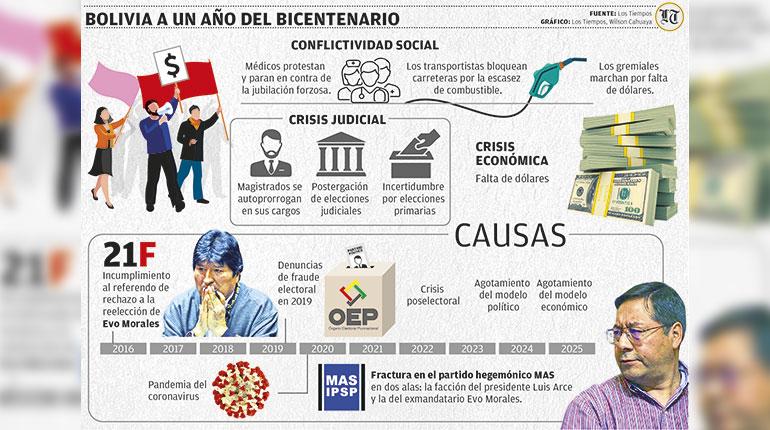
One year before Bolivia’s bicentennial of independence, to be celebrated on August 6, 2025, the country is facing an economic, political, judicial, and institutional crisis. Therefore, analysts agree that it is time to change the economic model and undertake a major national agreement.
The lack of dollars, fuel shortages, and disinstitutionalization are generating social conflict, reflected in blockades, marches, and protests from different sectors, such as traders, transport workers, doctors, and teachers.
Early Stages
Economist Roberto Laserna believes the crisis is in its early stages and may worsen. Therefore, it should be noted that the longer it takes to address it, the higher the social and economic cost will be.
In Laserna’s view, a minimal and emergency program must be undertaken, which involves reducing fiscal spending, eliminating regulations, opening borders, freeing markets, and quickly reforming the judicial and electoral systems.
Political scientist María Teresa Zegada pointed out that the first signs of the economic crisis appeared in 2014 with the depletion of hydrocarbon reserves. “Economists establish 2014 and 2015 as the beginning of the downward economic curve in the country,” she explained.
Zegada indicated that the crisis has escalated this year in an almost uncontrollable way and that the government’s efforts for economic recovery have not achieved the expected results.
Weakened Democracy
The political scientist said that another negative indicator is the public’s distrust in democracy. This began about two decades ago but worsened with the breach of the February 21 referendum that rejected the re-election of former President Evo Morales, with fraud allegations in the 2019 general elections, and due to the lack of transparency in investigating the post-electoral conflict. “Since the beginning of the century, surveys have shown that distrust in democracy, institutions, political parties, and even electoral processes has increased in Bolivia,” said the professional.
Crisis
The crisis of institutionalism is reflected in the lack of separation of powers. Zegada questioned, for example, the role of the Plurinational Constitutional Court (TCP), as it lacks independence and is functional to the Executive Branch. “The TCP began to act politically, and that has never been seen in the country’s history, generating distrust in justice and the Electoral Branch,” she indicated.
The high authorities of the TCP and the Supreme Court of Justice (TSJ) are criticized for having indefinitely extended their terms and for blocking judicial elections through resolutions and precautionary measures.
Political Crisis
To all the above, we must add the political leadership crisis of the current government. “We have seen the division between the two factions of the MAS, and the internal fights are showing us that the political model is exhausted, putting us in a situation of uncertainty,” she said.
As a result, there is a decline in people’s hope. The sense of malaise and crisis has been sharpening, and no improvement is seen until next year’s elections unless the government makes a policy shift. “It is a situation that dangerously disrupts social coexistence in the country, jeopardizing democratic rules and civic coexistence,” she concluded.
State Fragility
Political scientist Franklin Pareja spoke about the fragility of the state. He said that constitutional institutionalism has been destroyed, corruption has worsened, democracy has weakened, and the judicial system has not been reformed. “We will reach the bicentennial, having missed the opportunity that would have allowed us to make leaps in development and integration, and cultural revaluation,” he lamented.
According to Pareja, the country is more divided, more confrontational, and more insolvent, which is the result of a populist, demagogic, irresponsible, and “wasteful” policy.
He noted that Bolivia lost the great opportunity to transform its economic base and project towards stable, sustained, and democratic development because in the last two decades, it had more money than the entire last century. There was a time of prosperity that was wasted and probably won’t be repeated for decades.
The political scientist criticized the annulment of institutionalism.
Political scientist Claudia Mallón stated that one year before the bicentennial, we are in the midst of an economic crisis and on the verge of inflation.
She mentioned the urgency of making decisions that involve changing the economic model.
One of the decisions is to withdraw the hydrocarbon subsidy. “The fuel subsidy must be released because without these changes, the government will hardly be able to complete its term,” she warned.
She criticized the ruling party for internal division and early electoralization, which accelerated the country’s crisis.
Por Alejandra Hinojosa, Eju.tv:
Analistas ven un país en crisis política y económica a un año del bicentenario
Para el economista Roberto Laserna, la crisis está en su etapa inicial y puede empeorar. Por lo tanto, se debe tener en cuenta que mientras más se demore en enfrentarla, más alto será su costo social y económico.
Fuente: lostiempos.com
A un año del bicentenario de la independencia de Bolivia, a celebrarse el 6 de agosto de 2025, el país encara una crisis económica, política, judicial e institucional. Por ello, es el momento de cambiar el modelo económico y encarar un gran acuerdo nacional, coincidieron los analistas.
La falta de dólares, la escasez de combustible y la desinstitucionalización generan conflictividad social traducida en bloqueos, marchas y protestas de distintos sectores, como los gremiales, transportistas, médicos y maestros.
Etapa inicial
Para el economista Roberto Laserna, la crisis está en su etapa inicial y puede empeorar. Por lo tanto, se debe tener en cuenta que mientras más se demore en enfrentarla, más alto será su costo social y económico.
A juicio de Laserna, debe encararse un programa mínimo y de emergencia que tiene que ver con la reducción del gasto fiscal, la eliminación de regulaciones, la apertura de fronteras, la liberación de los mercados y una reforma rápida del sistema judicial y del electoral.
Para la politóloga María Teresa Zegada, las primeras señales de la crisis económica se presentaron en 2014 con el agotamiento de las reservas hidrocarburíferas. “Los economistas establecen el 2014 y 2015 como el inicio de la curva de la caída económica en el país”, explicó.
Zegada indicó que la crisis se precipitó este año de una manera casi incontrolable y que los esfuerzos desde del Gobierno por una recuperación económica no tienen los resultados esperados.
Democracia debilitada
La politóloga dijo que otro indicador negativo es la desconfianza en la democracia por parte de la población. Esta comenzó hace unas dos décadas, pero se agravó con el incumplimiento del referendo del 21F que rechazó la reelección del expresidente Evo Morales, con las denuncias de fraude en los comicios generales del 2019 y por la poca transparencia con la que se investigó el conflicto poselectoral. “Desde principio de siglo, las encuestas mostraron que en Bolivia subió la desconfianza en la democracia, en las instituciones, en los partidos políticos e incluso en los procesos electorales”, sostuvo la profesional.
Crisis
La crisis de la institucionalidad está reflejada en la falta de división de los poderes. Zegada cuestionó, por ejemplo, el papel del Tribunal Constitucional Plurinacional (TCP), ya que carece de independencia y es funcional al Órgano Ejecutivo. “El TCP comenzó a actuar políticamente y eso no se vio nunca en la historia del país y se genera desconfianza en la justicia y en Órgano Electoral”, indicó.
Las altas autoridades del TCP y del Tribunal Supremo de Justicia (TSJ) son criticadas por haberse autoprorrogado indefinidamente en sus cargos y por frenar las elecciones judiciales a través de resoluciones y medidas cautelares.
Crisis política
A todo lo anterior, se suma la crisis de conducción política del actual Gobierno. “Hemos visto la división entre las dos facciones del MAS y las peleas internas nos están mostrando que hay un agotamiento del modelo político y eso nos pone en una situación de incertidumbre”, dijo.
Como consecuencia, hay una caída en la esperanza de la gente. La sensación de malestar y crisis que se ha ido aguzando y no se avizora un mejoramiento del escenario hasta el próximo año de las elecciones, a menos que el Gobierno dé un giro en su política. “Es una situación que descompone peligrosamente la convivencia social en el país, pone en riesgo las reglas de la democracia y la convivencia de la ciudadanía”, concluyó.
Fragilidad como Estado
El politólogo Franklin Pareja habló de la fragilidad del Estado. Dijo que se destrozó la institucionalidad constitucional, se agravó la corrupción, se debilitó la democracia y no se logró reformar el sistema judicial. “Vamos a llegar al bicentenario habiendo perdido la oportunidad que nos hubiera permitido dar saltos en desarrollo e integración, revalorización cultural”, lamentó.
De acuerdo a Pareja, el país está más dividido, más confrontado, más insolvente, y ese es el resultado de una política populista, demagógica, irresponsable y “botarate”.
Señaló que Bolivia perdió la gran oportunidad de transformar su base económica y proyectarse hacia un desarrollo estable, sostenido y democrático, porque en la dos últimas décadas tuvo más dinero que todo el siglo pasado. Hubo una época de bonanza desaprovechada y que probablemente no habrá en décadas.
El politólogo criticó la anulación de la institucionalidad.
La politóloga Claudia Mallón señaló que a un año del bicentenario estamos en plena crisis económica y a puertas de una inflación.
Mencionó la urgencia de tomar decisiones que implican el cambio de modelo económico.
Uno de las decisiones es el retiro de la subvención de los hidrocarburos. “Debe liberarse la subvención de los combustibles porque mientras no haya esos cambios difícilmente el Gobierno podrá terminar su gestión”, alertó.
Criticó al partido gobernante por la división interna y la electoralización temprana que aceleró la crisis en el país.

 Bolivian Thoughts | Pensamientos Bolivianos (Bilingual/Bilingüe)