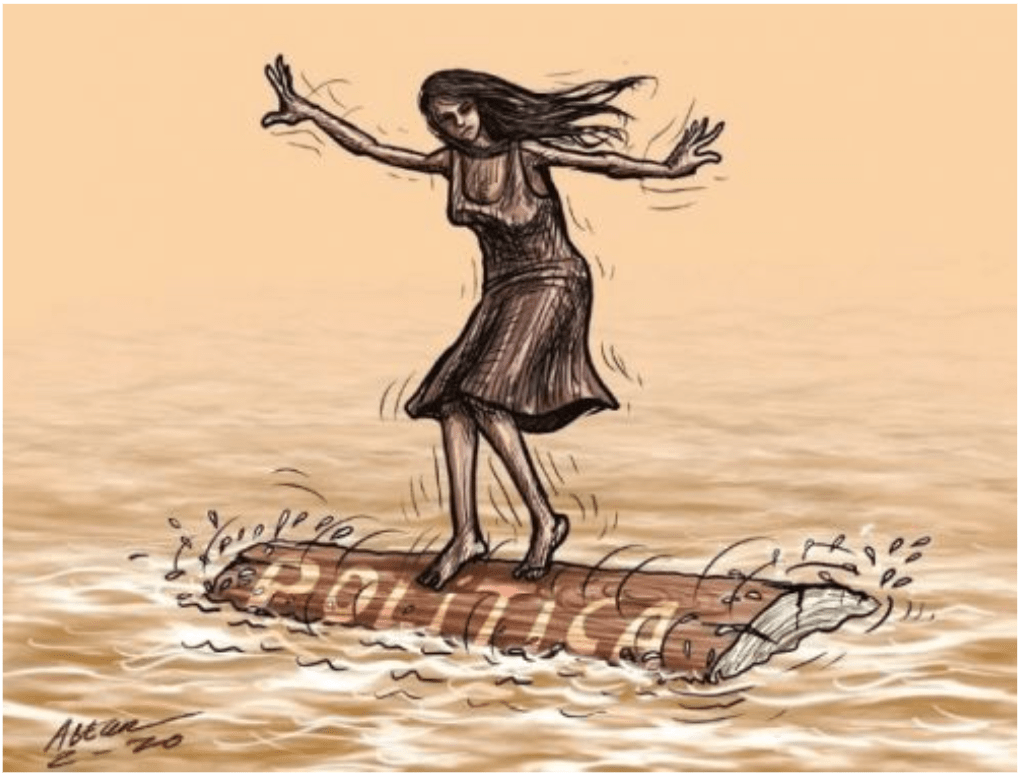
By Karen Longaric, El Deber:
Legally, the condition of interdict is defined as “the state of a person who has been judicially declared incapable of exercising certain rights, either by reason of a crime or for another cause provided for by law. This civil phrase is also used to indicate the suspension of office or the prohibition made on a person to continue in the exercise of their employment, position or profession” (Ossorio). That is to say, the interdict is the unfit person, disqualified from carrying out certain acts due to his manifest incapacity; For example, the prodigal who squanders the family assets, putting the family’s livelihood at risk, for which a judge can declare his incapacity and prohibit him from managing said assets.
The exercise of public function derived from political gifts exhibits the true essence of some officials, showing them as they are: dark, corrupt, mediocre and fallacious, prohibited from governing due to their manifest incapacity for the honest exercise of public function because they squander the money. state heritage, plundering it until it is left in misery, not only materially but also in patriotic spirit.
The shameful scene starring Luis Arce Catacora and Juan José Zúñiga in the corridors of the government palace has shown the Dantesque underworld to which our country has been dragged. And in such a situation we should not only be concerned about the pernicious effects of the political crisis on the national economy and the demolished state institutions, but it should alert us to the profound social and values crisis that is devouring Bolivian society and that will not be an easy task. to reverse, it will take at least four decades, that is, the same time as the debased policies carried out by the MAS.
Apologizing for this scene, Arce Catacora boasted that he had defended democracy from the siege of the right. What democracy was he talking about? Of the system that his government has vilified to the point of exhaustion? or the defense of public positions that he and his associates hold.
Democracy in Bolivia was broken a long time ago. There can be no half-hearted democracy. Either the rule of law is respected, strictly honoring the independence of powers, the Constitution and institutions, or there is no democracy, it’s that simple. Furthermore, where there are political prisoners, there is no democracy.
On October 29, 2020, a week before the end of my term as head of the Bolivian Foreign Ministry, I made international organizations (UN, EU, OAS) aware of the serious danger that loomed over Bolivian democracy, since, during In the last sessions of the Chambers of Senators and Deputies, the MAS caucus, since its party did not have two-thirds for the next legislature 2020-2025, arbitrarily modified the regulations of the Assembly, eliminating the “two-thirds” requirement for the approval of fundamental decisions in the Plurinational Legislative Assembly. Given the seriousness of this fact, Human Rights Watch also expressed its concern through a statement that literally said: “One day before losing the two-thirds majority in the Bolivian Senate, the MAS reduced the threshold to 2/3 of the votes to decide important matters. The MAS changed the rules of the game to suit them. Bad precedent.”
The MAS, which until then continued to hold political power in the country through its parliamentary majority, prepared the ground for Luis Arce Catacora to govern discretionally, without due oversight of the opposition in the Legislative Assembly, from which the opposition was warned.
The unconstitutional extension of functions from January 1, 2024 of magistrates, tribunes and judges, managed and implemented by the executive branch, has been a mortal blow to the judicial branch. What democracy is Luis Arce Catacora talking about?
Recently the “evista” faction, driven by the struggle within the MAS, has sought to return supervisory prominence to the legislative branch. Along these lines, it has been possible to approve a couple of laws that put an end to the unconstitutional extension of members of the judiciary, which, with ample arrogance, the government and David Choquehuanca disdained in his capacity as Vice President of Bolivia and ex-officio president of the Legislative Assembly , dealt another mortal blow against the legislative branch. What democracy is Luis Arce Catacora talking about?
The debasement of the public service demonstrates the inability of the current rulers to administer the state, configuring themselves as interdicts to govern. However, it is a utopia for the current judiciary to substantiate said interdiction ex officio, unless it is the citizens who identify them and point them out as such.
Por Karen Longaric, El Deber:
Jurídicamente se define la condición de interdicto como “el estado de una persona a la que judicialmente se ha declarado incapaz para ejercer ciertos derechos, o por razón de delito o por otra causa prevista en la ley. También se emplea esta locución civil para señalar la suspensión de oficio o la prohibición que se hace a una persona para continuar en el ejercicio de su empleo, cargo o profesión” (Ossorio). Es decir, el interdicto es la persona no apta, inhabilitada para realizar determinados actos debido a su manifiesta incapacidad; por ejemplo, el pródigo que dilapida el patrimonio familiar poniendo en riesgo el sustento de la familia, por lo cual un juez puede declarar su incapacidad y prohibirle administrar dicho patrimonio.
El ejercicio de la función pública derivada de la dádiva política exhibe la verdadera esencia de algunos funcionarios mostrándolos tal cual son: oscuros, corruptos, mediocres y falaces, interdictos para gobernar debido a su manifiesta incapacidad para el ejercicio probo de la función pública porque dilapidan el patrimonio del estado expoliándolo hasta dejarlo en la miseria, no solo material sino también de espíritu patriota.
La vergonzosa escena protagonizada por Luis Arce Catacora y Juan José Zúñiga en los pasillos del palacio de gobierno ha mostrado el dantesco submundo al que ha sido arrastrado nuestro país. Y en tal situación no solo debería preocuparnos los efectos perniciosos de la crisis política sobre la economía nacional y la derruida institucionalidad estatal, sino que debería alertarnos de la profunda crisis social y de valores que está devorando a la sociedad boliviana y que no será tarea fácil revertir, llevará al menos cuatro lustros, es decir el mismo tiempo que llevan las envilecidas políticas ejercidas por el MAS.
Apologizando dicha escena, Arce Catacora se jactó diciendo haber defendido la democracia del asedio de la derecha. ¿De qué democracia hablaba? ¿Del sistema que su gobierno ha vilipendiado hasta el hartazgo? o de la defensa de los cargos públicos que él y sus afines usufructúan.
Hace mucho tiempo que se quebrantó la democracia en Bolivia. No puede haber democracia a medias. O se respeta el estado de derecho honrando a rajatabla la independencia de poderes, la Constitución y la institucionalidad, o no hay democracia, así de simple. Además, donde hay presos políticos, no hay democracia.
El 29 de octubre de 2020, una semana antes que finalice mi gestión al frente de la Cancillería de Bolivia, hice conocer a los organismos internacionales (ONU, UE, OEA) el grave peligro que se cernía sobre la democracia boliviana, puesto que, durante las últimas sesiones de las Cámaras de Senadores y Diputados, la bancada del MAS, al no contar su partido con los dos tercios para la siguiente legislatura 2020-2025, modificó arbitrariamente los reglamentos de la Asamblea eliminando el requisito de “dos tercios” para la aprobación de decisiones fundamentales en la Asamblea Legislativa Plurinacional. Dada la gravedad de este hecho, Human Rights Watch también manifestó su preocupación a través de un comunicado que textualmente decía: “Un día antes de perder la mayoría de dos tercios en el Senado de Bolivia, el MAS redujo el umbral de 2/3 de los votos para decidir importantes materias. El MAS cambió las reglas del juego para hacerlas a su medida. Mal precedente.”
El MAS que hasta entonces seguía detentando el poder político en el país a través de su mayoría parlamentaria, dejó preparado el terreno para que Luis Arce Catacora gobierne discrecionalmente, sin la debida fiscalización de la oposición en la Asamblea Legislativa, de lo cual la oposición quedó advertida.
La inconstitucional prórroga de funciones desde el 1° de enero de 2024 de magistrados, tribunos y jueces, gestionada y accionada por el poder ejecutivo, ha sido un golpe mortal al poder judicial. ¿De qué democracia habla Luis Arce Catacora?
Recientemente la fracción “evista”, impelida por la pugna al interior del MAS, ha pretendido devolverle protagonismo fiscalizador al poder legislativo. En esa línea se ha podido aprobar un par de leyes que ponen fin a la inconstitucional prórroga de miembros del poder judicial, lo que, con sobrada soberbia desdeñó el gobierno y David Choquehuanca en su calidad de Vicepresidente de Bolivia y presidente nato de la Asamblea Legislativa, asestó otro golpe mortal contra el poder legislativo. ¿De qué democracia habla Luis Arce Catacora?
El envilecimiento de la función pública demuestra la incapacidad de los actuales gobernantes para administrar el estado, configurándose como interdictos para gobernar. Sin embargo, siendo una utopía que el actual poder judicial substancie de oficio dicha interdicción, al menos que sea la ciudadanía la que los identifique y los señale como tal.
https://eldeber.com.bo/edicion-impresa/interdictos-para-gobernar-por-manifiesta-incapacidad_375388


Leave a Reply