
By Marco Antonio Belmonte, Vision 360:
Seven decrees still restrict the export of sugar, oil, meat, soybeans, and derivatives
Caneb believes that the liberalization of exports, at least for non-traditional products, can generate a greater inflow of foreign currency into the country.
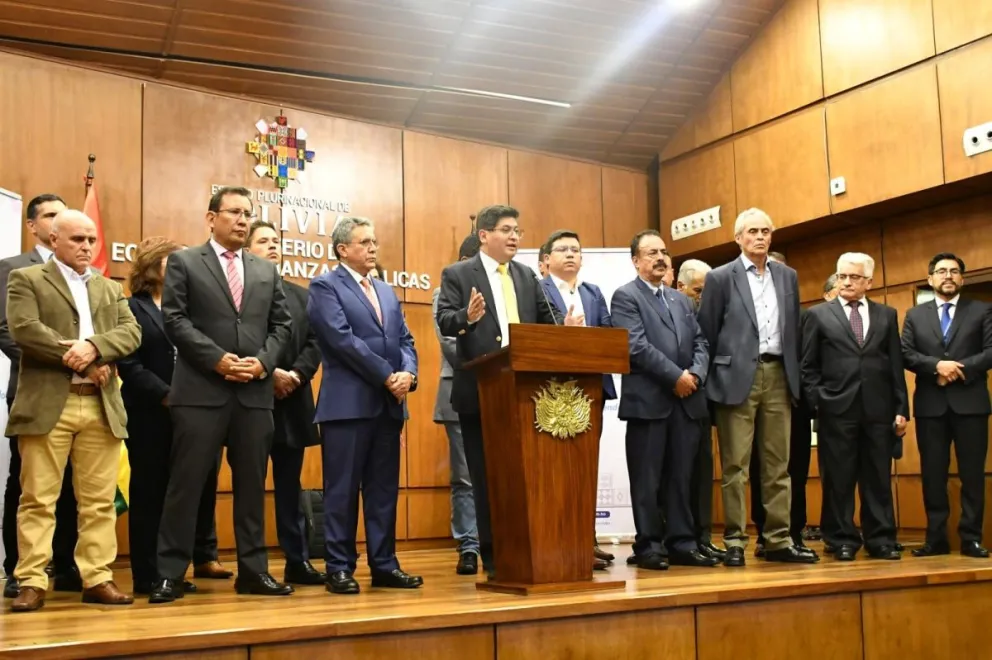
Minister of Economy, Marcelo Montenegro, and private entrepreneurs announced agreements on February 19. Photo: Ministry of Economy
Despite the agreement reached on February 19 between the Government and private entrepreneurs to implement actions to improve the inflow of foreign currency, seven supreme decrees that regulate and restrict the free export of products such as meat, sugar, oil, soybeans, and derivatives are still in force in the country.
Marcelo Olguín, the manager of Caneb, informed Visión 360 that the seven decrees that still regulate exports are: 3920; 725; 29524; 1163; 4680; 1554; and 3443.
He explained that these regulations affect products from the oilseed complex such as soybeans, crude and refined oil, and beef. However, since the country needs foreign currency, the export sector believes that at least non-traditional exports should be liberalized.
The seven decrees that regulate exports
1. Supreme Decree 3920, May 29, 2019
Authorizes the export of soybeans equivalent to 60% of the previous year’s national production according to official data from the National Institute of Statistics (INE) after verifying sufficient supply and fair pricing in the domestic market, of the goods classified under the following tariff subheadings:
2. Decree 0725, December 6, 2010
The supreme decree aims to regulate the export of the following products after verifying sufficient supply in the domestic market and fair pricing: soybeans, meal from seeds or oil-bearing fruits except mustard meal; cake and other solid residues from the extraction of fats or vegetable oils; cake and other solid residues from the extraction of soybean oil; and sunflower seeds.
This regulation establishes that the Ministry of Productive Development and Plural Economy, based on technical verification reports presented by the Ministry of Rural Development and Lands, will issue the certificate of sufficient supply and fair pricing to natural and legal persons, public, private, national or foreign who request it.
The products subject to restriction must be registered in the Export Registry of the Ministry of Productive Development and Plural Economy.
3. Supreme Decree 29524, April 18, 2018
The decree aims to authorize the export of the following products, after verifying sufficient supply in the domestic market at a fair price: crude oil, sunflower oil.
This regulation stipulates that the Ministry of Production and Microenterprise, based on technical verification reports of internal supply at a fair price from the Production and Market Supply Information System (SISPAM) under the Ministry of Rural Development, Agriculture, and Environment, will issue the certificate of sufficient internal supply at a fair price to exporting companies that comply with the established requirements.
It clarifies that SISPAM’s technical reports will include information from the following verification sources: National Institute of Statistics (INE), National Service of Agricultural Health and Food Safety (Senasag), and Superintendency of Companies. Additionally, it emphasizes that the fair price for each product must be listed in the price band established by SISPAM, considering quality and price, with minimum and maximum levels, updated periodically.
4. Supreme Decree 1153, March 18, 2012
The regulation exceptionally authorizes, after verifying sufficient supply at a fair price, the export of beef up to a maximum of 2,000 tons, and hard yellow corn up to a maximum of 30,000 tons.
5. Supreme Decree 4680, March 9, 2022
The decree aims to authorize the issuance of internal supply and fair pricing certificates to regulate the export of corn, sorghum, and sugar.
The regulation stipulates that the Ministry of Productive Development and Plural Economy, based on technical verification reports of internal supply at a fair price presented by the Ministry of Rural Development and Lands, as applicable, will issue the certificate of internal supply and fair pricing to natural and legal persons, public, private, national, or foreign who request it.
At the time of the approval of Supreme Decree 4680, the Minister of Productive Development, Néstor Huanca, assured that the regulation guaranteed the supply of strategic food at a fair price in the national market, such as sugar, milk, eggs, and meats of chicken, pork, and beef.
He detailed that the approval of this decree means that the destination of corn and sorghum will be prioritized for the livestock sector, so there will be no sales of these grains to the foreign market until December 31 of this year.
6. Supreme Decree 1554, April 11, 2013
The decree stipulates that before the start of the harvest, the Ministry of Productive Development and Plural Economy will quantify the production volume necessary for domestic market supply and the mandatory security inventory, based on the homologated harvest plans and the monthly sales projections to the domestic market declared by the sugarcane agricultural and agro-industrial sectors, and estimate if there is an exportable surplus.
If it is determined that there are exportable surpluses, the Ministry of Productive Development and Plural Economy will issue export licenses, according to the property rights of the sugarcane agricultural and agro-industrial sectors.
The sugarcane agricultural and agro-industrial sectors must obligatorily report production, internal and external sales biweekly according to the format established by the Ministry of Productive Development and Plural Economy.
With this decree, the export license for sugarcane, its main products, and by-products of sugarcane is created as a supporting document for the Single Export Declaration.
7. Supreme Decree 3443, December 27, 2017
The decree stipulates that to control internal supply and fair pricing, the Agro-environmental and Productive Observatory of the Ministry of Rural Development and Lands, in coordination with the Vice Ministry of Internal Trade and Exports of the Ministry of Productive Development and Plural Economy, will periodically evaluate the internal supply and fair pricing conditions of the products: fresh or chilled bovine beef and frozen bovine beef.
It clarifies that in the event of a potential risk of changing adequate internal supply and fair pricing conditions, the Ministry of Rural Development and Lands and the Ministry of Productive Development and Plural Economy, through a bi-ministerial resolution, will order the issuance of the Certificate of Internal Supply and Fair Pricing, which will be considered a supporting document for the export declaration of bovine beef.
Commitment
The National Chamber of Exporters of Bolivia (Caneb) considers that, given the need for dollars to enter the country due to the drop in Net International Reserves (RIN), these regulations that impose limits on foreign sales should be repealed, after guaranteeing internal supply and provided there are surpluses, and establish the issuance of certificates of sufficient internal supply and fair pricing by the Ministries of Productive Development and Rural Development.
On February 19, the Minister of Economy and Public Finance, Marcelo Montenegro, presented the ten measures of the “Economic, Productive, and Entrepreneurial Agreement between the National Government and the Bolivian Business Sector” aimed at normalizing the temporary dollar shortage scenario, as well as opening dialogue and negotiation scenarios to generate positive expectations that will lead to greater production and income for the benefit of the population.
This agreement comes after both sectors held a meeting on Friday, February 16, 2024, where they decided to find joint solutions to the dollar shortage and speculation.
Montenegro then reported that the first measure was the liberalization of exports with expedited procedures. “Exports of products that previously had to undergo a lengthy process for an internal supply certificate at a fair price are now liberalized (…) always ensuring there is a commitment to supply the national market,” he stated.
The second measure involved the immediate reinstatement of Tax Refund Certificates (Cedeims), upon delivery of foreign currency from exports.
Exports Decline
From January to February 2024, national exports (excluding re-exports and personal effects) reached 1,247.4 million dollars, a figure 377.9 million less than in the same period in 2023, when it reached 1,625.3 million dollars, representing a decrease of 23.3%.
This behavior is explained by the negative variations in the economic activities of hydrocarbon extraction by 26.1% and manufacturing by 36.8%.
Meanwhile, external sales of agriculture, livestock, hunting, forestry, and fishing increased by 9.1% and mineral extraction by 7.0%.
Por Marco Antonio Belmonte, Vision 360:
Siete decretos aún restringen las exportaciones de azúcar, aceite, carne, soya y derivados
La Caneb considera que la liberación de exportaciones, al menos de productos no tradicionales, puede generar una mayor llegada de divisas al país.
El ministro de Economía, Marcelo Montenegro y los empresarios privados anunciaron acuerdos el 19 de febrero. Foto: Ministerio de Economía
A pesar del acuerdo alcanzado el 19 de febrero entre Gobierno y empresarios privados para impulsar acciones que mejoren la llegada de divisas, aún están vigentes en el país siete decretos supremos que regulan y restringen la libre exportación de productos como carne, azúcar, aceite, soya y derivados.
El gerente de la Caneb, Marcelo Olguín, informó a Visión 360 que los siete decretos que aún regulan las exportaciones son: 3920; 725; 29524; 1163; 4680; 1554 y 3443.
Explicó que estas normas afectan a los productos del complejo oleaginoso como son la soya en grano, aceite crudo y refinado, y carne de res bovina, pero en la medida que el país requiere de divisas, el sector exportador considera que debería al menos liberarse las exportaciones no tradicionales.
Los siete decretos que regulan exportaciones
1.- Decreto Supremo 3920, del 29 mayo de 2019
Se autoriza la exportación de grano de soya equivalente al 60% de la producción nacional de la gestión anterior según datos oficiales del Instituto Nacional de Estadística – INE previa verificación de suficiencia y abastecimiento en el mercado interno a precio justo, de las mercancías clasificadas en las siguientes subpartidas arancelarias:
2.- Decreto 0725 del 6 de diciembre de 2010
El decreto supremo tiene por objeto regular la exportación de los siguientes productos, previa verificación de suficiencia de abastecimiento en el mercado interno y precio justo: habas de soya, harina de semillas o de frutos oleaginosos, excepto la harina de mostaza; torta y demás residuos sólidos de la extracción de grasas o aceites vegetales; torta y demás residuos sólidos de la extracción de aceite de soya; de semillas de girasol.
Esa norma establece que el Ministerio de Desarrollo Productivo y Economía Plural, en base a informes técnicos de verificación presentados por el Ministerio de Desarrollo Rural y Tierras, emitirá el certificado de suficiencia y abastecimiento interno y precio justo, a las personas naturales y jurídicas, públicas, privadas, nacionales o extranjeras que así lo soliciten.
Los productos sujetos a la restricción deben anotarse en el Registro de Exportaciones del Ministerio de Desarrollo Productivo y Economía Plural.
3.- Decreto Supremo 29524, del 18 de abril de 2018
El decreto tiene por objeto autorizar la exportación de los productos detallados a continuación, previa verificación de suficiencia de abastecimiento en el mercado interno a precio justo: aceite en bruto, aceite de girasol.
Esa norma dispone que el Ministerio de Producción y Microempresa, en base a informes técnicos de verificación de abastecimiento interno a precio justo del Sistema de Seguimiento y de Información de la Producción el Abastecimiento y Mercados (SISPAM) dependiente del Ministerio de Desarrollo Rural, Agropecuario y Medio Ambiente, emitirá el certificado de suficiencia y abastecimiento interno a precio justo, a las empresas exportadoras que cumplan con lo establecido.
Aclara que los informes técnicos del SISPAM contemplarán la información de las siguientes fuentes de verificación: Instituto Nacional de Estadística (INE), Servicio Nacional de Sanidad Agropecuaria e Inocuidad Alimentaria (Senasag) y Superintendencia de Empresas. Además, subraya que el precio justo para cada producto deberá estar consignado en la banda de precios establecida por el SISPAM, que contemple calidad y precio, con niveles mínimo y máximo, y que será actualizada periódicamente.
4.- Decreto Supremo 1153, del 18 de marzo de 2012
La norma autorizaba de manera excepcional, previa verificación de suficiencia de abastecimiento a precio justo, la exportación de carne de res, hasta un máximo de dos mil toneladas, y de maíz amarillo duro hasta un máximo de 30 mil toneladas.
5.- Decreto Supremo 4680, del 9 de marzo de 2022
El decreto tiene por objeto autorizar la emisión de certificados de abastecimiento interno y precio justo para regular la exportación de maíz, sorgo y azúcar.
La norma dispone que el Ministerio de Desarrollo Productivo y Economía Plural, en base a informes técnicos de verificación de abastecimiento interno a precio justo presentados por el Ministerio de Desarrollo Rural y Tierras, según corresponda, emitirá el certificado de abastecimiento interno y precio justo a las personas naturales y jurídicas, públicas, privadas, nacionales o extranjeras que así lo soliciten.
En oportunidad de la aprobación del Decreto Supremo 4680, el ministro de Desarrollo Productivo, Néstor Huanca, aseguró que la norma garantizaba el abastecimiento de alimentos estratégicos a precio justo en el mercado nacional, como azúcar, leche, huevo y carnes de pollo, cerdo y res.
Detalló que la aprobación de este decreto significa que se priorizará el destino de maíz y sorgo al sector productor pecuario, por lo que hasta el 31 de diciembre de este año no se realizarán ventas de esos granos al mercado exterior.
6.- Decreto Supremo 1554, del 11 de abril de 2013
El Decreto estipula que antes de iniciar la zafra, el Ministerio de Desarrollo Productivo y Economía Plural, cuantificará el volumen de producción necesario para el abastecimiento del mercado interno y el inventario de seguridad obligatorio, en función a los planes de zafra homologados y las proyecciones de ventas mensuales al mercado interno declaradas por el sector agrícola cañero y agroindustrial cañero, y estimará sí existe saldo exportable.
En caso de que se determine la existencia de excedentes exportables, el Ministerio de Desarrollo Productivo y Economía Plural emitirá licencias de exportación, conforme al derecho propietario del sector agrícola cañero y agroindustrial cañero.
El sector agrícola cañero y agroindustrial cañero deberán reportar obligatoriamente la producción, ventas internas y externas quincenalmente de acuerdo al formato establecido por el Ministerio de Desarrollo Productivo y Economía Plural.
Con el decreto, se crea la licencia de exportación de caña de azúcar, sus productos principales y subproductos de la caña de azúcar como un documento soporte de la Declaración Única de Exportación.
7.- Decreto supremo 3443, del 27 de diciembre de 2017
El decreto estipula que, a efectos de controlar el abastecimiento interno y el precio justo, el Observatorio Agroambiental y Productivo del Ministerio de Desarrollo Rural y Tierras, de manera coordinada con el Viceministerio de Comercio Interno y Exportaciones del Ministerio de Desarrollo Productivo y Economía Plural, evaluarán periódicamente las condiciones de abastecimiento interno y precio justo de los productos: carnes de res bovina fresca o refrigerada y carne bovina congelada.
Aclara que, ante un eventual riesgo de modificación de las condiciones adecuadas de abastecimiento interno y precio justo, el Ministerio de Desarrollo Rural y Tierras y el Ministerio de Desarrollo Productivo y Economía Plural a través de una resolución biministerial, dispondrán la emisión del Certificado de Abastecimiento Interno y Precio Justo, mismo que será considerado como documento soporte de la declaración de mercancías de exportación de carne bovina.
Compromiso
La Cámara Nacional de Exportadores de Bolivia (Caneb) considera que, en la medida que se necesita el ingreso de dólares al país por la caída en las Reservas Internacionales Netas (RIN), se debería dar de baja a estas normas que imponen límites a las ventas al exterior, previa garantía de abastecimiento interno y siempre que existan excedentes, y establece la emisión de certificados de suficiencia y abastecimiento interno, y precio justo a cargo de los Ministerios de Desarrollo Productivo y Ministerio de Desarrollo Rural.
El pasado 19 de febrero, el ministro de Economía y Finanzas Públicas, Marcelo Montenegro, presentó las diez medidas del “Acuerdo económico, productivo y empresarial entre el Gobierno Nacional y el empresariado boliviano” que tiene el objetivo de normalizar el escenario transitorio de escasez de dólares, además de abrir el diálogo y escenarios de concertación para que se generen expectativas positivas que generen mayor producción e ingreso en beneficio de la población.
Este acuerdo se da después que ambos sectores sostuvieran una reunión el viernes 16 de febrero de 2024, en la que determinaron encontrar soluciones conjuntas a la escasez y especulación de dólares.
Montenegro informó entonces que la primera medida era la liberación de exportaciones con agilización de trámites. “Están liberadas las exportaciones de los productos que anteriormente tenían que hacer un trámite largo de certificado de abastecimiento interno a precio justo (…) siempre cuidando que haya un compromiso de abastecimiento del mercado nacional”, señaló.
La segunda medida, consistía en la restitución inmediata de los Certificados de Devolución de Impuestos (Cedeims), previa entrega de divisas por exportaciones.
Caen exportaciones
De enero a febrero de 2024 las exportaciones nacionales (que no incluyen reexportaciones ni efectos personales) llegaron a 1.247,4 millones de dólares, cifra menor en 377,9 millones a la registrada en similar período de 2023, cuando alcanzó a 1.625,3 millones de dólares lo que representa una disminución de 23,3%.
Este comportamiento se explica por las variaciones negativas que registraron las actividades económicas: extracción de hidrocarburos 26,1% y la Industria manufacturera 36,8%.
En tanto que aumentaron las ventas externas de la agricultura, ganadería, caza, silvicultura y pesca 9,1% y la extracción de minerales en 7,0%.

 Bolivian Thoughts | Pensamientos Bolivianos (Bilingual/Bilingüe)