
Fundacion Jubileo, Brujula Digital:
Jubileo: fuel shortage has nothing to do with blockades, but with the drop in production and over time it will be greater
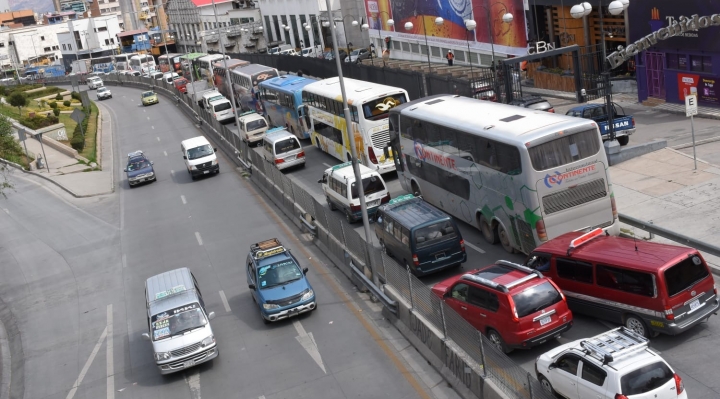
Vehicles line up to buy fuel. Photo: APG
The Jubilee Foundation reported this Wednesday that the fuel shortage in the country has nothing to do with the Evista blockade, but rather with the drop in hydrocarbon production by 50% since eight years ago, and warned that this situation will become worse as years goes by, because Bolivia imports hydrocarbon derivatives from neighboring countries.
“There are underlying structural problems that transcend far beyond any (road) blockage problem,” Energy and Hydrocarbons researcher Raúl Velásquez, from the Jubileo Foundation, assured Brújula Digital. “The structural problem lies in the fact that the production of hydrocarbons, both natural gas and liquid hydrocarbons, has been falling in the last eight years, in particular, the production of liquid hydrocarbons has fallen by 50%.”
At least in the city of La Paz and in others in the west, where there are no road blocks, long lines of vehicles are observed at service stations filling up with gasoline or diesel. Analyst Ximena Costa said this Tuesday on Panamericana that the lack of fuel is attributed by the Government to the road blockage. “It is to ignore and blame that there is none, an old strategy.”
On Monday, January 29, the executive director of the National Hydrocarbons Agency (ANH), Germán Jiménez, reported at a press conference that “every effort is made to guarantee the supply of the domestic market,” suggesting that fuel be purchased only if needs and announced that “controlled supply” is carried out.
“We have a controlled supply. We are making every effort to guarantee supply to the domestic market. It is not necessary for our population to go to our service stations when they do not need fuel,” Jiménez reported.
A decade ago, 60 million cubic meters of natural gas were produced per day, a figure that fell to around 35 million today. “This forces us to import more and more fuels. This drop in the production of liquids forces the country to import more and more fuels,” said Velásquez.
10 years ago, exports were around 6.6 billion dollars and imports did not exceed 1.15 billion dollars of gasoline and diesel. In 2023, the country exported about $3 billion of gas, but imported around $4.2 billion of gasoline and diesel.
“So, there are underlying structural problems that transcend far beyond any (road) blockage problem. In fact, if we review and remember a little what was happening in November and December (2023), there were already complaints of lines at gas stations, at service stations, both in La Paz and in Santa Cruz and Cochabamba,” said the expert in Energy and Hydrocarbons.
Velásquez anticipated that once the road blocks are lifted, the problem of fuel shortages will continue in the country. “It is a problem that is latent, I believe, beyond the specific or very specific issue of the blockades. Suddenly, if the blockages were solved, we would continue to have the same problem because we have already seen it like this in December, November, particularly last year.”
The Jubileo expert explained that, in the case of gasoline, “approximately 50% of the gasoline consumed in the domestic market is domestically produced” and “50% comes from imports.”
In the case of diesel, he continued, “the situation is a little more dramatic,” since “about 80% of national consumption comes from imports and 20% from national production.” He insisted that this situation “is the result of the drop in hydrocarbon production in the country, which has been occurring since 2015 at a general level, both in gas and liquids.”
Velásquez recalled that the drop in production dates back to 2005, followed by an increasing subsidy each year that passes. “A subsidy policy has been in force in Bolivia since August 2004, but it froze the price of a barrel of oil at 27 dollars and 11 cents. And of course, if you put yourself in the shoes of a foreign oil company, where would you prefer to invest? In Bolivia, where they are going to pay you 27 dollars and 11 cents? Or in Vaca Muerta (Argentina), where they will pay you close to 80 dollars? Or in Colombia, where they are going to pay you 78 dollars a barrel? “With certainty he is going to invest abroad.”
Given the lack of investment in new hydrocarbon deposits, the expert projected a possible trend that consists of increasing the percentage of imports, since investments in the sector require a long term to reap the investments.
“That’s how it will be, the trend is going there. The hydrocarbon sector is a long-term sector and, unfortunately, it is a condition that exists worldwide. So, what the country is reaping today, these problems that we are seeing (queues and fuel imports), are the result of the hydrocarbon policies that have been implemented in Bolivia in the last 18 years. That is the result, it is what we are seeing today and if we decide, finally, to agree as a country and achieve a new hydrocarbon policy that corrects these structural problems, it will take time,” said Velásquez.
The Energy and Hydrocarbons researcher stated that the lines at service stations will not disappear, because the country until now depends on the importation of gasoline and diesel with a decreasing national production.
“We are also going to see the changes five or ten years from now, so in the short or even medium term it is very difficult to overcome the situation that the country had previously, because due to the very characteristics of the exploratory activity it is not something that can be done overnight, but it takes time.”
On January 26, the Minister of Hydrocarbons and Energy, Franklin Molina, asked “the mobilized groups to allow the transitability” of the tanks. Of the 1,054 tankers that travel on the roads to different regions, more than a hundred were stopped at the blocking points in the Cochabamba tropics, and 260 run the risk of being in a similar situation in other conflict zones, so routes are being sought. alternate to reach your destination.
The executive director of the ANH, Germán Jiménez, said: “We have more than 100 tankers that are stranded. These hundred tankers are equivalent to more than 3.5 million liters, which compromise some regions or municipalities where these fuels have to arrive.”
BD/CT
Jubileo: escasez de carburantes no tiene que ver con bloqueos, sino con la caída en la producción y con el tiempo será mayor
Vehículos hacen fila para comprar carburantes. Foto: APG
La Fundación Jubileo informó este miércoles que la escasez de carburantes en el país no tiene que ver con el bloqueo evista, sino con la caída en la producción de hidrocarburos en 50% desde hace ocho años, y alertó que esta situación será mayor con el paso de los años porque Bolivia importa los derivados de los hidrocarburos de países vecinos.
“Hay problemas estructurales de fondo que trascienden mucho más allá de cualquier problema de bloqueo (carretero)”, aseguró a Brújula Digital el investigador en Energía e Hidrocarburos, Raúl Velásquez, de la Fundación Jubileo. “El problema estructural radica en que la producción de hidrocarburos, tanto de gas natural como de hidrocarburos líquidos, viene cayendo en los últimos ocho años, en particular, la producción de hidrocarburos líquidos ha caído un 50%”.
Al menos en la ciudad de La Paz y en otras del occidente, donde no hay bloqueo de carreteras, se observan largas filas de vehículos en las estaciones de servicio que cargan gasolina o diésel. La analista Ximena Costa dijo este martes en Panamericana que la falta de carburantes es atribuida por el Gobierno al bloqueo vial. “Es para desentenderse y culpar que no hay, una vieja estrategia”.
El lunes 29 de enero, el director ejecutivo de la Agencia Nacional de Hidrocarburos (ANH), Germán Jiménez, informó en conferencia de prensa que se hace “todos los esfuerzos para garantizar el abastecimiento del mercado interno”, sugirió adquirir el carburante solo si se necesita y anunció que se efectúa el “abastecimiento controlado”.
“Tenemos un abastecimiento controlado. Estamos haciendo todos los esfuerzos para garantizar el abastecimiento al mercado interno. No es necesario que nuestra población acuda a nuestras estaciones de servicio cuando no necesitan el carburante”, informó Jiménez.
Hace una década se producía 60 millones de metros cúbicos diarios de gas natural, cifra que cayó a alrededor de 35 millones en la actualidad. “Esto nos obliga a importar cada vez más combustibles. Esta caída en la producción de líquidos le obliga al país a importar cada vez más combustibles”, dijo Velásquez.
Hace 10 años la exportación bordeaba los 6.600 millones de dólares y la importación no superaba los 1.150 millones de dólares de gasolina y diésel. En 2023 el país exportó unos 3.000 millones de dólares de gas, pero importó alrededor de 4.200 millones de dólares por gasolina y diésel.
“Entonces, hay problemas estructurales de fondo que trascienden mucho más allá a cualquier problema de bloqueo (de carreteras). De hecho, si revisamos y recordamos un poco lo que estaba ocurriendo en noviembre y diciembre (2023), ya se realizaban denuncias de filas en gasolineras, en estaciones de servicio, tanto en La Paz como en Santa Cruz y Cochabamba”, dijo el experto en Energía e Hidrocarburos.
Velásquez anticipó que una vez que se levanten los bloqueos de carreteras, el problema de la falta de carburantes continuará en el país. “Es un problema que está latente, creo yo, más allá del tema específico o muy puntual de los bloqueos. De pronto, si los bloqueos se solucionasen, seguiríamos arrastrando el mismo problema porque ya lo hemos visto así en diciembre, en noviembre, particularmente del año pasado”.
El experto de Jubileo explicó que, en el caso de la gasolina, “aproximadamente un 50% de la gasolina que se consume en el mercado interno es de producción nacional” y un “50% viene de la importación”.
En el caso del diésel, prosiguió, “la situación es un poquito más dramática”, pues “cerca del 80% del consumo nacional viene de la importación y el 20% de la producción nacional”. Insistió que esta situación “es el resultado de la caída en la producción de hidrocarburos en el país, que viene desde el 2015 a nivel general, tanto en gas como en líquidos”.
Velásquez recordó que la caída en la producción data de 2005, seguida por una subvención ascendente por año que pasa. “Desde agosto de 2004 está vigente en Bolivia una política de subvención, pero que congeló el precio del barril de petróleo en 27 dólares con 11 centavos. Y claro, si usted se pone en los zapatos de una petrolera extranjera, ¿dónde preferiría invertir? ¿En Bolivia, donde le van a pagar 27 dólares con 11 centavos? ¿O en Vaca Muerta (Argentina), donde le van a pagar cerca de 80 dólares? ¿O en Colombia, donde le van a pagar 78 dólares el barril? Con seguridad que va a ir a invertir al exterior”.
Ante la falta de inversión en nuevos yacimientos de hidrocarburos, el experto proyectó una posible tendencia que consiste en aumentar el porcentaje de la importación, pues las inversiones en el sector demandan es a largo plazo para cosechar las inversiones.
“Así va a ser, va por ahí la tendencia. El sector hidrocarburos es un sector de largo plazo y, lamentablemente, es una condición que se tiene a nivel mundial. Entonces, lo que hoy está cosechando el país, estos problemas que estamos viendo (filas e importación de carburantes), son el resultado de las políticas hidrocarburíferas que se han implementado en Bolivia en los últimos 18 años. Ese es el resultado, es el que estamos viendo hoy y si decidimos, finalmente, ponernos de acuerdo como país y logramos una nueva política hidrocarburífera que corrija estos problemas estructurales, demandará tiempo”, dijo Velásquez.
El investigador en temas de Energía e Hidrocarburos afirmó que las filas en las estaciones de servicio no desaparecerán, porque el país hasta ahora depende de la importación de gasolina y diésel con una producción nacional descendente.
“Los cambios también los vamos a ver de aquí a cinco o diez años hacia adelante, entonces en el corto o incluso mediano plazo es muy difícil poder remontar la situación que tenía el país anteriormente, porque por las características mismas de la actividad exploratoria no es algo que se pueda hacer de la noche a la mañana, sino que toma tiempo”.
El pasado 26 de enero, el ministro de Hidrocarburos y Energías, Franklin Molina, pidió “a los grupos movilizados que permitan la transitabilidad” de las cisternas. De 1.054 cisternas que transitan por las carreteras hacia distintas regiones, más de un centenar estaban paradas en los puntos de bloqueo del trópico de Cochabamba, y 260 corren el riesgo de quedar en similar situación en otras zonas de conflicto, por lo que se buscan rutas alternas para llegar a destino.
El director ejecutivo de la ANH, Germán Jiménez, dijo: “Tenemos más de 100 cisternas que están varadas. Estas cien cisternas equivalen más de 3,5 millones de litros que comprometen algunas regiones o municipios donde tienen que llegar estos combustibles”.
BD/CT

 Bolivian Thoughts | Pensamientos Bolivianos (Bilingual/Bilingüe)