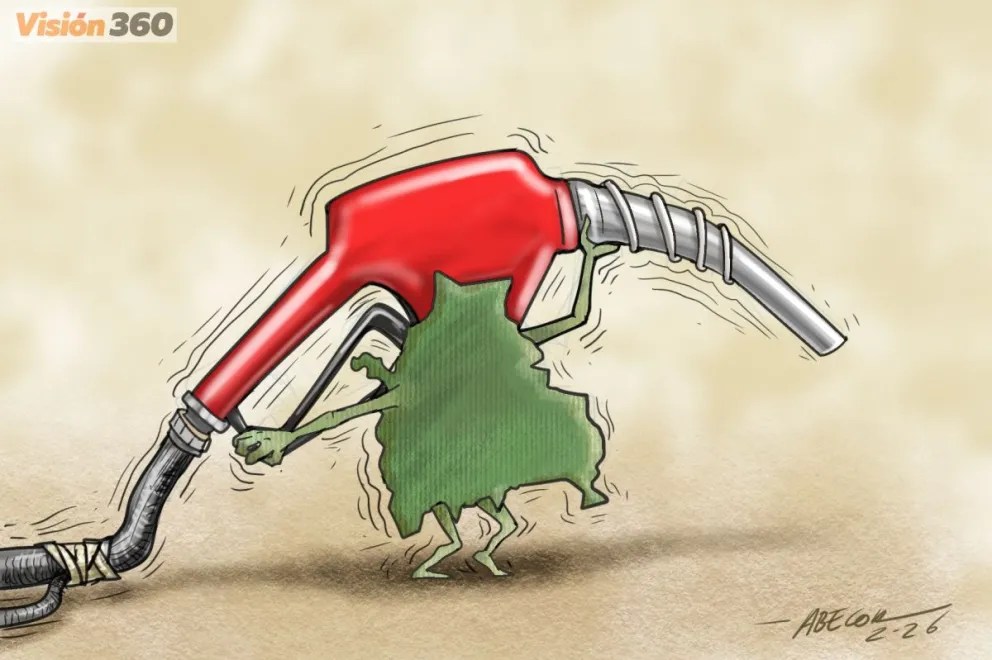
By Erika Segales, El Deber:
Bolivia maintains fuel prices despite the cost of a new subsidy

For the moment, the country is going through a conflict with fuel supply due to road blockades. Photo: APG
Analysts warn that the subsidized price in Bolivia is once again creating an incentive for smuggling to neighboring countries. They emphasize that between January and April of this year, the Government allocated US$814 million for the purchase of fuels.
More than six months after the fuel price adjustment, the Government is keeping gasoline and diesel prices frozen, despite the fact that the 180-day period that Supreme Decree 5516 itself had established to review the pricing scheme again based on the behavior of the international market has already expired.
The date passed almost unnoticed. The transitional period established by the regulation ended between June 15 and 16, and so far the authorities have not announced an update of prices or modifications to the mechanism approved in December 2025.
“We do not plan to raise the fuel price. Those carrying out the blockades talk about privatizations and other things; they do it to mislead people. We have no intention of privatizing and no intention of raising fuel prices,” said Minister of Hydrocarbons and Energy Marcelo Blanco last week.
The Executive’s decision comes after Supreme Decree 5516 ratified the prices set following the adjustment applied at the end of 2025. The regulation keeps regular gasoline at Bs 6.96 per liter and diesel oil at Bs 9.80 per liter, while also establishing prices for other fuels.
However, the scenario that justified those prices has changed significantly. When the adjustment was approved, the price of oil was between US$60 and US$65 per barrel. Months later, amid the escalation of the conflict in the Middle East, the price exceeded US$100 per barrel, once again increasing the cost of fuel imports.
Another unexpected factor for the Government was added. Gasoline at the new price reached the market in the middle of the scandal involving destabilized gasoline, a case that led to judicial investigations, the arrest of former YPFB executives, and questions regarding the quality of fuel sold in the country.
Raúl Velásquez, energy and hydrocarbons researcher at the Fundación Jubileo, explained that the increase in international prices reduced part of the fiscal effect that the adjustment approved in December had sought to achieve.
“Between February and June of this year, the country has undoubtedly returned to subsidizing both gasoline and diesel,” he pointed out.
Another element to consider is the cost of importing fuels. Economic analyst Óscar Mario Tomianovic noted that, based on data from the National Statistics Institute (INE), between January and April 2026 Bolivia allocated approximately US$814 million to the import of fuels and fuel derivatives.
The amount represents a reduction compared to the US$908 million recorded during the same period in 2025, but it still reflects a significant outflow of foreign currency.
Regarding import volumes, the expert points out that there was a reduction from 903 tons between January and April 2025 to 668 tons during the same period in 2026, figures corresponding to foreign trade records measured by weight.
For Tomianovic, the central problem is that when the international price rises and the domestic price remains fixed, the difference must be absorbed by the State.
“Although that initial adjustment was already made at the beginning of the year, an increase in the price of oil and, therefore, in derivatives such as gasoline means that the differential grows again,” he explained.
The Government’s decision also comes amid pressure from transportation sectors, which expressed their rejection of any possible increase in fuel prices following the destabilized gasoline scandal.
For transport operators, before discussing a new price adjustment, the situation regarding supply and the quality of fuel reaching the domestic market must first be resolved.
Nevertheless, the difference between Bolivia’s domestic prices and hydrocarbon prices in neighboring countries has once again sparked debate about the risk of smuggling.
“This year and during the semester that has passed, the incentive for smuggling has once again been created. In Bolivia, gasoline costs Bs 6.96 per liter, equivalent to about US$0.70 (using the reference exchange rate), and it is being sold in Peru at US$1.70; and if we look at diesel, something similar happens,” Velásquez emphasized.
Por Erika Segales, El Deber:
Bolivia mantiene el precio de carburantes pese al costo de una nueva subvención
Por el momento el país atraviesa un conflicto con el abastecimiento de combustible debido a los bloqueos. Foto: APG
Analistas advierten que el precio subsidiado en Bolivia vuelve a generar un incentivo para el contrabando hacia países vecinos. Se enfatiza que entre enero y abril de este año, el Gobierno destinó $us 814 millones para la compra de combustibles
A más de seis meses del ajuste de precios de los combustibles, el Gobierno mantiene congeladas las tarifas de la gasolina y el diésel, pese a que ya venció el plazo de 180 días que el propio Decreto Supremo 5516 había fijado, para revisar nuevamente el esquema de precios en función del comportamiento del mercado internacional.
La fecha pasó prácticamente inadvertida. El periodo transitorio establecido por la norma concluyó entre el 15 y el 16 de junio, sin que hasta ahora las autoridades hayan anunciado una actualización de los precios ni modificaciones al mecanismo aprobado en diciembre de 2025.
“No tenemos planeado subir (el precio) del combustible. Los bloqueadores hablan de privatizaciones y demás cosas, lo hacen para poner mal a la gente. No tenemos la intención de privatizar ni la intención de subir el combustible”, aseguró la semana pasada el ministro de Hidrocarburos y Energía, Marcelo Blanco.
La decisión del Ejecutivo llega después de que el Decreto Supremo 5516 ratificó los precios fijados tras el ajuste aplicado a finales de 2025. La norma mantiene la gasolina especial en Bs 6,96 por litro y el diésel oil en Bs 9,80 por litro, además de establecer los valores para otros combustibles.
Sin embargo, el escenario que justificó esos precios cambió significativamente. Cuando se aprobó el ajuste, el barril de petróleo se encontraba entre 60 y 65 dólares. Meses después, en medio de la escalada del conflicto en Medio Oriente, la cotización superó los 100 dólares, elevando nuevamente el costo de importación de combustibles.
A ello se sumó otro factor inesperado para el Gobierno. La gasolina con el nuevo precio llegó al mercado en medio del escándalo de la gasolina desestabilizada, un caso que derivó en investigaciones judiciales, aprehensiones de exejecutivos de YPFB y cuestionamientos sobre la calidad del combustible comercializado en el país.
El investigador en energía e hidrocarburos de Fundación Jubileo, Raúl Velásquez, explicó que el incremento internacional de los precios redujo parte del efecto fiscal que buscaba el ajuste aprobado en diciembre.
“Entre febrero y junio de este año, sin duda el país ha vuelto otra vez a subvencionar tanto la gasolina como el diésel”, apuntó.
Otro elemento a considerar es el costo de importar combustibles. El analista económico Óscar Mario Tomianovic señaló que, con base en datos del INE, entre enero y abril de 2026 Bolivia destinó aproximadamente $us 814 millones a la importación de combustibles y derivados.
El monto representa una reducción frente a los 908 millones de dólares registrados en el mismo periodo de 2025, pero continúa mostrando una elevada salida de divisas.
En cuanto al volumen registrado en las importaciones, el experto señala que hubo una reducción de 903 toneladas entre enero y abril de 2025 a 668 toneladas en el mismo periodo de 2026, cifras que corresponden al registro de comercio exterior en términos de peso.
Para Tomianovic, el problema central está en que cuando el precio internacional sube y el precio interno permanece fijo, la diferencia debe ser absorbida por el Estado.
“Si bien ya se hizo ese ajuste inicial a comienzos de año, un incremento en el precio del petróleo y, por lo tanto, de los derivados como la gasolina, significa que ese diferencial vuelve a aumentar”, explicó.
La decisión del Gobierno se da además en medio de la presión de sectores del transporte, que expresaron su rechazo a un eventual incremento de los precios de los carburantes, tras del escándalo de la gasolina desestabilizada.
Para los transportistas, antes de discutir un nuevo ajuste de precios debe resolverse la situación del abastecimiento y la calidad del combustible que llega al mercado interno.
No obstante, la diferencia entre los precios internos de Bolivia y los valores de los hidrocarburos en países vecinos vuelve a poner en debate el riesgo del contrabando.
“Nuevamente este año y en este semestre que ha pasado, se ha vuelto a generar el incentivo para el contrabando. Es decir, usted tiene en Bolivia el litro de gasolina Bs 6.96, equivalente a $us 0,70 (con la cotización referencial), y lo están vendiendo en el Perú a $us 1.70 y si vemos el caso del diésel, ocurre algo similar”, enfatizó Velásquez.


Leave a Reply