By El Diario;
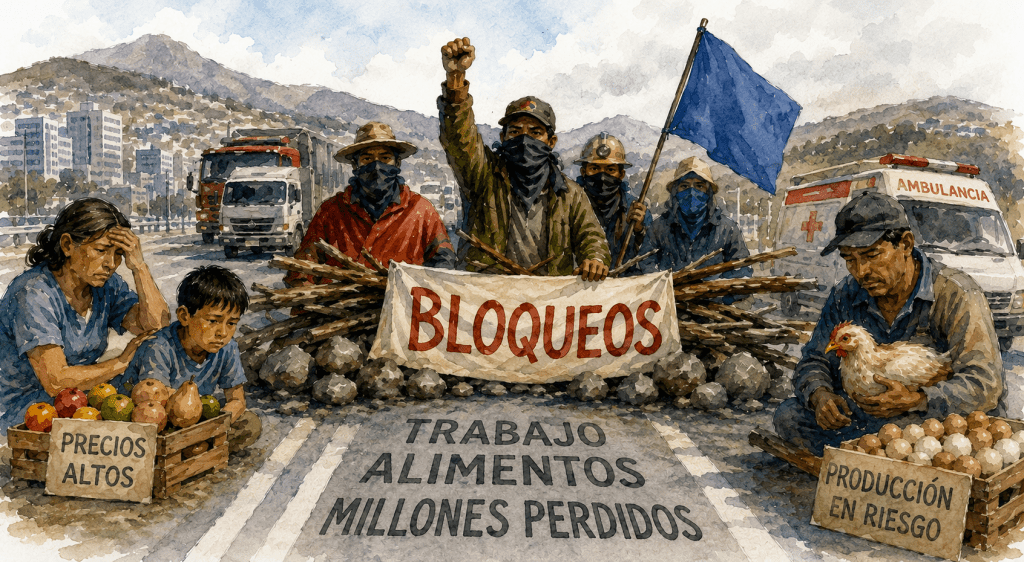
The economic and social crisis affecting Bolivia is deepening poverty and, without dialogue and reconciliation, the most vulnerable people will continue to be the hardest hit, warned the Fundación Jubileo while assessing the impact of more than a month of roadblocks across the country.
The protest measures restricted the movement of food, fuel, and medicines, placing the supply of major cities in a critical situation. According to Jubileo, this scenario worsens a multidimensional crisis that Bolivia was already facing and that is now reflected in one of the most severe inflationary episodes in recent decades.
Fundación Jubileo’s director, Juan Carlos Núñez, warned that the middle class is among the principal victims of the roadblocks because of job losses, declining income, and the economic fragility of thousands of households.
Núñez cautioned that part of the middle class could fall back into poverty if the crisis continues. “Seven out of every ten households depend on the informal economy because they lack social security coverage,” he stated.
The Jubileo representative also noted that millions of families may not have sufficient savings to withstand the current economic paralysis.
Similarly, economic analyst Gustavo Machicado said that many people have likely exhausted their savings and entered a state of family or business bankruptcy. In his view, the roadblocks are worsening the national economy, deepening the recession, and could double the contraction forecasts published by international organizations.
Fundación Jubileo also warned that food inflation has reduced the population’s purchasing power. According to the institution, food prices increased by 30% in 2025 and had already risen another 15% through April of the current year.
Those most exposed are people who depend on daily earnings, including informal workers, transport operators, producers, vendors, and rural families. Jubileo argues that roadblocks leave these groups unprotected because they interrupt income streams and limit access to food, transportation, and basic services.
The institution also warned of a growing risk of food insecurity. The roadblocks prevent producers from transporting their goods to cities, while rural production deteriorates because harvests cannot be marketed.
Jubileo maintained that the measure harms both rural and urban areas: some people cannot sell their products, while others cannot obtain essential supplies. In that context, it described the roadblocks imposed by union leaders as a “self-inflicted wound,” because they simultaneously damage both the countryside and the cities, and therefore their promoters must assume responsibility.
Jubileo’s analysis coincides with Machicado’s assessment that economic recovery will take time, even after transportation routes are reopened.
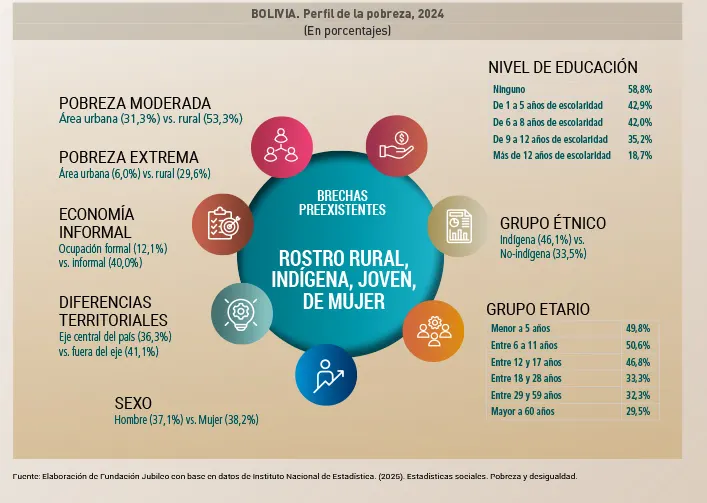
According to the study “Poverty in Bolivia,” prepared by Fundación Jubileo, the country was already facing a structural problem before the current conflict. In 2024, moderate poverty affected 37.7% of the population, equivalent to 4.7 million people, while extreme poverty reached 12.8%, or 1.6 million people.
When poverty lines are adjusted to the real cost of living and accumulated inflation is incorporated, moderate poverty rises to between 44% and 47%, equivalent to between 5.5 and 5.8 million people. This means that between 800,000 and 1.2 million additional Bolivians are living in poverty, although they are not fully reflected in official statistics. Jubileo reports have also warned that, after updating poverty lines for inflation, poverty indicators may stand between five and eight percentage points higher than official figures.
Inflation-adjusted extreme poverty would range between 17.5% and 19%, affecting between 2.2 and 2.4 million people. According to Jubileo, official indicators have fallen behind the rising cost of living, leaving hundreds of thousands of vulnerable families outside the statistical radar.
The institution also warns that the so-called middle class is, to a large extent, a fragile sector living close to the poverty threshold. An increase in food prices, job loss, illness, or an economic crisis can quickly push these households below the poverty line.
A prolonged roadblock represents exactly that type of combined shock: it raises the cost of basic necessities, interrupts income, and paralyzes the activities of millions of people. For a household living on the edge, several weeks without working, selling, or obtaining supplies are not merely an inconvenience—they can mean the difference between eating and not eating.
This vulnerability is further intensified by a highly informal labor market. Jubileo reports that 83.9% of employed people work in the informal sector, without health insurance, pensions, or labor protections. Reports associated with the institution’s study also place informality at close to 84% in Bolivia, one of the highest rates in South America.
For Jubileo, discussing poverty in Bolivia is not simply repeating a familiar diagnosis but examining a structural problem that, despite periods of progress and economic prosperity, has never disappeared.
The institution warns that the current combination of economic crisis, accumulated inflation, widespread informality, an energy crisis, stagnant production, and social conflict requires poverty to be analyzed not merely as a statistical figure but as a condition that directly affects human dignity.
In its assessment, Jubileo emphasized that 1.2 million poor people are invisible in official statistics, consumption of unhealthy foods has doubled in three years, the middle class can fall into poverty following any major shock, and nearly 84% of Bolivians work in the informal economy without health insurance, pensions, or social protection.
Por El Diario;
La crisis económica y social que atraviesa Bolivia profundiza la pobreza y, sin diálogo ni reencuentro, las personas en situación de mayor vulnerabilidad seguirán como las más afectadas, advirtió la Fundación Jubileo, al evaluar el impacto de más de un mes de bloqueos en el país.
Las medidas de presión restringieron la circulación de alimentos, combustibles y medicamentos, y colocaron el abastecimiento de las ciudades en una situación crítica. Según Jubileo, este escenario agrava una crisis multidimensional que Bolivia ya enfrentaba y que hoy se expresa en uno de los episodios inflacionarios más severos de las últimas décadas.
El director de la Fundación Jubileo, Juan Carlos Núñez, alertó que la clase media es una de las principales víctimas de los bloqueos, debido a la pérdida de empleos, la falta de ingresos y la fragilidad económica de miles de hogares.
Núñez advirtió que parte de la clase media podría retornar a la pobreza si la crisis se prolonga. “De cada 10 hogares, siete viven en la economía informal, debido a que no cuentan con seguridad social”, señaló.
El representante de Jubileo también reflexionó que millones de familias podrían encontrarse sin ahorros suficientes para resistir la actual situación de paralización económica.
En la misma línea, el analista económico, Gustavo Machicado, indicó que muchas personas ya habrían agotado sus ahorros e ingresado en una situación de quiebra familiar o empresarial. A su criterio, los bloqueos agravan la economía nacional, profundizan la recesión y podrían duplicar las estimaciones de contracción publicadas por organismos internacionales.
La Fundación Jubileo también advirtió que la inflación de alimentos redujo el poder adquisitivo de la población. Según la institución, este indicador registró un incremento de 30% en 2025 y hasta abril de la presente gestión llegó a 15%.
Los sectores más expuestos son quienes viven del ingreso diario, entre ellos trabajadores informales, transportistas, productores, vendedores y familias rurales. Para Jubileo, los bloqueos dejan sin protección a estos grupos porque interrumpen sus ingresos y limitan su acceso a alimentos, transporte y atención básica.
La institución también alertó sobre un riesgo creciente de inseguridad alimentaria. Los bloqueos impiden que los productores trasladen su mercadería a las ciudades, mientras la producción rural se deteriora por la imposibilidad de comercializar las cosechas.
Jubileo sostuvo que la medida afecta tanto al campo como a la ciudad: unos no pueden vender sus productos y otros no pueden abastecerse. En ese contexto, consideró que los bloqueos aplicados por dirigencias sindicales constituyen un “tiro al pie”, porque golpean simultáneamente al área rural y urbana, por lo que sus promotores deben asumir responsabilidad.
El análisis de Jubileo coincide con el criterio de Machicado en que la recuperación económica tomará tiempo, aun cuando se restablezca la circulación en las rutas.
De acuerdo con el estudio “Pobreza en Bolivia”, elaborado por Fundación Jubileo, el país ya enfrentaba un problema estructural antes del actual conflicto. En 2024, la pobreza moderada afectaba a 37,7% de la población, equivalente a 4,7 millones de personas, mientras que la pobreza extrema alcanzaba a 12,8%, es decir, a 1,6 millones de personas.
Al ajustar las líneas de pobreza al costo real de vida e incorporar la inflación acumulada, la pobreza moderada sube a un rango de entre 44% y 47%, lo que equivale a entre 5,5 y 5,8 millones de personas. Esto significa que entre 800.000 y 1,2 millones de bolivianos adicionales viven en pobreza, aunque no aparecen plenamente reflejados en las cifras oficiales. Informes de Jubileo también alertaron que, al actualizar las líneas de pobreza por inflación, los indicadores pueden ubicarse entre cinco y ocho puntos porcentuales por encima de las cifras oficiales.
La pobreza extrema ajustada por inflación se ubicaría entre 17,5% y 19%, con una afectación de entre 2,2 y 2,4 millones de personas. Según Jubileo, los indicadores oficiales quedaron rezagados frente al aumento del costo de vida, lo que deja fuera del radar estadístico a cientos de miles de familias vulnerables.
La institución también advierte que la denominada clase media es, en gran medida, un sector frágil que vive cerca de la frontera de la pobreza. Un aumento en el precio de los alimentos, la pérdida del empleo, una enfermedad o una crisis económica pueden empujar rápidamente a estos hogares por debajo de la línea de pobreza.
Un bloqueo prolongado representa ese tipo de shock combinado: encarece la canasta básica, interrumpe ingresos y paraliza la actividad de millones de personas. Para un hogar que vive al límite, varias semanas sin trabajar, vender o abastecerse no son solo una incomodidad, sino la diferencia entre comer y no comer.
Esta fragilidad se profundiza en un mercado laboral altamente informal. Jubileo señala que 83,9% de la población ocupada trabaja en la informalidad, sin seguro de salud, sin jubilación ni protección laboral. Reportes vinculados al estudio de la institución también ubican la informalidad en niveles cercanos al 84% en Bolivia, una de las tasas más altas de Sudamérica.
Para Jubileo, hablar de pobreza en Bolivia no es repetir un diagnóstico conocido, sino mirar un problema estructural que, pese a avances parciales y periodos de bonanza, nunca dejó de estar presente.
La institución advierte que la actual combinación de crisis económica, inflación acumulada, alta informalidad, crisis energética, estancamiento productivo y conflictividad obliga a analizar la pobreza no solo como dato estadístico, sino como una situación que afecta directamente a la dignidad humana.
En su diagnóstico, Jubileo remarcó que 1,2 millones de pobres están invisibles en las cifras oficiales, que el consumo de alimentos no saludables se duplicó en tres años, que la clase media puede caer en pobreza ante cualquier shock y que cerca de 84% de los bolivianos trabaja en la informalidad, sin seguro de salud, jubilación ni protección social.
https://www.eldiario.net/portal/2026/06/04/bloqueos-profundizan-la-pobreza-en-bolivia-2/


Leave a Reply