By Diego Ayo, Brujula Digital:
Hearing a peasant announce that “we are going to carpet the La Paz-Oruro highway with corpses” is dramatic. It is even worse when a pair of lawmakers openly devote themselves to issuing threats without the slightest shame.
Nilton Condori states that “if we are going to change the Political Constitution of the State, we have to reform it in order to execute these political thieves by firing squad.” His colleague Rómulo Villca is no less extreme: “No disgusting q’ara is going to shoot at my people,” he declared in reference to the “Croats from Santa Cruz.”
I have no doubt that these verbal outrages should fall under the Penal Code. However, the judicial outlook is not what interests this reflection, but rather understanding how these authorities, along with many other radicalized leaders, are adapting themselves to this moment. A historical moment of territorial isolation now being experienced by Evo Morales.
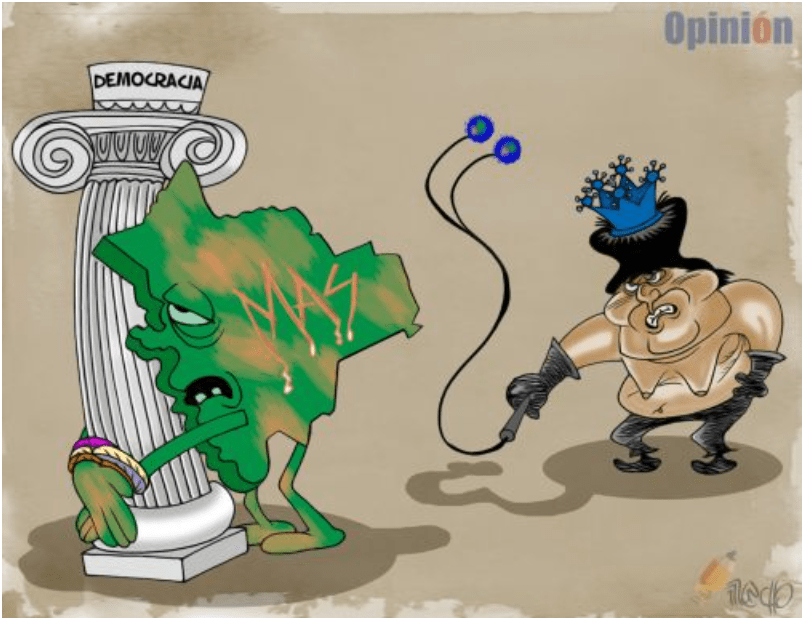
He lives hidden in the Chapare, and that certainty makes us believe he is already defeated. Wrong! He is not. In reality, seeing himself cornered by justice, Morales has resorted to his last stronghold of absolute power: the rural/peasant populations.
In psychological terms, a leader of Evo Morales’ magnitude develops what the psychology of power calls identity fusion: Bolivia and he become one and the same.
Let us remember that, for centuries, the indigenous population felt that the State was a hostile entity that came to take away their land, their coca, their dignity. Evo Morales was seen as the opposite: a shield preventing that hostility from continuing. Consequently, collective psychology processes that, if the shield is destroyed, they themselves would be stripped of the State and left defenseless.
From this perspective, any accusation against the leader is not seen as an act of justice but as an attack by the system against the indigenous movement itself. In that scenario, the behavior of the people closest to Evo does not moderate itself — it becomes hyper-radicalized.
I repeat: when that leader who once commanded millions ends up entrenched exclusively within his historical bastions, the behavior of his “soldiers” turns radical. Morales’ final battle, therefore, is not experienced as the pursuit of an institutional victory — it is lived as an epic of resistance.
At this stage, moderates flee or are expelled. Only the “true believers” remain. The psychological bond becomes mystical: marching across the Altiplano in the cold, resisting tear gas, blocking a highway for weeks is no longer done for an economic subsidy, it is done for the survival of the plurinational myth. In summary: the transition from the grandiose (the presidency) to the minimal (isolation in the Chapare) does not weaken the hard core — it transforms it into a dogmatic faction. And that is what we are seeing today in the Altiplano. We also see it in circles of fanatical MAS loyalists deeply opposed to democracy.
Let us go back and compare. When the movement was large and powerful, from 2000 onward, it attracted many people. There was a respectable space for debate. The situation began to change when Morales started losing power, eventually reaching this year, 2026. The loyalists fled, demonstrating the limits of their loyalty. Who remained? His bases: those who today are carrying out the blockades. Evo ultimately withdrew into his most loyal core once he no longer enjoyed the proximity to State power that he had for 20 years and found himself entrenched in Villa Tunari.
What happened? A natural purge: the moderates, the bureaucrats, and the pragmatists fled because the cost of remaining became excessively high — losing jobs, facing legal prosecution, being injured in marches. Who stayed behind? Only the peasant militants.
With the moderates gone, there is no one left to say, “we should be careful, this measure is too extreme” or “we should negotiate.” No longer. The population geographically barricaded in the Altiplano becomes homogeneous. And that is not even the most remarkable part. In truth, within a group where everyone thinks alike, the only way to stand out is by being the most radical. One must be radical against the enemy government in La Paz!
This is a population that has already broken contact with the reality of the rest of the country. They no longer listen to national news broadcasts or read the press. They only hear their own community radio stations. Within that echo chamber, rumors of “persecution,” “imminent massacre,” and “plans to destroy the indigenous movement” have multiplied and are accepted as absolute truths.
As that brutal collective paranoia feeds itself, launching an indefinite blockade, resisting with dynamite, confronting the police, ceases to be viewed as insanity and instead comes to be seen as a sacred and heroic duty.
Within this core of exacerbated fundamentalism, we find the concept of martyrdom. For these hyper-radicalized populations, fighting for the leader is experienced as a badge of honor. It bears repeating: once Evo is no longer the State, his power is reestablished in these territories as an untouchable deity.
The transition from the grandiose to the minimal does not extinguish the fire. In reality, it compresses the fuel, transforming what was once a powerful political movement lasting approximately two decades into a dogmatic faction willing to burn everything down before surrendering.
We cannot allow it.
Diego Ayo holds a PhD in political science.
Por Diego Ayo, Brujula Digital:
Escuchar a un campesino anunciar que “vamos a alfombrar la carretera La Paz-Oruro de cadáveres” es dramático. Es aún peor que un par de diputados se dediquen a amenazar sin rubor.
Nilton Condori afirma que “si vamos a cambiar la Constitución Política del Estado, tenemos que reformarla para fusilar a estos ladrones políticos”. Su colega Rómulo Villca no se queda atrás: “Ningún q’ara asqueroso va a meter bala a mi pueblo”, expresó refiriéndose a los “croatas cruceños”.
No tengo duda de que estos dislates verbales deberían sujetarse al Código Penal. Sin embargo, no es el panorama judicial lo que interesa en esta reflexión sino conocer cómo estas autoridades, además de muchos líderes radicalizados más, se amoldan a este momento. Un momento histórico de aislamiento territorial en que vive Evo Morales.
Vive escondido en el Chapare y esa certeza nos hace creer que ya está derrotado. ¡Error! No lo está. En realidad, al verse cercado por la justicia, Morales recurre a su último reducto de poder absoluto: las poblaciones rurales/campesinas.
En términos psicológicos, un líder de la magnitud de Evo Morales desarrolla lo que en psicología del poder se llama fusión de identidad: ¡Bolivia y él son lo mismo!
Recordemos que, during siglos, el indígena sintió que el Estado era un ente hostil que venía a quitarle la tierra, la coca, ¡la dignidad! Evo Morales fue visto como el reverso: un escudo que impedía que esa hostilidad continuara. Por ende, la psicología colectiva procesa que, si destruyen al escudo, ellos mismos quedarían desestatizados y desprotegidos.
Bajo esta óptica, cualquier acusación contra el líder no es vista como un acto de justicia sino como un ataque del sistema contra el mismo movimiento indígena. En ese escenario, el comportamiento de esta gente cercana a Evo no se modera, ¡se hiperradicaliza!
Repito: cuando ese líder que mandaba sobre millones pasa a atrincherarse exclusivamente en sus bastiones históricos, el comportamiento de sus “soldados” se torna radical. Esta última batalla de Morales, por tanto, no se vive como la búsqueda de una victoria institucional, ¡se vive como una epopeya de resistencia!
En esta fase, los moderados huyen o son expulsados. Solo se quedan los “verdaderos creyentes”. La ligazón psicológica se vuelve mística: marchar por el Altiplano bajo el frío, resistir los gases lacrimógenos, bloquear una carretera por semanas ya no se hace por un bono económico, se hace por la supervivencia del mito plurinacional. En resumen: el paso de lo magnánimo (la presidencia) a lo mínimo (el aislamiento en el Chapare) no debilita al núcleo duro, ¡lo convierte en una facción dogmática! Y es eso lo que vemos hoy en el Altiplano. También lo vemos en círculos de fanática adscripción masista profundamente antidemocrática.
Volvamos atrás para cotejar. Cuando el movimiento era grande y poderoso, de 2000 en adelante, atrajo a mucha población. Había un respetable espacio para el debate. La situación comenzó a variar cuando Morales empezó a perder poder hasta llegar a este 2026. Los leales huyeron demostrando el límite de su lealtad. ¿Quiénes quedaron? Sus bases: aquellas que hoy bloquean. Evo terminó por replegarse hacia su núcleo más leal al no contar con la cercanía estatal de 20 años y verse atrincherado en Villa Tunari.
¿Qué fue lo que sucedió? Una depuración natural: los moderados, los burócratas y los pragmáticos huyeron ante un costo de permanencia excesivamente alto: perder el empleo, enfrentar juicios, ser heridos en las marchas. ¿Quiénes se quedaron? Únicamente los militantes campesinos.
Al desaparecer los moderados, ya no hay nadie que diga, “tengamos cuidado, esta medida es muy extrema” o “deberíamos negociar”. Ya no. La población geográficamente parapetada en el Altiplano se vuelve homogénea. Y no es lo más destacable. En verdad, en un grupo donde todos piensan igual, la única forma de destacar es ser el más radical. ¡Hay que ser radical contra el gobierno enemigo de La Paz!
Es una población que ya ha roto contacto con la realidad del resto del país. Ya no escuchan los noticieros nacionales ni leen la prensa. Solo oyen las radios comunitarias propias. En esa cámara de eco, los rumores de “persecución”, “masacre inminente”, “planes para destruir al movimiento indígena” se han multiplicado y se toman como verdades absolutas.
Al alimentarse esa brutal paranoia colectiva, lanzarse a un bloqueo indefinido, resistir con dinamita, enfrentarse a la policía, deja de verse como una insensatez y pasa a verse como un deber sagrado y heroico.
En este núcleo de exacerbado fundamentalismo, hallamos el concepto del martirio. Para estas poblaciones hiperradicalizadas, luchar por el líder se vive como una medalla de honor. Valga insistir: una vez que Evo ya no es Estado, su poder se reinstala en estos territorios como deidad intocable.
El paso de lo magnánimo a lo mínimo no apaga el fuego. En realidad, compacta el combustible, transformando lo que fue un poderoso movimiento político de aproximadamente dos décadas en una facción dogmática dispuesta a quemarlo todo antes que rendirse.
No podemos permitirlo.
Diego Ayo es PhD en ciencias políticas.


Leave a comment