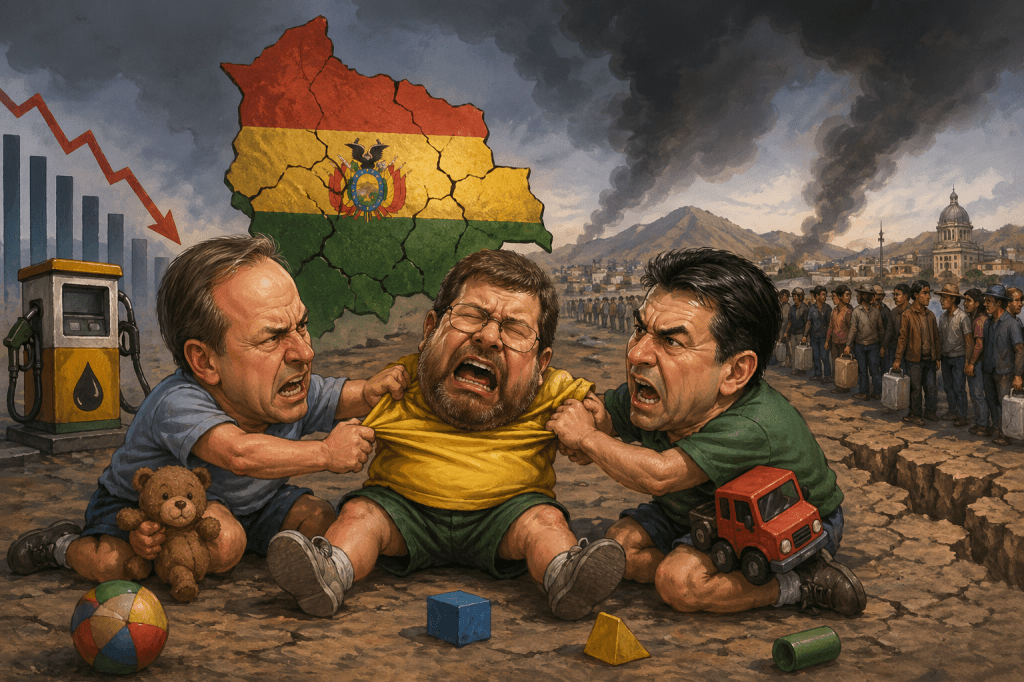
By Ronald MacLean-Abaroa, Brujula Digital:
The current government is the synthesis, the legitimate heir, of the struggle and the reconquest of democracy; subverted, snatched away, and trampled by the MAS autocracy for nearly a quarter of a century. It is also a government that was born with support extending beyond those of us who voted for Rodrigo Paz. For the first time in many years, we have a government with the initial backing of the vast majority of Bolivians. That is to say, with a great deal of political capital.
Up to now.
With the subnational elections concluded, we now have the full composition of the new democratic Bolivia, in all its legitimate nuances. The new national government was the result of the electoral surprise that rejected the MAS’s immediate past, just as much as it rejected the classic opposition candidacies.
The time for definitions has arrived. The government has the mandate and the historic obligation to defend our democracy. But it also faces the challenge of not squandering its political capital amid growing uncertainty.
Many of the elected candidates are remnants of the defeated masismo, presented under different disguises. At the same time, a gap has emerged between what people expected and what the government has achieved in these first six months. The majority still maintain hope: that the government will do well; that all of us will do well.
But it becomes evident that electoral voices, subnational wills, and municipal authorities must be added together in order to define the country’s course more clearly and move from dialogue to governmental action, no longer with only the word of the central government, but with actions arising from the country’s deepest levels.
Given this panorama, we must talk!
The only great dialogue that must be held without delay is with the more than 300 constituted municipalities and the nine governorships. That was the spirit of the National Dialogue of the year 2000: an efficient exercise so that the economy would define politics, and not the other way around, as happened later under MAS, when politics disordered the economy until reaching the current disaster.
It was also a successful exercise in consultation and guidance to identify economic priorities and allocate the resources from the “debt forgiveness” in the fight against poverty.
Today, the question is unavoidable: how do we organize our priorities in the face of the scarce resources available? Without responsible dialogue, governability will be impossible and dangerously confrontational.
But we must move from discourse to concrete action, at the territorial level, with the participation of elected actors, building priorities from the bottom up. That is to say, in a decentralized manner, in direct opposition to the centralized model of the previous regime. In other words: how is popular capitalism, the capitalism of “everyone,” to be built?
That is the subject of “National Dialogue II”: the decentralized economic construction of popular capitalism. Our navigational chart for escaping socialist misery.
To govern is to decide. It is not enough to announce or deliberate indefinitely. A government that does not produce decisions begins to accumulate tensions that end up eroding its legitimacy. Every postponed decision and every unattended demand becomes political debt. Legitimacy is not sustained by narrative, but by the ability to transform reality.
Now then, dialogue does not mean renouncing authority. The monopoly on force belongs to the State, through its Armed Forces and National Police, which have the constitutional obligation to defend the constituted regime.
One does not dialogue with subversion; the law is imposed upon them. But one thing is the defense of order, and something very different is the construction of the country’s course.
The dialogue is not with corporate factions nor in road blockades. The only legitimate dialogue is the one carried out between the institutions of the State legitimately constituted last November, with Edman Lara included, and the subnational governments. That is the space where Bolivia can find itself.
If MAS taught us anything, it is that one governs with strength. But not with brute force, rather with the strength of reason and democratic legitimacy. Because, as Samuel Huntington rightly said, “weak governments are bad governments.” And a government weakens when it does not build agreements for action.
Therefore, this is the hour of dialogue and action. Not as a gesture, but as an instrument of government. Bolivia cannot continue dispersed and disoriented; it needs to organize itself in order to act with a common objective.
It is the hour of consensual definitions and not those imposed by the blackmail of pressure; and the young president is staking the destiny of our democracy, accompanied by nine governors, more than 300 mayors, councilors, and municipal legislators. May God enlighten them to save Bolivia!
Ronald MacLean is a professor; he was mayor of La Paz and minister of State.
Por Ronald MacLean-Abaroa, Brujula Digital:
El actual gobierno es la síntesis, el legítimo heredero, de la lucha y la reconquista de la democracia; subvertida, arrebatada y pisoteada por la autocracia del MAS durante casi un cuarto de siglo. Es, además, un gobierno que nació con un respaldo que fue más allá de quienes votamos por Rodrigo Paz. Por primera vez en muchísimos años, tenemos un gobierno con el apoyo inicial de la gran mayoría de los bolivianos. Es decir, con un gran capital político.
Hasta hoy.
Concluidas las elecciones subnacionales, ahora se tiene la composición total de la nueva Bolivia democrática, en todos sus matices legítimos. El nuevo gobierno nacional fue fruto de la sorpresa electoral que rechazó el pasado inmediato del MAS, tanto como a las candidaturas clásicas de oposición.
Ha llegado la hora de las definiciones. El gobierno tiene el mandato y la obligación histórica de defender nuestra democracia. Pero también el desafío de no dilapidar su capital político en medio de una creciente incertidumbre.
Muchos de los candidatos electos son resabios del masismo derrotado, presentados bajo distintos disfraces. Al mismo tiempo, ha surgido un desfase entre lo que la gente esperaba y lo que el gobierno ha logrado en estos primeros seis meses. La mayoría mantiene la esperanza: que al gobierno le vaya bien; que nos vaya bien a todos.
Pero se hace evidente sumar a las voces electorales, las voluntades subnacionales y municipales para fijar con mayor claridad el rumbo del país y pasar del diálogo a la acción de gobierno, ya no con la sola palabra del gobierno central, sino con acciones del país más profundo.
Ante este panorama ¡debemos hablar!
El único gran diálogo que se debe hacer sin demora es con los más de 300 municipios constituidos y las nueve gobernaciones. Ese fue el espíritu del diálogo nacional del año 2000: un ejercicio eficiente para que la economía defina la política, y no al revés, como sucedió después con el MAS, cuando la política desordenó la economía hasta llegar al desastre actual.
Fue, además, un ensayo exitoso de consulta y orientación para identificar las prioridades económicas y asignar los recursos del “perdón de la deuda” en la lucha contra la pobreza.
Hoy, la pregunta es inevitable: ¿cómo organizar nuestras prioridades frente a los escasos recursos disponibles? Sin un diálogo responsable, la gobernabilidad será imposible y peligrosamente contestataria.
Pero debemos pasar del discurso a la acción concreta, a nivel territorial, con la participación de los actores electos, construyendo prioridades desde la base hacia arriba. Es decir, de manera descentralizada, en directa oposición al modelo centralizado del anterior régimen. En otras palabras: ¿cómo se construye el capitalismo popular, el de “todos”?
Ese es el tema del “Diálogo Nacional II”: la construcción económica descentralizada del capitalismo popular. Nuestra carta de navegación para salir de la miseria socialista.
Gobernar es decidir. No basta con anunciar o deliberar indefinidamente. Un gobierno que no produce decisiones comienza a acumular tensiones que terminan erosionando su legitimidad. Cada decisión postergada y cada demanda no atendida se convierte en deuda política. La legitimidad no se sostiene en el relato, sino en la capacidad de transformar la realidad.
Ahora bien, dialogar no significa renunciar a la autoridad. El monopolio de la fuerza corresponde al Estado, a través de sus FF. AA. y su Policía Nacional, que tienen la obligación constitucional de defender el régimen constituido.
No se dialoga con la subversión; se les impone la ley. Pero una cosa es la defensa del orden, y otra muy distinta es la construcción del rumbo del país.
El diálogo no es con las facciones corporativas ni en los bloqueos. El único diálogo legítimo es el que se realiza entre las instituciones del Estado legítimamente constituidas en noviembre pasado, con Edman Lara incluido, y los gobiernos subnacionales. Ese es el espacio donde Bolivia puede encontrarse consigo misma.
Si algo nos enseñó el MAS es que se gobierna con fuerza. Pero no con la fuerza bruta, sino con la fuerza de la razón y la legitimidad democrática. Porque, como bien dijo Samuel Huntington, “los gobiernos débiles son malos gobiernos”. Y un gobierno se debilita cuando no construye acuerdos para la acción.
Por eso, esta es la hora del diálogo y de la acción. No como gesto, sino como instrumento de gobierno. Bolivia no puede seguir dispersa y desorientada, necesita organizarse para actuar con un objetivo común.
Es la hora de las definiciones consensuadas y no por el chantaje de la presión; y el joven presidente se juega el destino de nuestra democracia, acompañado de nueve gobernadores, más de 300 alcaldes, consejeros y concejales. ¡Que Dios los ilumine para salvar a Bolivia!
Ronald MacLean es catedrático; fue alcalde de La Paz y ministro de Estado.
https://brujuladigital.net/opinion/la-hora-del-dialogo-para-la-accion


Leave a Reply