
Inflation: The drop in product prices is due to the economic recession, says analyst Chávez
Inflation in Bolivia returned to negative territory in March with a decline of -0.34%, marking the second consecutive month of decrease, according to data from the National Institute of Statistics (INE).
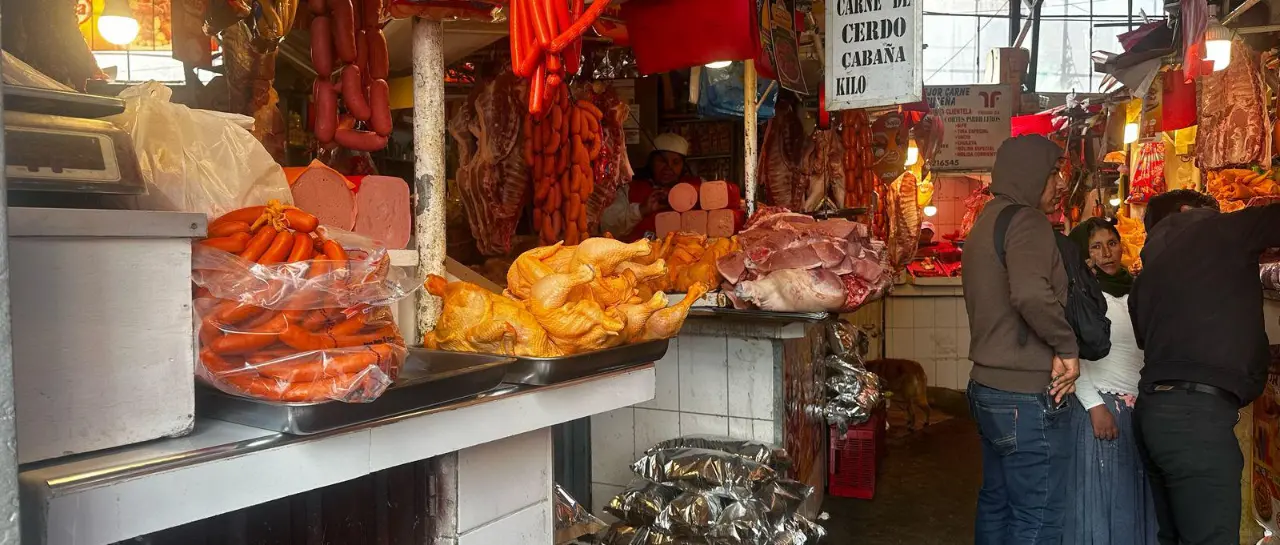
[Photo: Archive] / Reference image of a market in Bolivia.
The government highlighted that inflation is “fully under control.” In this context, analyst Gonzalo Chávez argued that the drop in prices of some products is due to the economic recession that—according to his view—the country has been facing for the third consecutive year.
Within this framework, he proposed that the government promote public investment and exports.
Inflation in Bolivia returned to negative territory in March with a decline of -0.34%, marking the second consecutive month of decrease, according to data from the National Institute of Statistics (INE).
This dynamic follows the February figure, when the Consumer Price Index (CPI) also recorded a negative variation of -0.68%.
“What happens is that when there is a recession, there are no sales, there is no demand, and that also implies a drop in prices. So, the problem is that this deflation, this average reduction in prices, is explained by the recession we are experiencing,” he said in an interview with La Revista on the UNITEL network.
“There are no consumers with money to buy goods and services and, therefore, those who supply have to lower their prices or not make products available,” he added.
In that context, he explained that the last time the country faced a similar scenario was in the 1980s, and it “lasted four years.”
“We are already in the third year of recession, and that is complicated, and we will have to see how the government can reactivate,” he noted.
Solutions
Chávez considered it “essential for the government to improve exports,” which are key to boosting the economy.
He also pointed out that it is important that “once and for all” public investment, projected at $7.8 billion with loans from CAF and the IDB, “enters the economy through projects, and that will help partially offset the drop in output.”
“You have to urgently reactivate aggregate demand,” he stated.
Government
The Minister of Planning, Fernando Romero, emphasized that “we have inflation fully under control.”
“It goes up and down at times, depending on climate issues, etc., but it is under control,” the authority stated.
Por Unitel:
Inflación: La caída de los precios de los productos se debe a la recesión de la economía, señala analista Chávez
La inflación en Bolivia volvió a terreno negativo en marzo con una caída de -0,34%, sumando así el segundo mes consecutivo en descenso, según datos del Instituto Nacional de Estadística (INE)
[Foto: Archivo] / Imagen referencial de un mercado de Bolivia.
El Gobierno destacó que la inflación está “totalmente controlada”. En ese contexto, el analista Gonzalo Chávez consideró que la caída de los precios de algunos productos se debe a la recesión económica que -según su visión- enfrenta el país por tercer año consecutivo.
En ese marco, planteó que el Gobierno impulse la inversión pública y las exportaciones.
La inflación en Bolivia volvió a terreno negativo en marzo con una caída de -0,34%, sumando así el segundo mes consecutivo en descenso, según datos del Instituto Nacional de Estadística (INE).
Esta dinámica se produce tras el registro de febrero, cuando el Índice de Precios al Consumidor (IPC) también marcó una variación negativa de -0,68%.
“Lo que ocurre es que cuando hay recesión, no hay ventas, no hay demanda y eso implica también una caída en los precios. Entonces, es problema que esta deflación, esta reducción de precios en promedio se explique por la recesión que estamos viviendo”, señaló en una entrevista con La Revista de la red UNITEL.
“No hay consumidores con dinero para comprar bienes y servicios y. por lo tanto, los que ofertan tienen que bajar sus precios o no tener los productos a disposición”, añadió.
En ese contexto, explicó que la última vez que el país enfrentó un escenario similar fue en la década del 80 del siglo pasado y “duró cuatro años”.
“Aquí ya vamos por el tercer año de recesión y eso es complicado y habrá que ver de qué manera el Gobierno puede reactivar”, señaló.
Soluciones
Chávez consideró “fundamental que el Gobierno mejore las exportaciones”, que son clave para el impulso de la economía.
Pero además señaló que es importante que “de una vez por todas” la inversión pública, proyectada en 7,800 millones de dólares con los créditos de la CAF y el BID, “entre a la economía a través de proyectos y eso va a ayudar a atenuar parcialmente la caída del producto”.
”Tienes que reactivar la demanda agregada urgentemente”, sostuvo.
Gobierno
El ministro de Planificación, Fernando Romero, destacó que “estamos con una inflación totalmente controlada”.
“Ya sube y baja, a veces, dependiendo de temas climáticos, etcétera, pero está controlado”, señalo la autoridad.

 Bolivian Thoughts | Pensamientos Bolivianos (Bilingual/Bilingüe)