
By Erika Ibáñez, La Razón; Eju.tv:
Fuel: CAO says the situation has gone ‘from irresponsibility to negligence’
The president of the CAO said that the entire productive chain is deteriorated and that, as a result of the shortage, a black market has emerged where fuel is being sold for more than Bs 14 per liter.
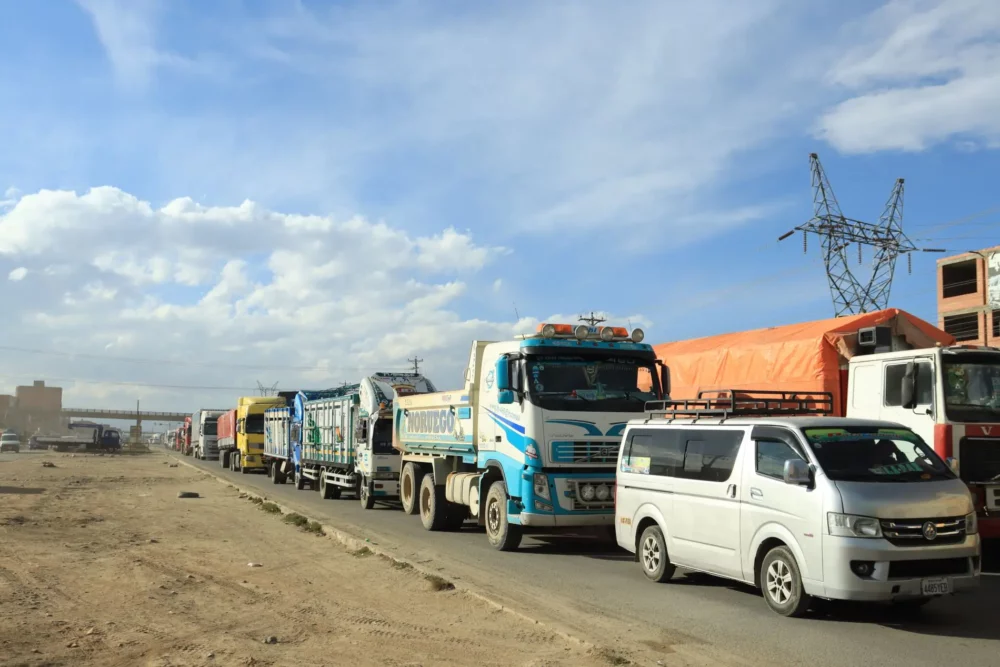
Several vehicles are lining up for fuel. Photo: Archive
The president of the Eastern Agricultural Chamber (CAO), Klaus Frerking, stated that the entire productive chain is deteriorating due to the fuel shortage and affirmed that the situation has shifted “from irresponsibility to negligence.”
“The productive chains are already deteriorating—some more than others. We’ve now moved from irresponsibility to outright negligence,” he said in Santa Cruz.
He also emphasized the urgency for the government to fully liberalize fuel imports for the private sector, eliminating all bureaucratic barriers. He pointed out that the diesel shortage, in particular, has led to the emergence of a “black market,” where fuel is being sold for over Bs 14 per liter.
“They say there are 33 companies importing, but ask those companies what obstacles they’ve faced, how much tax they’re paying, what bribes they’ve had to give—or ask whether the black market hasn’t taken over in Santa Cruz. They’re selling fuel for up to Bs 14,” he stressed.
Like the CAO, several other productive sectors, such as transportation, have also voiced concerns over the fuel shortage, which is halting operations and affecting exports, production, and product distribution.
The government has claimed it is distributing fuel at full capacity; however, it has acknowledged that this is not enough to eliminate the long lines at service stations.
The president of state-owned Yacimientos Petrolíferos Fiscales Bolivianos (YPFB), Armin Dorgathen, recently stated that the company depends on funding from the Ministry of Economy to import fuel.
President Luis Arce has attributed the fuel shortage to a lack of U.S. dollars and has repeatedly blamed the Legislative Assembly for failing to approve pending loans.
Por Erika Ibáñez, La Razón; Eju.tv:
Combustible: CAO dice que se pasó ‘de irresponsabilidad a negligencia’
El presidente de la CAO dijo que toda la cadena productiva está deteriorada y que producto de la escasez hay un mercado negro, donde el combustible se vende por encima de Bs 14 el litro.
Varios vehículos realizan filas por combustible. Foto: Archivo
El presidente de la Cámara Agropecuaria del Oriente (CAO), Klaus Frerking, dijo que la falta de combustible está deteriorando a toda la cadena productiva y aseguró que se pasó de “la irresponsabilidad a la negligencia”.
“Las cadenas productivas ya están en deterioro, unas más que otras. Aquí ya estamos pasando de la irresponsabilidad a la negligencia”, dijo en Santa Cruz.
Asimismo, remarcó la urgencia de que el Gobierno libere completamente la importación de combustibles para el sector privado, sin trabas ni burocracia. Y aseguró que la escasez de combustible, diésel principalmente, provocó la aparición de un “mercado negro”, donde se comercializan carburantes por encima de Bs 14 el litro.
“Dicen que hay 33 empresarias que traen, pero pegunten a esas empresas qué trabas han tenido, cuántos impuestos se pagan, qué coimas han tenido que dar o preguntemos si el mercado negro no se ha copado en Santa Cruz, venden hasta en Bs 14”, remarcó.
Al igual que la CAO, varios sectores productivos, como el transporte, también reclaman por la falta de combustibles que está frenando las operaciones y afectando la exportación, la producción y la distribución de productos.
El Gobierno aseguró que está distribuyendo carburantes al 100%; sin embargo, reconoció que no es suficiente para terminar con las largas filas en las estaciones de servicio.
El presidente de Yacimientos Petrolíferos Fiscales Bolivianos (YPFB), Armin Dorgathen, dijo hace unos días que la empresa estatal depende de los recursos económicos que le entrega el Ministerio de Economía para poder importar.
El presidente Luis Arce atribuyó la escasez de combustibles a la falta de dólares y culpó, en varias oportunidades, a la Asamblea Legislativa por la no aprobación de créditos pendientes.
https://eju.tv/2025/07/combustible-cao-dice-que-se-paso-de-irresponsabilidad-a-negligencia/

 Bolivian Thoughts | Pensamientos Bolivianos (Bilingual/Bilingüe)