
By El Diario:
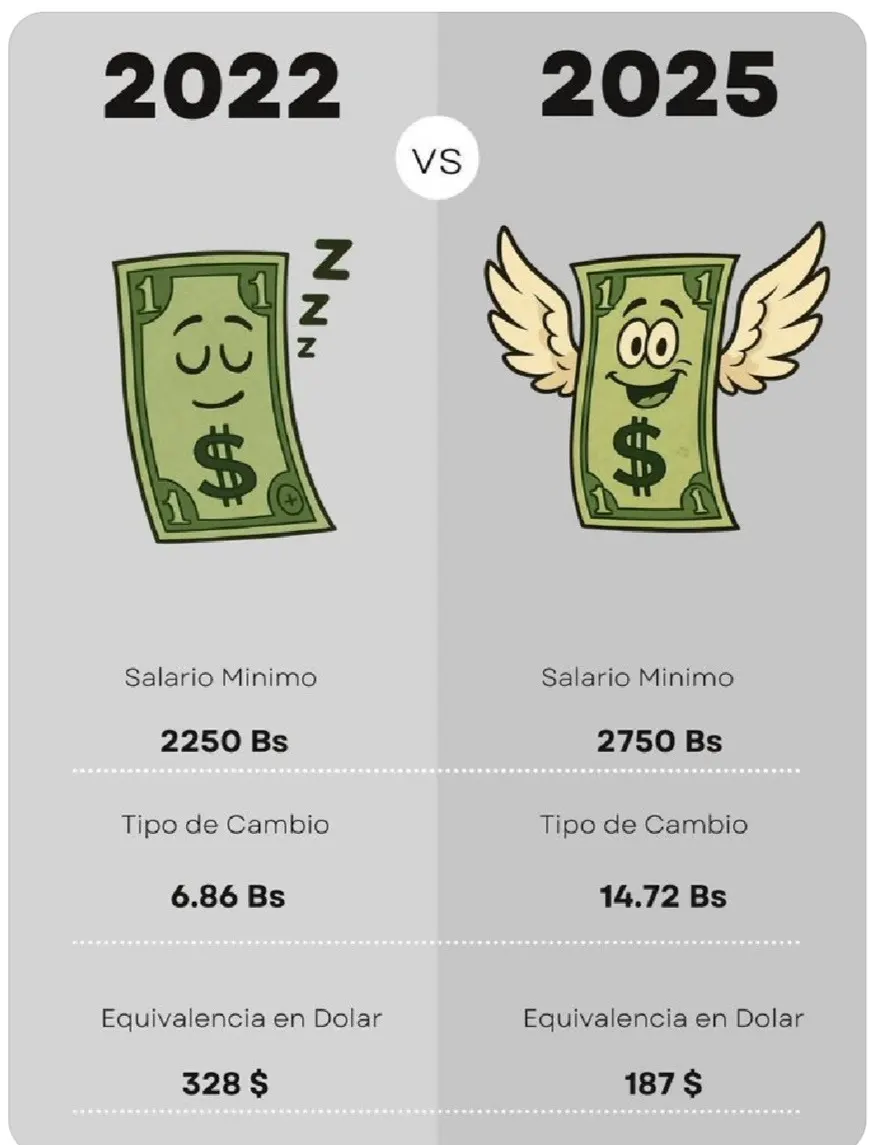
Despite the 5% wage increase set by the government for this year, from 2,500 to 2,750 bolivianos, the widening gap between the official and parallel exchange rates has caused a 50% devaluation.
A few days ago, Bloomberg reported that Bolivia’s national minimum wage is the third lowest in the region using the official exchange rate of 6.96 bolivianos per dollar, equivalent to $398, but using the parallel rate of 15 bolivianos, the figure drops to $181.
The 2025 wage increase is the highest in the past seven years. Although this year will be more inflationary and marked by low economic growth (stagflation), a higher increase than expected by various economic actors was implemented, which will generate more uncertainty in the markets and will likely raise the parallel dollar rate, as economic analyst Fernando Romero warned after the decree was enacted.
He mentioned that the consequences include more inflation in the coming weeks, short-term increases in informality and job instability, a contraction in private investment, further economic slowdown, and possibly more poverty.
As a reminder, inflation as of June exceeded 15%, and it is estimated that by the end of this year it could reach 30%.
Romero explained that Bolivia’s currency has been affected by two factors: the dollar by approximately 120% and inflation by 30%; therefore, Bolivians’ incomes are becoming increasingly limited.
He referred to the Bloomberg report that ranked Bolivia third for the lowest minimum wage, but pointed out that using the parallel exchange rate, the purchasing power of the boliviano is further reduced.
He warned that high inflation will push more people into poverty, as their income will not be enough to cover basic needs.
As an example, the national minimum wage of 2,750 bolivianos at the official exchange rate of 6.96 amounts to $398, but if calculated at the parallel market rate of 14, it drops to $198. This figure may vary due to currency volatility.
Currently, the nominal wage has grown by 10% compared to 2024, but in real terms (according to official statistics) it has dropped by approximately 25%. Possibly, in terms of market purchasing power, it has decreased by at least 50% (possibly up to 70%) since last year. Therefore, this wage increase clearly does not recover or even cover the loss of purchasing power due to inflation in both this and the previous year, he stated.
Meanwhile, the national minimum wage has also been devalued in terms of the dollar. Last year, the 2,500 bolivianos equaled $359 at the official exchange rate and only $217 at the parallel rate. The current minimum wage of 2,750 equals $398 at the official rate and only around $180 at the parallel rate (Bs 15.3 in May).
Por El Diario:
A pesar del aumento salarial determinado por el Gobierno de 5% para la presente gestión, de 2.500 a 2.750 bolivianos, la ampliación de la brecha entre el tipo de cambio oficial y el paralelo, ha provocado una devaluación del 50%.
Días atrás, el medio digital Bloomberg informó que el salario mínimo nacional de Bolivia es el tercero más bajo de la región al tipo de cambio oficial de 6,96 bolivianos por dólar, es decir 398 dólares, pero frente al paralelo de 15 bolivianos, la cifra baja a 181.
El incremento salarial 2025 es el más alto en los últimos 7 años. Aunque este año será más inflacionario y con un bajo crecimiento económico (estanflación), se viabilizó uno más elevado a las expectativas de los diferentes agentes económicos, lo cual generará mayor incertidumbre en los mercados y con seguridad una subida del precio del dólar paralelo, ya adelantaba el analista económico Fernando Romero, luego de la promulgación del Decreto.
Mencionó que entre las consecuencias está mayor inflación en las próximas semanas, a corto plazo mayor informalidad e inestabilidad laboral, contracción de la inversión privada, aún más ralentización de la economía y posiblemente mayor pobreza.
Como se recordará, la inflación a junio pasó el 15% y estiman que hasta finales de la presente gestión la misma llegue a 30%.
Romero explicó que la moneda de Bolivia fue afectada por dos factores: uno por el dólar en un 120%, aproximadamente y otra por la inflación en un 30%; por lo que los ingresos de los bolivianos cada vez son más reducidos.
Mencionó la publicación de Bloomberg, en donde ubica a Bolivia en tercer lugar con el salario más bajo, sin embargo, con el tipo de cambio paralelo el boliviano tiene menos capacidad de compra y resta su poder adquisitivo.
Alertó que la inflación alta empujará a más personas a la pobreza, ya que no alcanzarán sus recursos para cubrir sus necesidades básicas.
Como ejercicio, el salario mínimo nacional es de 2.750 bolivianos al tipo de cambio oficial de 6,96, alcanza a 398 dólares, pero si se calcula al mercado paralelo de 14, el valor baja a 198 dólares. Esta cifra puede variar debido a la volatilidad de la divisa.
Actualmente, el salario nominal creció en un 10% respecto al 2024, pues en términos reales (estadísticas oficiales) ha caído en un 25%, aproximadamente. Posiblemente el mismo, en términos de poder de compra (mercado) ha rebajado al menos en un 50% (hasta posiblemente el 70%) desde el año pasado. Por lo tanto, claramente este incremento salarial no recupera ni menos cubre la pérdida de su poder adquisitivo por la inflación de esta y la anterior gestión, señalaba.
Entretanto, el salario mínimo nacional también se ha devaluado respecto al dólar. El año pasado los 2.500 equivalían a 359 dólares al tipo de cambio oficial y al paralelo solo a 217 dólares. El actual salario mínimo de 2.750 equivale a 398 y al dólar paralelo (Bs 15,3 en mayo) solo vale alrededor de 180.

 Bolivian Thoughts | Pensamientos Bolivianos (Bilingual/Bilingüe)