
By Marco Antonio Belmonte, Vision 360:
Climate Change
Households estimated that their income allocated to food purchases was affected on average by 46% due to drought, 62.4% due to fires, and 27.2% due to illnesses, endangering their regular access to food.

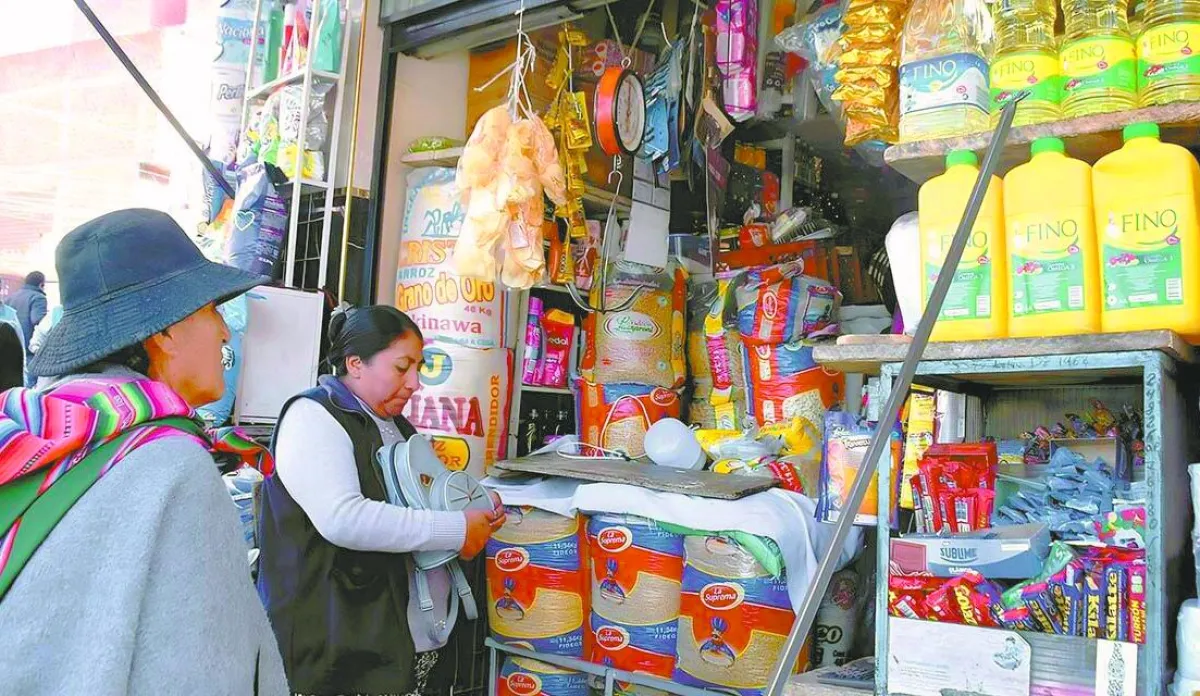
Drought affected potato, vegetable, and other crops in the Altiplano. Photo: Abi
The National Meteorology and Hydrology Service (Senamhi) study, “Food Security Analysis in Emergencies 2024–2025”, reveals that droughts, frosts, snowfalls, and hailstorms are the extreme weather events that most affect the country, negatively impacting household incomes, productive activity, and generating food insecurity.
The document analyzed the situation in the Altiplano, valleys, plains, and the Chaco region. Data collection was carried out by Fundación Aru in January 2024 in vulnerable communities, covering the topic of Emergency Food Security Assessment (ESAE). The information was cross-checked with key stakeholders, municipal and community authorities, as well as focus groups and local residents.
The ESAE focused on private households in municipalities under climate emergency due to the El Niño phenomenon. The sample size included 37 communities and 302 households; data collection occurred between January 23 and February 4, 2024.
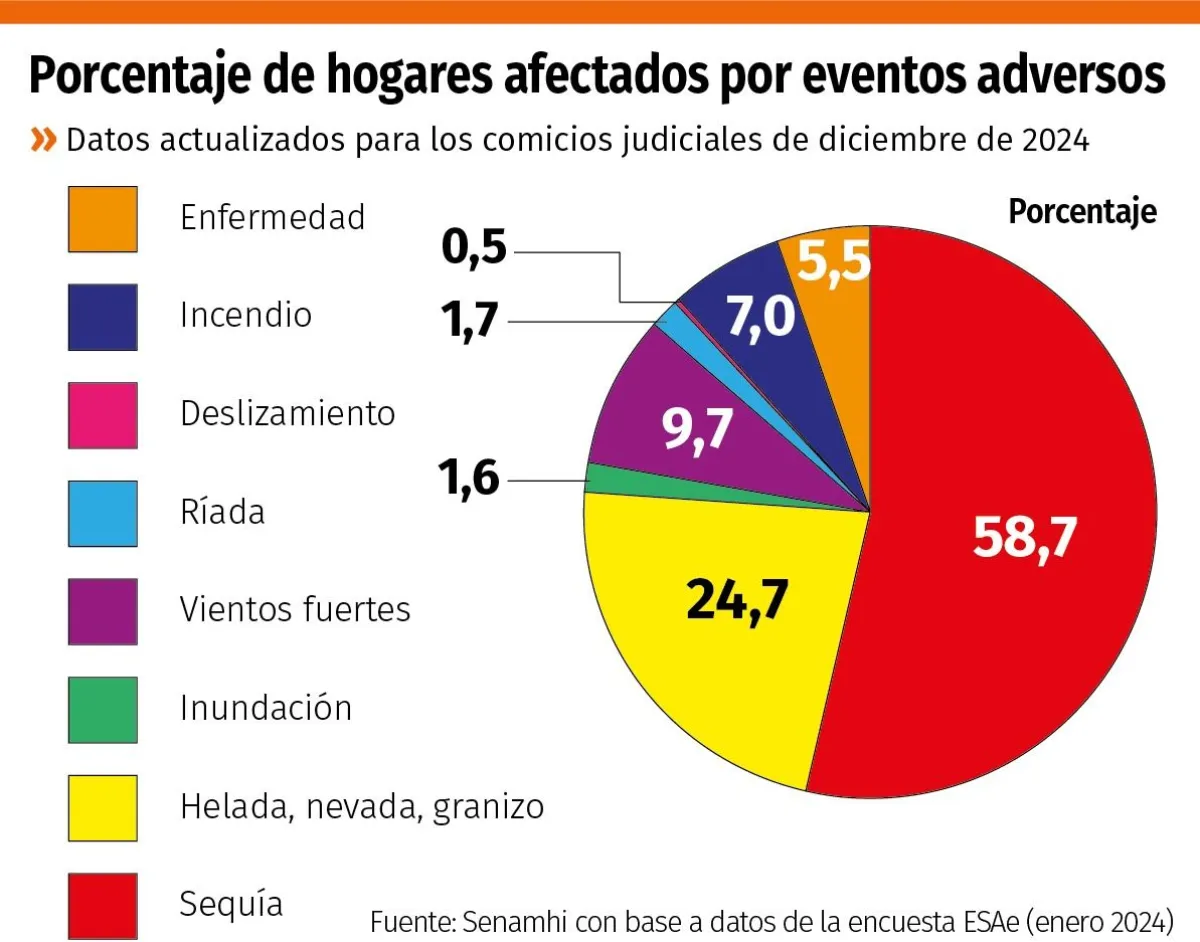
The most frequent adverse events were: drought reported by 58.7% of households, frost, snow, and hail (24%), strong winds (9.7%), and fires (7%). Drought and fires were mostly present during August, September, and October, while illnesses appeared in December 2023.
Additionally, information from the Vice Ministry of Civil Defense indicated that forest fires between July 2023 and January 5, 2024, affected 6,935.5 hectares, around 24,769 families, and 6,881 heads of livestock. Droughts impacted 961 families and affected 2,600 hectares.
Effects of the events
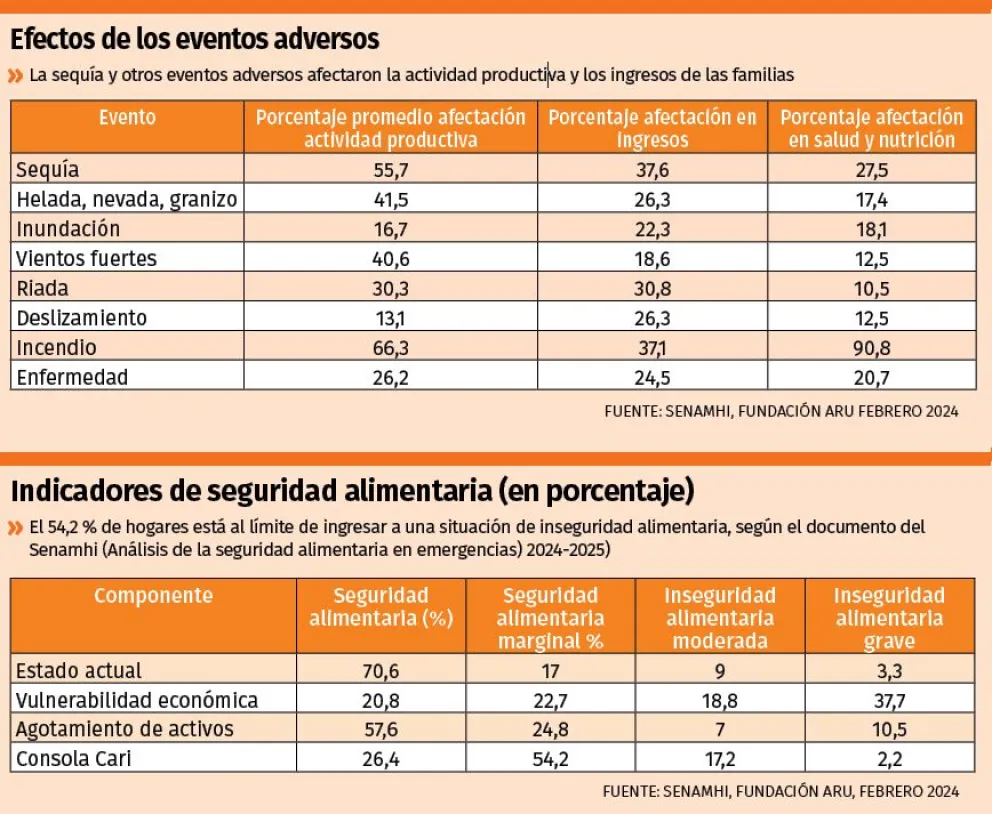
These extreme events impacted family incomes. Households estimated that their food-related income was affected on average by 46% due to drought, 62.4% due to fires, and 27.2% due to illnesses, putting regular access to food at risk.
In terms of productive activity, 55.7% of households were affected by droughts, 66.3% by fires, and 26.2% by illnesses. According to the study, this impact could threaten the continuous availability of food in households.
There was also an impact on the health or nutritional status of family members. Households considered their health deteriorated by 27.5% due to droughts, 90.8% due to fires, and 20.7% due to illnesses.
The study states that the aforementioned adverse events jeopardize the food security of households, especially affecting the most vulnerable populations such as children and the elderly.
CARI is a harmonized methodology of the World Food Programme used to analyze and classify households using food security indicators at the individual level, across different food security groups: food secure, moderately food secure (food consumption gaps and need for coping strategies), marginally food insecure (inadequate food consumption), and severely food insecure (extreme food consumption gaps or extreme loss of livelihoods).
Plains
The study, using this approach, found that in the plains only 26.4% of households are food secure; 54.2% are marginally food secure, meaning on the brink of food insecurity.
The document warns that this transition could be triggered by political or social conflicts that impact family income sources and their access to sufficient and quality food.
17.2% of households are moderately food insecure, meaning their food consumption is not ideal and their capacity to respond to potential supply issues is limited. 2.2% are severely food insecure.
Altiplano
Only 27% of households are food secure, 53.2% are marginally food secure, 18.3% moderately food insecure, and 1.4% severely food insecure.
Chaco
32.1% of households are food secure, 51.4% are marginally food secure, 15% moderately food insecure, and 1.4% severely food insecure.
Valleys
Only 22% of households are food secure, 58.4% are marginally food secure, 18.3% moderately food insecure, and 1.1% severely food insecure.
Capacity to cope
The study also analyzed the ability of households to cope with the crisis, with the aim of measuring their resilience. Two indicators were considered: 1) proportion of spending on food, and 2) livelihood-based strategies.
The proportion of food expenditure was calculated based on both monetary spending—how much money households spend monthly on food—and non-monetary spending, which includes food consumed from reserves, exchanges, or humanitarian assistance, valued at market prices by the surveyed population.
The study concluded that 56.7% of households are economically vulnerable. Of these, 18.8% spend between 65% and 75% of their income on food (vulnerable), and 37.7% spend more than 75% (highly vulnerable).
Meanwhile, 22.7% of households have borderline spending (between 50% and 65%), and 20.8% spend less than 50% on food, considered a secure group.
The average monthly food expenditure is 866.9 bolivianos and the average non-food expenditure is 427.8 bolivianos.
The total (sum of averages) is 1,285.6 bolivianos. However, differences are observed by department.

The study warns that households in western Beni (1,276.5 bolivianos), as well as those in Chiquitania—where there is a high fire risk—spend most on food. The same occurs in Pando (1,803.5 bolivianos).
In Santa Cruz, the average spending is 1,490 bolivianos, in Tarija 1,375.1 bolivianos, in La Paz 1,282.7 bolivianos, in Potosí 1,237 bolivianos, in Cochabamba 1,162 bolivianos, and in Chuquisaca 1,048 bolivianos.
According to Senamhi, the 2023–2024 drought has had a significant impact across all regions of Bolivia, with adverse effects on agriculture, livestock, and water access. For this reason, the study emphasizes the need to continue implementing adaptation and mitigation measures, raise awareness about sustainable water management, and promote policies that strengthen community resilience.
Senamhi’s drought monitoring platform allows identification of drought severity by region, and therefore, priority actions include: strengthening early warning systems to enable quicker response; promoting research in drought-resistant crops and agricultural practices; and increasing investment in water infrastructure to ensure constant access to water.
Additionally, the intense rains and floods in Bolivia during 2023–2025 exposed the vulnerability of various regions, especially in rural and peri-urban areas. Strengthening emergency prevention and response strategies is recommended.
Recommendations
Senamhi’s study recommends two types of aid for households facing food insecurity:
a) Provision of food; and
b) Provision of cash. It is also important to distinguish between immediate, medium-term, and long-term assistance.
Immediate food aid should be provided to severely food-insecure households for a period of one to two months. This will ensure coverage of basic needs for affected households, avoiding deterioration of the nutritional status of the most vulnerable age groups.
It is most effective for the poorest households that suffered the effects of floods due to the significant impact of natural disasters on staple food production, rising food prices, and scarcity, which disrupt markets.
The Study
- Population: Households in municipalities with climate emergencies due to El Niño.
- Sampling frame: Community list from the Census, 2013 Agricultural Census, and additional data from Civil Defense and Senamhi.
- Method: Face-to-face data collection from January 23 to February 4, 2024.
Por Marco Antonio Belmonte, Vision 360:
Cambio climático
Los hogares estimaron que sus ingresos destinados a la compra de alimentos, en promedio, se vieron afectados en un 46% por las sequías, en un 62,4% por los incendios y en un 27,2% por enfermedades, arriesgando el acceso frecuente a alimentos.
La sequía afectó los cultivos de papa, hortalizas y otros en el Altiplano. Foto: Abi
El estudio del Servicio Nacional de Meteorología e Hidrología (Senamhi) “Análisis de la seguridad alimentaria en emergencias 2024-2025” revela que las sequías, heladas, nevadas y granizos son los eventos extremos climáticos que más afectan al país e inciden negativamente en los ingresos de los hogares, en la actividad productiva y generan inseguridad alimentaria.
El documento analizó la situación en el Altiplano, en los valles, en los llanos y en el Chaco, con el levantamiento de datos a cargo de la Fundación Aru en enero de 2024, en comunidades vulnerables de la región, cubriendo la temática Evaluación de la seguridad alimentaria en emergencia (ESAE). Se corroboró la información con actores clave, autoridades municipales y comunales, así como con grupos focales y habitantes de territorio.
La ESAE tomó en cuenta hogares particulares en los municipios con emergencia climática por el fenómeno El Niño y el tamaño de la muestra incluyó a 37 comunidades y 302 hogares; el periodo de recolección abarcó del 23 de enero de 2024 al 4 de febrero de 2024.
Los eventos adversos más frecuentes fueron: sequía reportada por el 58,7% de los hogares, las heladas nevadas y granizos (24%), vientos fuertes (9,7%), incendios (7%). La sequía y los incendios estuvieron mayormente presentes en los meses de agosto, septiembre y octubre; en cambio las enfermedades se presentaron en diciembre de 2023.
Adicionalmente se detectó, con información del Viceministerio de Defensa Civil, que los incendios forestales entre julio de 2023 y 5 de enero de 2024 afectaron a 6.935,5 hectáreas, a unas 24.769 familias y 6.881 cabezas de ganado. Las sequías golpearon a 961 familias y 2.600 hectáreas fueron afectadas.
Efectos de los eventos
Estos eventos extremos tuvieron incidencia en los ingresos de las familias. Los hogares estimaron que sus ingresos destinados a la compra de alimentos, en promedio, se vieron afectados en un 46% por las sequías, en un 62,4% por los incendios y en un 27,2% a causa de las enfermedades, poniendo en riesgo el acceso frecuente a alimentos.
En su actividad productiva, la ocurrencia de los eventos reveló que un 55,7% de los hogares se vio afectada por las sequías, en un 66,3% por los incendios y en un 26,2% a causa de la presencia de enfermedades. Este impacto, de acuerdo con el estudio, podría amenazar la disponibilidad continua de alimentos en los hogares.
Por otro lado, se observó un efecto sobre la salud o el estado nutricional de los miembros de la familia. Los hogares consideraron que su salud se vio deteriorada en un 27,5% a causa de las sequías, en un 90,8% debido a los incendios y en un 20,7% a causa de la presencia de enfermedades.
El estudio sostiene que los eventos adversos mencionados ponen en riesgo la seguridad alimentaria de los hogares donde las poblaciones más vulnerables, como son los niños y adultos mayores, son los más afectados.
CARI es una metodología armonizada del Programa Mundial de Alimentos que se utiliza para analizar y clasificar los hogares mediante indicadores de seguridad alimentaria a nivel individual en diferentes niveles de grupos de seguridad alimentaria: seguridad alimentaria, seguridad alimentaria moderada (brechas en consumo de alimentos y necesidad de estrategias para afrontar el problema), inseguridad alimentaria marginal (consumo de alimentos inadecuado) e inseguridad alimentaria grave (brechas extremas en consumo de alimentos o pérdida extrema de medios de vida).
Llanos
El estudio, a partir de este enfoque, permitió detectar que en los llanos solo un 26,4% de los hogares presenta seguridad alimentaria; un 54,2% de hogares está en situación de seguridad alimentaria marginal, es decir al límite de ingresar a una situación de inseguridad alimentaria.
El documento alerta que este paso podría ser detonado por conflictos políticos o sociales que afecten las fuentes de ingreso de las familias y sus mecanismos de acceso a alimentos en la cantidad y calidad necesarias.
Un 17,2% de los hogares se encuentra en situación de inseguridad alimentaria moderada, es decir que su consumo de alimentos no era ideal y además su capacidad de respuesta ante eventuales problemas de abastecimiento es reducida. Un 2,2% está en inseguridad alimentaria grave.
Altiplano
Solo un 27% de los hogares presenta seguridad alimentaria, un 53,2% está en situación de seguridad alimentaria marginal, un 18,3% en inseguridad alimentaria moderada y el 1,4% en inseguridad alimentaria grave.
Chaco
Un 32,1% de los hogares presenta seguridad alimentaria, un 51,4% se encuentra en situación de seguridad alimentaria marginal, un 15% en situación de inseguridad alimentaria moderada y 1,4% en inseguridad alimentaria grave.
Valles
Solo un 22% de hogares presenta seguridad alimentaria, el 58,4% está en situación de seguridad alimentaria marginal, un 18,3% en situación de inseguridad alimentaria moderada y el 1,1% en inseguridad alimentaria grave.
Capacidad de afrontar
El estudio analizó también la capacidad para afrontar la crisis que tienen los hogares, con el objetivo de medir la resiliencia de los hogares ante la crisis. Se consideraron dos indicadores: 1) proporción del gasto en alimentos; y 2) estrategias basadas en medios de vida.
Se calculó la proporción de gasto en alimentos considerando el gasto monetario, es decir la cantidad de dinero que los hogares gastan mensualmente en la compra de alimentos, como el gasto no monetario, que tiene que ver con alimentos consumidos por el hogar, provenientes de las reservas de los intercambios o de la asistencia humanitaria, valorados a precios de mercado por la misma población consultada.
El estudio concluyó que el 56,7% de los hogares son vulnerables económicamente. De los cuales, el 18,8% dedica entre el 65 %y 75% de sus gastos a la compra de alimentos (vulnerable) y un 37,7% de los hogares dedican más del 75% de sus ingresos para la compra de alimentos (muy vulnerable).
Por otra parte, 22,7% de los hogares tiene un gasto límite (entre 50% y 65%) y 20,8% de los hogares gasta menos del 50% en alimentos y se considera como un grupo seguro.
El promedio de gasto mensual en alimentos es de 866,9 bolivianos y el promedio de gasto no alimentario mensual es de 427,8 bolivianos.
El gasto total (suma de promedios) es de 1.285,6 bolivianos. Sin embargo, a nivel departamental se observan diferencias.
El estudio advierte que los hogares que residen en el oeste de Beni (1.276,5 bolivianos), así como los hogares de la Chiquitania, donde existe una alta probabilidad de incendio, concentran la mayor parte del gasto en alimentación y lo propio ocurre en Pando (1.803,5 bolivianos).
En Santa Cruz, el gasto promedio alcanza a 1.490 bolivianos, en Tarija a 1.375,1 bolivianos, en La Paz a 1.282,7 bolivianos, en Potosí a 1.237 bolivianos, en Cochabamba a 1.162 bolivianos y en Chuquisaca a 1.048 bolivianos.
Para el Senamhi, la sequía de 2023-2024 ha tenido un impacto significativo en todas las regiones de Bolivia con efectos adversos en la agricultura, la ganadería y el acceso al agua. Es por eso que en el estudio se sostiene que es crucial continuar con la implementación de medidas de adaptación y mitigación, así como fomentar la concienciación en la gestión sostenible del agua y promover políticas que fortalezcan la resiliencia de las comunidades afectadas.
La plataforma de monitoreo para las sequías que realiza el Senamhi permite identificar los grados de sequía de cada región y por eso se ha orientado como principales acciones: fortalecer los sistemas de alerta temprana para facilitar la respuesta ante este fenómeno; promover la investigación en cultivos y práctica agrícolas que sean resistentes a la sequía; e incrementar la inversión en infraestructura hídrica para asegurar el acceso constante al agua.
Por otra parte, las lluvias intensas y las inundaciones en Bolivia durante 2023-2025 expusieron la vulnerabilidad de diversas regiones, especialmente en áreas rurales y periurbanas. Se sugiere fortalecer las estrategias de prevención y respuesta ante emergencias.
Recomendaciones
El estudio del Senamhi recomienda dos tipos de ayuda que deberían ser ofrecidos a los hogares que se encuentren en inseguridad alimentaria: a) Contemplar la dotación de alimentos; y b) Dotación de dinero, a su vez es importante desglosar el tipo de ayuda inmediata, de mediano y largo plazo.
La ayuda alimentaria inmediata debe estar destinada a los hogares con inseguridad alimentaria grave y debe ser otorgada por un periodo de uno a dos meses. De esta manera se garantizará la cobertura de las necesidades de los hogares afectados, evitando el deterioro del estado nutricional de los grupos etarios más vulnerables.
Es más efectiva para los hogares más pobres que sufrieron las consecuencias de las inundaciones debido al efecto significativo de los desastres naturales en la producción de alimentos básicos, en el incremento de los precios de los alimentos y en la escasez, lo cual distorsiona los mercados.
El estudio
- Población. Hogares en los municipios con emergencia climática por El Niño.
- Marco muestral. Listado de comunidades del Censo, Censo Agropecuario 2013 e información complementaria de Defensa Civil y Senamhi.
- Criterio. Se empleó una estrategia de recolección cara a cara entre el 23 de enero de 2024 a 4 de febrero de 2024.

 Bolivian Thoughts | Pensamientos Bolivianos (Bilingual/Bilingüe)