
By Sumando Voces, Brújula Digital:
Reports indicate the roads were opened without authorization, without environmental licenses, and on non-available public lands.
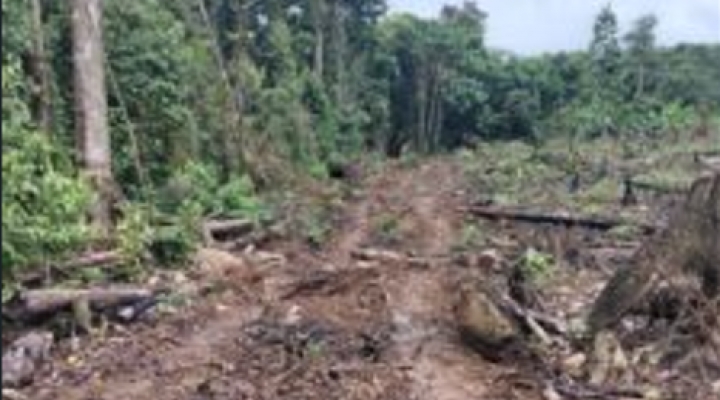
One of the roads opened in the protected area. Photo: Sumando Voces
Carrasco National Park (located in the tropics of Cochabamba) is the protected area with the highest presence of coca plantations among all protected areas, according to the most recent report by the United Nations Office on Drugs and Crime (UNODC), corresponding to 2023 and presented in January 2025.
Therefore, it’s not surprising that this activity is on the rise, to the point that between October of last year and February of this year, four roads have been opened to facilitate the cultivation of new plots, according to a local source who sent this outlet a series of photographs showing the roads and plantations.
The source stated that these roads were opened without authorization, without environmental licenses, and on public lands not designated for use.
The first of these four roads dates back to October 2024 in the Campamento and Carmen Pampa unions. It extends approximately five kilometers.
The second road was opened in the Yungas Perguantillo union in November 2024, with a length of four and a half kilometers.
The third road was opened in Machu Yungas, measures 16 kilometers, and also dates from November 2024.
The fourth road was built in the Pampas Amarías sub-central, which comprises the unions Peña Rumi, Nuevas Pampas, Primero de Agosto, and Chaco Soberano. These roads were opened in February 2025 and already span approximately 15 kilometers.
Reports Indicate the Unions Are Illegal
The source noted that all these unions are illegal, as they are located within a national park, where such settlements should not exist—especially not for coca cultivation.
“The goal is to increase the surplus coca production in Carrasco Park and therefore boost drug trafficking, because the coca produced in that area goes to the illegal market,” said the source, adding that eradication forces do not enter the area because the unions prevent them.
This situation was also denounced in October of last year by the Economic and Social Development Unit of the Tropics (Udestro).
“They claim they’re not in the park, yet there is a resolution from INRA (National Institute for Agrarian Reform) confirming they are in the park. What are they hiding? There are more than 16 communities inside the park, and the illegal coca must be eradicated… there must be over 3,000 hectares in the park,” denounced Udestro director Nivardo Rivera, according to a report by the state news agency ABI.
The director said there are around 16 communities settled in the park, and they have already planted about 3,000 hectares of coca.
According to the UNODC report, in 2023 there were 583 hectares of coca in protected areas, of which 310 were in Carrasco Park.
Former Government Minister Eduardo Del Castillo, now a presidential pre-candidate for the Movement Toward Socialism (MAS), stated in January this year that Amboró and El Choré National Parks had been declared “free of coca cultivation” and that for 2025, the same declaration is sought for Carrasco Park and the Isiboro Sécure Indigenous Territory and National Park.


BD/
Por Sumando Voces, Brújula Digital:
Se informa que los caminos se han abierto sin autorización, sin licencia ambiental y en tierras fiscales no disponibles.
Uno de los caminos que se abrieron en el área protegida. Foto: Sumando Voces
El Parque Nacional Carrasco (trópico de Cochabamba) es el área protegida que tiene mayor presencia de plantaciones de coca entre las áreas protegidas, según el más reciente informe de la Oficina de las Naciones Unidas contra la Droga y el Delito (ONUDC), correspondiente a 2023 y que fue presentado en enero de este 2025.
Por eso, no es extraño que la actividad vaya en aumento, al punto que, entre octubre del año pasado y febrero de este año, se han abierto cuatro caminos para facilitar el cultivo de nuevas parcelas, según una fuente de la zona que hizo llegar a este medio una serie de fotografías que demuestran las brechas y las plantaciones.
La fuente indicó que estos caminos se han abierto sin autorización, sin licencia ambiental y en tierras fiscales no disponibles.
El primero de estos cuatro caminos data de octubre del 2024 en los sindicatos denominados Campamento y Carmen Pampa. La extensión es de cinco kilómetros aproximadamente.
La segunda apertura es en el sindicato Yungas Perguantillo, data de noviembre del 2024 y tiene una distancia de cuatro kilómetros y medio.
La tercera apertura es en Machu Yungas, tiene 16 kilómetros y también es de noviembre de 2024.
La cuarta apertura fue realizada en la subcentral Pampas Amarías, que está compuesta por los sindicatos Peña Rumi, Nuevas Pampas, Primero de agosto y Chaco Soberano. Estas aperturas fueron realizadas en febrero de este 2025 y ya tienen 15 kilómetros de longitud aproximadamente.
Se informa que son sindicatos ilegales
La fuente indica que estos sindicatos son todos ilegales por tratarse de un parque nacional, donde no deberían existir este tipo de asentamientos y menos para plantar coca.
“La finalidad es aumentar la producción de coca excedentaria que se tiene en el Parque Carrasco y por tanto, para aumentar el narcotráfico porque la producción de esa zona va al mercado ilegal”, dijo la fuente, quien añadió que las fuerzas erradicadoras no ingresan porque los sindicatos lo impiden.
Esta situación también fue denunciada en octubre del año pasado por Unidad de Desarrollo Económico Social del Trópico.
“Dicen que no están en el parque, sin embargo, hay una resolución del INRA (Instituto Nacional de Reforma Agraria) que están en el parque. ¿Qué es lo que están escondiendo? Son más de 16 comunidades que están en el Parque, la coca ilegal sí o sí se tiene que erradicar (…), en el parque debe haber más de 3.000 hectáreas”, denunció el director de Udestro, Nivardo Rivera, según una nota de la agencia gubernamental ABI.
El director de dicha unidad dijo que serían unas 16 comunidades las asentadas y que ya habrían plantado unas tres mil hectáreas de coca.
Según el informe de la UNODC, en 2023 se registraron 583 hectáreas de coca en las áreas protregidas, de las cuales, 310 estaban en el parque Carrasco.
El exministro de Gobierno Eduardo Del Castillo, ahora precandidato del Movimiento Al Socialismo (MAS), informó en enero de este año que se declaró “libres de cultivos de coca” a los parques nacionales Amboró y El Choré, y que para este 2025 se busca la misma declaratoria para los parques Carrasco y para el Territorio Indígena y Parque Nacional Isiboro Sécure.
BD/

 Bolivian Thoughts | Pensamientos Bolivianos (Bilingual/Bilingüe)