
By Brújula Digital
Bolivian biologist studies jaguar genome to save the species and fight trafficking
Paola Nogales, a Bolivian biologist, is leading a pioneering investigation that uses genomics to trace the illegal trafficking of jaguars in Bolivia
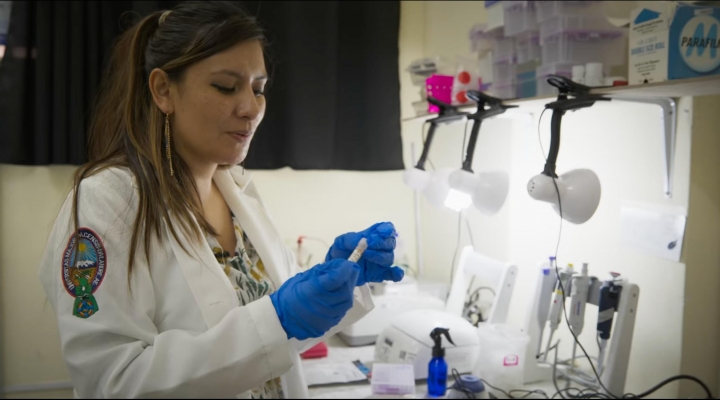
Paola Nogales in a laboratory. Photo: Tim Hartrick.
Bolivian biologist Paola Nogales is leading a pioneering investigation that uses genomics to trace the illegal trafficking of jaguars in Bolivia. Her work aims not only to identify the trade routes of jaguar parts but also to provide tools for their conservation.
For more than three years, Nogales traveled through the Amazon, the Chaco, and the Pantanal in search of remains of illegally hunted jaguars. Her goal was to obtain genetic material to analyze the DNA of these felines and contribute to their protection.
This work gave rise to the project Improving Jaguar Conservation Through Genomics, an initiative under the Felids Bolivia Research Program, which employs whole genome sequencing to trace the illegal trafficking of jaguars and preserve the species.
The project is being developed in the Molecular Genetics Laboratory of the Institute of Chemical Research at the Universidad Mayor de San Andrés.
“You see on CSI (the TV show) that from a single hair they can extract DNA and determine where it comes from—we’re doing the same thing but applied to animals. That’s when I started to carve my path into genetics,” explains Nogales, who works at Bolivia’s National Museum of Natural History.
Thanks to advances in genetic technology, it is now possible to identify the origin of hunted jaguars and the routes used by traffickers. With this information, the scientist aims to develop effective conservation strategies and provide evidence to combat the illegal trade in jaguar parts.
Trafficking routes
Nogales has determined that there are two main jaguar populations in Bolivia: one in the north and one in the south, with four well-defined genetic signatures.
Through the analysis of 29 samples collected from different regions of the country, she identified critical trafficking points, especially in Beni and northern Santa Cruz.
“We have some pelts from northern Santa Cruz. So, we would consider these places as those with the most trafficking,” the biologist points out.
Conflict with ranchers
“What might be happening is that this is related to the conflict jaguars have with cattle ranchers. When a jaguar attacks livestock, ranchers often retaliate by hiring someone to kill the animal. Then, the animal’s parts end up on the black market.”
This conflict poses a serious threat to the species. Nogales highlights the importance of implementing biological corridors that allow connectivity between jaguar populations and reduce the impact of hunting.
“If we have ranching areas where this problem occurs, there will be zones without jaguars, affecting the ecological balance.”
Forensic science for conservation
The use of advanced genomic sequencing techniques has allowed Nogales and her team to obtain key information about jaguar trafficking in Bolivia.
“This is cutting-edge technology and we’re applying it to conservation,” she explains. With just a single sample, it’s possible to obtain the complete genetic map of a jaguar, reducing the need for large quantities of specimens for analysis.
Nogales’ work has received international recognition. In 2023, her proposal to track jaguar trafficking through DNA earned her a win at the Falling Walls Lab competition in Berlin.
Moreover, the researcher hopes this technology can be used across Latin America to trace other endangered species. “I would like them to use the genome in different countries and have their own tracking systems for different species,” she says.
Toward more effective protection
One of the main challenges in the fight against jaguar trafficking is the lack of legal proceedings to punish those responsible. Nogales hopes her studies can serve as tools to support legal cases and generate more effective conservation policies.
“We want to find out if Bolivia is a point of origin for wildlife trafficking or also a transit hub to send animals to China,” she notes.
In the future, the scientist hopes to develop a technique similar to the PCR test used for COVID-19, with swabs that can identify jaguar genomics and distinguish their DNA from that of other felines such as the puma.
“If we know where the jaguars come from, we can identify which areas need more careful conservation and track the path of their trafficking,” concludes Nogales.
Thanks to these studies, there is now a key scientific tool to fight the illegal trade of jaguars and ensure their protection in Bolivia and the region.
BD/MS/JA
Por Brújula Digital:
Bióloga boliviana estudia el genoma del jaguar para salvar la especie y luchar contra el tráfico
Paola Nogales, bióloga boliviana, lidera una investigación pionera que utiliza la genómica para rastrear el tráfico ilegal de jaguares en Bolivia.
Paola Nogales en un laboratorio. Foto: Tim Hartrick.
La bióloga boliviana Paola Nogales lidera una investigación pionera que utiliza la genómica para rastrear el tráfico ilegal de jaguares en Bolivia. Su trabajo busca no solo identificar las rutas del comercio de partes de este felino, sino también aportar herramientas para su conservación.
Durante más de tres años, Nogales recorrió la Amazonia, el Chaco y el Pantanal en busca de restos de jaguares cazados ilegalmente. Su objetivo era obtener material genético para analizar el ADN de estos felinos y contribuir a su protección.
Este trabajo dio origen al proyecto Improving Jaguar Conservation Through Genomics, una iniciativa dependiente del Programa de Investigación Felidos Bolivia, que emplea la secuenciación del genoma completo para rastrear el tráfico ilegal de jaguares y preservar la especie.
El proyecto se desarrolla en el Laboratorio de Genética Molecular del Instituto de Investigaciones Químicas de la Universidad Mayor de San Andrés.
“Ves en CSI (serie televisiva) que de un pelo pueden sacar el ADN y ver de dónde viene, lo mismo (hacemos) pero aplicado a animales, es ahí cuando empecé a formar mi camino para ir a la genética”, explica Nogales, quien trabaja en el Museo Nacional de Historia Natural de Bolivia.
Gracias a los avances en tecnología genética, es posible identificar el origen de los jaguares cazados y las rutas que siguen los traficantes. Con esta información, la científica busca desarrollar estrategias efectivas de conservación y aportar pruebas para combatir el comercio ilegal de partes del felino.
Rutas del tráfico
Nogales ha determinado que en Bolivia existen dos poblaciones principales de jaguares: una en el norte y otra en el sur, con cuatro huellas genéticas bien definidas.
Mediante el análisis de 29 muestras recolectadas en distintas regiones del país, identificó puntos críticos del tráfico, especialmente en Beni y el norte de Santa Cruz.
“Tenemos algunas pieles del norte de Santa Cruz. Entonces, tendríamos estos lugares como los que tienen más tráfico”, señala la bióloga.
Conflicto con ganaderos
“Lo que podría ser es que está relacionado al conflicto que tienen los jaguares con los ganaderos. Cuando ocurre un ataque al ganado por parte del jaguar, los ganaderos a menudo responden en represalia contratando a alguien para matar al felino. Luego, las partes del animal terminan en el mercado negro”.
Este conflicto representa una grave amenaza para la especie. Nogales destaca la importancia de implementar corredores biológicos que permitan la conectividad entre poblaciones de jaguares y reduzcan el impacto de la cacería.
“Si tenemos lugares con ganadería donde ocurre este problema, habrá zonas sin jaguares, afectando el equilibrio ecológico”.
Ciencia forense para la conservación
El uso de técnicas avanzadas de secuenciación genómica ha permitido a Nogales y su equipo obtener información clave sobre el tráfico de jaguares en Bolivia.
“Es tecnología de última generación y lo estamos aplicando en conservación”, explica. Con una sola muestra, se puede obtener el mapa genético completo de un jaguar, reduciendo la necesidad de grandes cantidades de especímenes para el análisis.
El trabajo de Nogales ha sido reconocido internacionalmente. En 2023, su propuesta para rastrear el tráfico de jaguares a través del ADN le permitió ganar el concurso Falling Walls Lab en Berlín.
Además, la investigadora busca que esta tecnología se utilice en toda Latinoamérica para rastrear otras especies amenazadas. “Me gustaría que usen el genoma en diferentes países y que tengan su propio rastreo de diferentes especies”, expresa.
Hacia una protección más efectiva
Uno de los principales desafíos en la lucha contra el tráfico de jaguares es la falta de procesos fiscales que sancionen a los responsables. Nogales espera que sus estudios sirvan como herramienta para sustentar casos legales y generar políticas de conservación más efectivas.
“Queremos saber si Bolivia es un punto donde sale el tráfico de animales o también un punto intermedio para mandarlos a China”, señala.
En el futuro, la científica espera desarrollar una técnica similar a la utilizada en la prueba PCR para el Covid-19, con hisopos que permitan identificar la genómica de los jaguares y diferenciar su ADN del de otros felinos como el puma.
“Si sabemos de dónde vienen los jaguares, podemos identificar qué lugares hay que conservar con más cuidado y rastrear el camino de su tráfico”, concluye Nogales.
Gracias a estos estudios, hoy se cuenta con una herramienta científica clave para combatir el comercio ilegal de jaguares y garantizar su protección en Bolivia y la región.
BD/MS/JA

 Bolivian Thoughts | Pensamientos Bolivianos (Bilingual/Bilingüe)