
By Álvaro Rosales Melgar, Unitel; Eju.tv:
Bolivia is Without Dollars, Fuel, Facing High Inflation, and a Negative Trade Balance, Analysts and Politicians Warn
On Monday, alarms were raised after the government revealed that it does not have enough foreign currency to purchase fuel and will now supply it to productive sectors at international prices.
The shortage of dollars, which affects fuel imports, the rising inflation—reaching 3.24% so far this year—and a negative trade balance of $845 million in 2024 are official figures from the central government that have sparked concern among politicians and analysts.
The Minister of Hydrocarbons, Alejandro Gallardo, acknowledged the difficulties in accessing foreign currency to import fuel and meet domestic demand, leading to the announcement of a plan to provide fuel at international prices for productive sectors. This was reinforced by the President of YPFB, Armin Dorgathen, who admitted that they cannot fully meet the fuel demands of productive sectors.
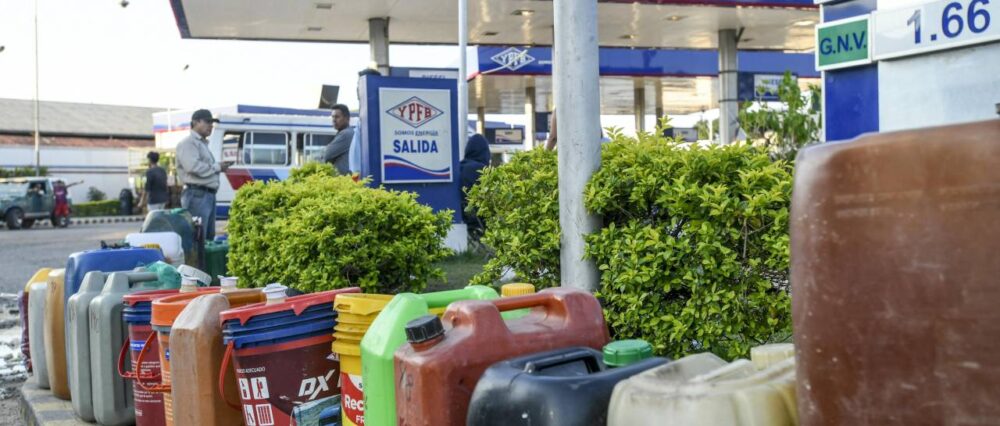
[Reference Photo: AFP] / The fuel supply issue has persisted for several days in the country.
Additionally, Dorgathen stated that at least 500 fuel tankers are stranded in Arica (Chile) and cannot enter Bolivia due to non-payment to suppliers. Both officials blamed the Legislative Assembly for failing to approve loans, warning that this is affecting the flow of foreign currency.
“After years of lies, they are finally being honest: soaring inflation, they squandered the gas we left them, depleted our dollars, and now we are out of fuel,” said presidential candidate Jorge Tuto Quiroga, asserting that Bolivia’s economy is “in a coma and heading for collapse.”
Similarly, fellow presidential candidate Rodrigo Paz claimed that the government “has launched another lie and opened the floodgates for inflation to keep soaring in Bolivia,” questioning, “With what dollars will private importers buy gasoline and diesel at international market prices?”
“Bolivia is a country without dollars, and that is also the government’s fault. The result is that inflation will skyrocket even more,” Paz added. “Without fuel, products won’t reach the markets, prices will rise, and inflation will spiral further,” he warned.
Negative Trade Balance
According to the National Institute of Statistics (INE), Bolivia ended 2024 with a negative trade balance of $845.3 million, reflecting a drop in both exports and imports.
In 2024, national exports amounted to $9.059 billion, compared to $10.918 billion in 2023. Meanwhile, imports totaled $9.904 billion in 2024, also lower than the $11.489 billion recorded in 2023.
Economist Gonzalo Chávez pointed out that foreign currency does not only come from loans stuck in the Assembly but also from sources such as remittances and exports, both of which have significantly declined and have not been replenished.
“There are no loans, no foreign direct investment, no massive remittances—so there’s the bottleneck,” said Chávez, criticizing the lack of understanding regarding how loans function.
Rising Inflation
Furthermore, the INE reported on Monday that Bolivia’s accumulated inflation reached 3.24% in the first two months of 2025 (January and February), a sharp rise from the 0.28% recorded in the same period of 2024. The government’s inflation target for the year, according to the 2025 General State Budget, is 7.5%.
Economist José Gabriel Espinoza warned that one of the major consequences of President Luis Arce’s economic mismanagement—one that will likely be inherited by the next government—is inflation, with the food sector being one of the hardest hit.
Espinoza identified four key factors behind food inflation: the shortage of dollars and crisis in domestic production, rising contraband and market distortions, an expansionary monetary policy and government financing, and state intervention in strategic markets.
“The combination of these factors has created a vicious cycle: the dollar shortage hampers production and drives up the cost of basic goods, while the government’s monetary expansion fuels inflation and further depletes foreign currency reserves. In this context, food—an essential component of household expenses—remains the most affected, hitting Bolivian families hard,” Espinoza concluded.
Por Álvaro Rosales Melgar, Unitel; Eju.tv:
Bolivia está sin dólares, sin combustible, con alta inflación y una balanza comercial negativa, advierten analistas y políticos
Este lunes, saltaron las alertas después de que el Gobierno sacó a relucir que no cuenta con las suficientes divisas para la compra de combustibles y ahora lo entregará a sectores productivos a precio internacional
La falta de dólares que tiene incidencia en la importación de combustibles, el aumento de la inflación -que en lo que va de año alcanzó el 3,24%- y una balanza comercial negativa en $us 845 millones en la gestión 2024 son datos del Gobierno central que encienden las alertas y no pasan inadvertidos por políticos y analistas.
El ministro de Hidrocarburos, Alejandro Gallardo, reflejó que existe un problema para acceder a divisas para importar combustibles y cubrir la demanda interna, por lo que anunció un plan de otorgar el carburante a precio internacional para sectores productivos. Esto fue apuntalado por el presidente de YPFB, Armin Dorgathen, quien refirió que no pueden cubrir la demanda de los sectores productivos.
[Foto referencial: AFP] / La problemática del abastecimiento de carburantes persiste desde hace varios días en el país.
Además, Dorgathen manifestó que hay al menos 500 cisternas paradas en Arica (Chile) y que no pueden ingresar el combustible a Bolivia debido a la falta de pago a los proveedores. Ambas autoridades apuntaron a la Asamblea Legislativa por la falta de aprobación de créditos, advirtiendo que esto afecta al flujo de divisas.
“Después de años de mentiras, se sinceran: inflación disparada, liquidaron gas que les dejamos, acabaron nuestros dólares y nos dejaron sin combustibles”, señaló el precandidato presidencial Jorge Tuto Quiroga, considerando que la economía de Bolivia está “en estado de coma y rumbo al colapso”.
Por su parte, el también precandidato presidencial Rodrigo Paz manifestó que el Gobierno “lanzó una nueva mentira y abrió la compuerta para que la inflación se siga disparando en Bolivia” al cuestionar: “¿con qué dólares se importarán los privados la gasolina y el diésel, al precio internacional del mercado?”.
“Bolivia es un país que no tiene dólares, eso también por culpa del Gobierno. El resultado es que la inflación se disparará mucho más”, sostuvo Paz. “Por la falta de carburantes los productos no podrán llegar a los mercados, se encarecerán y desatarán más inflación”, insistió.
Balanza comercial negativa
De acuerdo con el Instituto Nacional de Estadística (INE), Bolivia cerró el año 2024 con una balanza comercial negativa que alcanza los $us 845,3 millones, registrando una caída en las exportaciones y también en las importaciones.
En 2024, las exportaciones nacionales alcanzaron a $us 9.059,2 millones, pero en 2023 la cifra fue de $us 10.918,7 millones. Mientras lo referido a la importaciones refleja un valor total de $us 9.904,5 millones durante la gestión 2024, cifra que también es menor a lo registrado en 2023, cuando se alcanzó la cifra de $us 11.489,3 millones.
Desde el punto de vista del economista Gonzalo Chávez, señaló que los dólares no solo vienen de los créditos trabados en la Asamblea, sino que hay otras fuentes como las remesas y las exportaciones, las cuales están cayendo significativamente y no han sido repuestas
“No hay préstamos, no hay inversión extranjera directa, no hay remesas de manera gigantesca, por lo tanto ahí está el cuello de botella”, sostuvo el analista al considerar que hay un desconocimiento sobre el funcionamiento de los préstamos.
Mayor inflación
Asimismo, el INE reportó este lunes que la inflación acumulada en Bolivia llegó al 3,24% en los dos primeros meses del año (enero y febrero de 2025), cifra que está lejos del 0,28% que se registraba en el mismo periodo de 2024. Y la meta gubernamental de inflación para la presente gestión, de acuerdo al Presupuesto General del Estado 2025, es del 7,5%.
Al respecto, el economista José Gabriel Espinoza sostuvo que uno de los grandes efectos del mal manejo económico del presidente Luis Arce, que seguramente será heredado al próximo gobierno, es la inflación, siendo uno de los sectores más afectados es de los alimentos.
Espinoza señaló que hay cuatro factores clave detrás de este aspecto de inflación de alimentos: la falta de dólares y crisis en la producción interna, el incremento del contrabando y distorsiones en el mercado, una política monetaria expansiva y financiamiento del Gobierno y también la intervención del Estado en mercados estratégicos.
“La combinación de estos factores ha creado un círculo vicioso: la escasez de dólares dificulta la producción y encarece los bienes básicos, mientras que la expansión monetaria del gobierno aumenta la inflación y reduce aún más la disponibilidad de divisas. En este contexto, los alimentos, un componente esencial de la canasta familiar, continúan siendo los más afectados, golpeando el bolsillo de los bolivianos”, señaló el economista.

 Bolivian Thoughts | Pensamientos Bolivianos (Bilingual/Bilingüe)