
By Brujula Digital, El Diario:
Bolivia is one week away from another failed judicial election
- This Sunday, the 15th, citizens will elect new magistrates for the Plurinational Constitutional Court (TCP), Supreme Court of Justice (TSJ), Agro-Environmental Court, and the Magistrates Council.
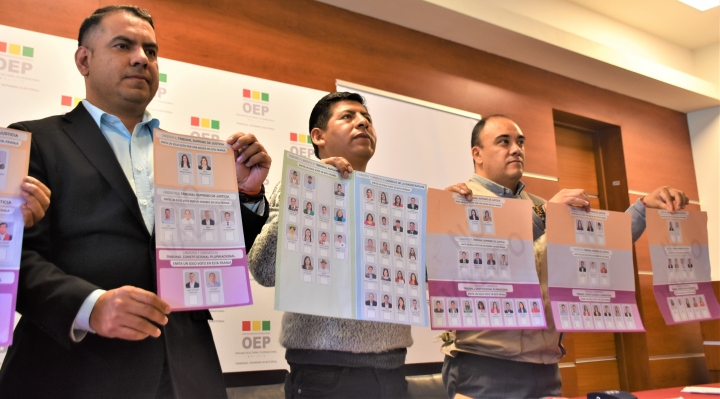
Bolivia heads toward voting in the judicial elections on Sunday, December 15, which will undoubtedly fail again, as did the previous two, where generally submissive magistrates accused of irregularities and considered mediocre were elected.
This time, the situation is even worse, as self-extended magistrates, in office for nearly a year, ensured that in five departments, the judicial election would not be comprehensive, clearly aiming to remain in their positions as long as possible.
In the last two elections (2011 and 2017), null and blank votes won by two-thirds, stripping the process of any legitimacy. However, Evo Morales’ government supported those elected to maintain control over the judiciary. Now, Luis Arce’s government is doing the same.
It is expected that null and blank votes will prevail again, as the public is unfamiliar with the candidates and rejects the voting system. A ruling by the Plurinational Constitutional Tribunal (TCP) issued on November 4 suspended the judicial elections for this body in Pando, Cochabamba, Santa Cruz, Beni, and Tarija, as well as for the Supreme Court of Justice (TSJ) in Beni and Pando.
Unlike previous elections, it was believed that opposition participation in selecting candidates in the Legislature would ensure higher professional quality aspirants. However, this did not materialize.
The magistrate voting system is considered one of the worst 2009 constitutional reforms, influenced by a group of Spanish experts and supported domestically by figures like Álvaro García Linera and Héctor Arce Zaconeta. The reform aimed for government control over the judiciary, which succeeded, but also led to the decline of the judicial system.
On election day, there will be two ballots: one for the Constitutional Tribunal and the Supreme Court of Justice at the departmental level, and another for the Agro-environmental Tribunal and the Magistracy Council at the national level. However, not all departments will receive both ballots.
In La Paz, Oruro, Chuquisaca, and Potosí, voters will receive both ballots to elect authorities for all four bodies.
In Cochabamba, Santa Cruz, and Tarija, voters will also receive two ballots, but the departmental one will only include the TSJ election.
Meanwhile, in Beni and Pando, voters will only receive the national-level ballot.
Of the 52 authorities initially planned for election, only 38 will now be chosen: four principal and four alternate magistrates for the TCP; seven principal and seven alternates for the TSJ; five principal and four alternates for the Agro-environmental Tribunal; and three principal and three alternates for the Magistracy Council. (With data from Brújula Digital)
Por Brujula Digital, El Diario:
Bolivia está a una semana de otra elección judicial fallida
- Este domingo 15, la ciudadanía deberá elegir a los nuevos magistrados del Tribunal Constitucional Plurinacional (TCP), Tribunal Supremo de Justicia (TSJ), Tribunal Agroambiental y Consejo de la Magistratura.
El país se encamina a votar en los comicios judiciales del domingo 15 de diciembre, que sin duda serán nuevamente fallidos, como los dos anteriores, que eligieron a magistrados por lo general sumisos al poder, acusados de irregularidades y considerados mediocres.
En esta ocasión la situación es aún peor, porque los magistrados autoprorrogados hace casi un año lograron además que en cinco departamentos la elección judicial no fuera completa, con el evidente propósito de mantenerse el mayor tiempo posible en sus cargos.
En las dos elecciones anteriores (2011 y 2017), los votos nulos y blancos vencieron con dos tercios, lo que le restó total legitimidad al proceso, pero el gobierno de Evo Morales apoyó a los elegidos para poder controlar a la justicia. Ahora hace lo mismo el gobierno de Luis Arce.
Se cree que nuevamente ganará el voto blanco y nulo, considerando que la ciudadanía no conoce a los candidatos y que el sistema de votación es rechazado por la ciudadanía.
Un fallo del TCP emitido el 4 de noviembre suspendió las elecciones judiciales para este órgano en Pando, Cochabamba, Santa Cruz, Beni y Tarija, y para el TSJ en Beni y Pando.
Se pensaba que, a diferencia de las dos elecciones anteriores, esta vez la participación de la oposición en la selección de candidatos en el Legislativo aseguraría aspirantes de mejor calidad profesional, pero al final no fue así.
Se considera el método de votación de magistrados como una de las peores reformas constitucionales de 2009, idea influida por un grupo de especialistas españoles y defendida en el país por personajes como Álvaro García Linera y Héctor Arce Zaconeta. El fin de la reforma era que el Gobierno controlara la justicia, lo que se logró, pero otro efecto fue la decadencia del sistema judicial.
El día de las elecciones habrá dos papeletas: una de ellas será para el Tribunal Constitucional y el Tribunal Supremo de Justicia a nivel departamental. La otra se destinará al Tribunal Agroambiental y al Consejo de la Magistratura a nivel nacional.
Sin embargo, no todas serán entregadas a los nueve departamentos.
En los departamentos de La Paz, Oruro, Chuquisaca y Potosí, la población recibirá las dos papeletas para elegir a autoridades de las cuatro instancias.
Para los departamentos de Cochabamba, Santa Cruz y Tarija se entregará dos papeletas, pero la de circunscripción departamental solo contará con la parte de elección para el TSJ.
Mientras que en Beni y Pando solo recibirán la papeleta de circunscripción nacional.
De las 52 autoridades que debían elegirse para estas elecciones ahora solo se elegirán 38. Serán cuatro titulares y cuatro suplentes para el TCP; siete titulares y siete suplentes para el TSJ; cinco titulares y cuatro suplentes para el Tribunal Agroambiental y tres titulares y tres suplentes para el Consejo de la Magistratura. (Con datos de Brújula Digital)

 Bolivian Thoughts | Pensamientos Bolivianos (Bilingual/Bilingüe)